[As a reminder, all paid posts go free after one month.]
My first trip to Las Vegas was in 1987. I was twelve years old.
I was excited having seen pictures and heard stories. I didn’t really understand how adult it was. In fact I really didn’t know you had to be 21 to gamble. It wasn’t like I expected to be able to—just hadn’t given it much thought.
Some of that was I didn’t really see myself as a kid. I liked adult things, thoughts, and conversations. I watched adult movies and TV shows for the most part. Hearing that I wouldn’t be able to participate was a letdown. Not so much in the missing out, though. It was more because it was yet another realization that I was just a kid. Inside I protested, “But I’m not like the others. I’m smarter, more mature. Just give me a test or something so I can show you.”
As immature as I was and would be for a long time after that, my judgement was much more adult-like than many adults I encountered. And after all, how “adult” do you have to be to lose your money to Vegas? That last part wasn’t exactly my thought process then, but it wasn’t too far off. Regardless, this was my first encounter with Las Vegas and how it was pretending to be something it was not in many various ways. It was pretending to be a special type of playground for those who could responsibly enjoy it. Yet it was actually a combination playground and hunting ground built on imitation, extremes, and flirts with danger all offered with various exclusions and inclusions that are never completely consistent or sane. I fell in love with it, and I’ve been wrestling with that and all the contradictions ever since.
My family pulled into town after a A VERY long drive through the California desert arriving at The New Frontier hotel. The Strip was as amazing as advertised—that wasn’t fake. The hotel on the other hand wasn’t fake either provided you were expecting the most adult (boring) version of a gaming destination possible. But to me it was fake because it looked like the worst version of the adult world I liked to dabble in.
It was drab, smoky, dingy even. In fact it was pretty depressing. I couldn’t understand why someone would enjoy it. And worst yet, I was quickly ushered away from the parts that looked slightly appealing—the gaming floor. I felt very unwelcome. My younger brothers even more so.
We went to the room where my dad helped us to bed while my mom went down to gamble some. Fortunately, this wasn’t the prelude to the casino scene in Lost in America.
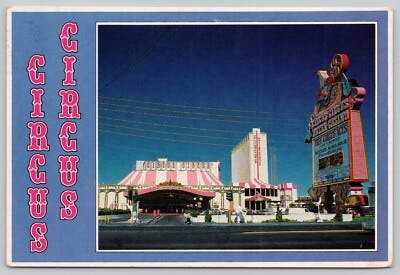
After a hard sleep, we awoke to good news. They had found a place that we would LOVE. It was down the strip and we were going to stay there the rest of the trip. The place was Circus Circus. It sounded like the Las Vegas I expected, and it didn’t disappoint.
It smelled good and looked good. Every touch was done seemingly with intentionality. And that style was designed to appeal to the entire family. I immediately embraced it and reconciled that this was the new horizon for Las Vegas. These insightful creators obviously knew that the customer base was broader than the sad adults who were willing to be stuck in the dull, rundown past.
Above the casino floor, where only adults could stop and linger much less engage the entertainment, was a floor for customers of all ages. Sure, it was “for kids”, but plenty of adults were playing the games there too. Above and around it all were circus acts. This was genius. Rather than fight the law, this place had found a workaround. Kids too could engage in games of skill and chance—just for prizes rather than pure cash winnings.
This was in fact the business plan partners William Bennett and William Pennington had in mind when they took over the property in 1974, 13 years before my first visit. They eventually purchased it in 1983 reincorporating it as Circus Circus Enterprises. Indeed they did know that there was a bigger customer base than just the stereotypical adults who frequented all the other Las Vegas destinations.
Aside from verifying that history in writing this post, I actually knew it from memory at the time because upon returning home from that trip I purchased 7 shares of Circus Circus Enterprises stock—told you I was adult-like.
I studied the company becoming a fan as well as owner (I wore people out letting them know I was an actual owner as many adults and all the kids I knew didn’t understand what being a stockholder meant). The two Williams did as much to shape the evolution of Las Vegas over the coming decades as did Steve Wynn eventually becoming Mandalay Resort Group and then merging with MGM-Mirage, after MGM bought out Wynn’s signature property.
At this point you may think I lost the plot from the title of the post. On the contrary, this is just the prelude for understanding where I come from in this analysis.
I’ve been back to Vegas over 25 times—I’ve lost count. I have stories, of course, but as they say, “What happens in Vegas . . .” Well, at least it will stay out of this post. Some stories are worth sharing and may make their way into a future one.
Las Vegas is for many the quintessential example of inauthentic. “It’s so fake!” many will dismissively say. For them that is a strong criticism. For others that is a virtue. After all, the marketing motto “What happens in Vegas, stays in Vegas” is used for a reason.
Circuses are explicitly fake by design. They are filled with acrobats whose death-defying acts are protected by training and nets. There are “wild” animals who are actually quite tame and well trained. And of course there are magicians whose entire raison d'être is deception.
Las Vegas is famous for performers beyond the circus, of course. It has a rich history of music performances ranging from lounge acts to famous bands and singers. In the former group there are those trying to pay the bills who hide that struggle while on stage. They are often trying to fake it until they make it. For the other more famous acts, some are those still clinging to an audience who, though aged, are back now with a lot more money to spend. Some of these musicians are pretending to be as good as they once were. Indeed some are.
Comedy is yet another performance art Las Vegas offers. In one sense comedy can be the most honest of all performances—just a man and a mic telling you the way it is with a humorous touch. But his stories are often not true despite the authenticity with which he delivers them.
The best comedy is executed with ease as the comedian goes through the act not hinting that he has practiced it and performed it hundreds of times prior. So it is authentically rehearsed and crafted until it is honed to perfection to be offered up with false spontaneity and vigor. Even if you were to go to an improv show, it is hardly what it appears. They’ve done it before and are following more of a script than even they realize.
Theater too is found in Las Vegas. The theater can be a source of commentary on real life or a story beyond reality. Often it is both.
The circus theme met up with theater in the incredible Cirque du Soleil. This group’s act is unreal and unlike most other performances—it is other worldly impressive. The show you see the night you attend will stun you. Perhaps it might also stun you to think they did it all once before that evening and will do it all again several times that week (twice each night). It seems it was there just for you. But that is not the case at all.
Las Vegas is all about deception—deception from reality. It is an escape. One that people very willingly give over to.
It is a place where you are encouraged to suspend judgement and belief. Don’t judge yourself or others as you indulge in excesses and fantasies. Forget that magic isn’t real as you watch people attempt to deceive your understanding of physics—notably Penn and Teller rebuke this. And don’t allow yourself to do the math or work through the logic of what your chances of winning actually are—the casino makes sure it always has the edge as there is a reason they can keep the lights on.
I remember on one Las Vegas trip walking through the newly finished Venetian Resort admiring its amazing interior. Then I tapped on one of the Roman columns as I walked through the lobby to the casino floor. It was hollow plastic. I shouldn’t have been surprised, but I was, and I was equally disappointed. It made sense yet still was frustrating. I had a child-like hope that there was genuineness beyond the visual.
The resort hotels of Las Vegas each have their own storied histories beyond the themed facades. Yet they share a common thread: Build for magnificence, give an illusion of opulence of one form or another, exploit that market until it no longer impresses, then remake or entirely rebuild anew.
The original theme of the new MGM Grand built in the late 1990s was a heavy-handed Wizard of Oz motif. The developer, Kirk Kerkorian, was another founder and innovator in this era of Las Vegas rebirth. This MGM Grand was the largest hotel in the world displacing the recently completed Excalibur, built by Circus Circus. Excalibur was even heavier-handed in its motif—King Arthur’s realm. The Venetian displaced the MGM Grand for the title of world’s largest. It seems that each iteration was getting larger and more sophisticated. The MGM Grand soon realized to keep up it would need a renovation. This renovation increased the elegance and decreased the kitsch.
Excalibur on the other hand didn’t change. It seems Circus Circus had a better grasp on product differentiation from the start with Excalibur. And their P&L showed it as both the original Circus Circus and Excalibur were perennial cash (and profit) cows for decades. All of these were pretending, they were just pretending for different audiences.
The Wizard of Oz theme never resonated with me the way Circus Circus did when I was younger and how I expected Excalibur would as I kept up with it from early conception to ultimate opening. I eagerly entered the contest to name the hotel quite certain that one of my ~25 entries would be chosen. Sadly, I completely whiffed on the obvious “Excalibur” missing out on a share of the $30,000 prize money (my memory is that about 20 entries shared the winnings).
It should have been no surprise that eventually I grew up in age and taste such that Excalibur and Circus Circus would no longer appeal to me. Looking back, I will never be sure how much the erosion of time depreciated those properties versus how much my eyes were simply opened. Likely some of both. The magic of Circus Circus was now in the past, and it couldn’t excite me. However, the company’s next two properties on The Strip did in varying degrees. Luxor came first though it missed on the full hope—mine and management’s. It was too elegantish and quiet. Mandalay Bay came second and was very much in my new wheelhouse.
As for what would become a new management’s direction, it fulfilled in spades. To a small degree I regretted this change as it signaled the end of eras—mine with respect to my childhood and Las Vegas’ with respect to inclusiveness for families. This pendulum swing was short, though, as Las Vegas was now too big for its historic smaller audience. Vegas needed all the customer base it could garner as everyone’s money was needed and wanted.
It wasn’t just casino style that was evolving and me with it. My taste in food broadened and stepped up just as America’s did the same. The original kitsch of the new MGM stood in contrast to some of the restaurants within it. My first trip to Emeril Lagasse’s Fish House blew my mind. Not to be outdone, Mandalay Bay offered dining sophistication from Charlie Palmer’s Aureole to Red Square (complete with a statue to Lenin himself, which was fortunately beheaded after I’m sure many customers more vocal than me but sharing my distaste complained about the imagery). Rum Jungle and the House of Blues were a combination of adult and party perfectly matched for us kids who grew up with but no longer could be satisfied by the thrills of the Circus Circus midway.
The food was not fake in the least. It was very good to great in the late 90s come early 2000s. And it still is having evolved through many iterations. Most of these places I’m remembering have since been replaced by the next version of haute cuisine with a Vegas touch. That Vegas touch includes cocktail sophistication, and I’m not simply saying expensive though they certainly have that too. Las Vegas is a dining destination provided you want to pay more and risk getting a relatively bad version of otherwise great food and drink—with demand as it is, something has to give. That tradeoff is price goes higher and taste gets compromised all the while with experience in one direction—big, loud, and flashy.
Nobody eats anywhere else the way they eat (and drink) in Vegas. So there is something inauthentic about it. You might get the best steak you’ve ever had, yet it comes to you in a way you would otherwise never have it.
At the extreme of all this are the clubs. There you can get the typical combination of music louder than you would ever consciously choose to hear it, surrounded by people who look better in that light than they would ever look in reality, consuming alcohol for more than you would ever pay outside of those walls ($1,000 for a $30 bottle of mid-shelf booze). All this with an opportunity to have fun (charitably said) or indulge in debauchery (uncharitably said)—on this last point there is plenty of both and room for all. Vegas isn’t by any means the only place you can experience club life—it is, like all things Vegas touches, just the most extreme version imaginable.
There is nothing real about this experience at all except the consequences and bill at the end. I am not condemning nor shunning this entirely as there is space for partying in this world including extreme partying. Still, . . . something, something . . . Icarus . . . something, something . . . Dionysus. The Hangover was a cautionary tale.
Playgrounds are for fun, and fun comes with risk. A kid can break his arm on the monkey bars, but that doesn’t mean we shouldn’t have monkey bars or playgrounds. As a late Gen Xer, I witnessed the full social transition to safety first!, which killed the fun. My grade school playground literally had all of its equipment shortened one summer—they dug them up and reinstalled it all burying them to make any fall minimally risky. The result was to rob us of the thrill of taking risk and teach us that we were fragile. Lenore Skenazy can tell you more about this tragic turn to intolerance for childhood risk. Like all things, we must strive to strike the appropriate balance. Some risk is desired.
And also certainly this can go too far. Mistakes can be made when we test and redraw and blur the lines between what and who is allowed. Vegas is fake, but so is Disneyland, and so is the daily life we all inhabit one way or another. Disneyland is the illusion of a childhood ideal—a dream-like place where it is happy, clean, and designed first and foremost for a child’s imagination. Obviously adults enjoy it too. Importantly this includes adults enjoying it without kids. Life needs escapes. Sometimes these are found in Orlando with cartoon characters on roller coasters. Sometimes these are found in our backyards smoking a cigar by the fire listening to music. And sometimes these are found chasing jackpot dreams while pretending to be rich, beautiful, and famous in the Nevada desert.
I have always found Las Vegas to be a safe refuge from the culture of safety if not renewed, extreme Victorian attitudes. It is a playground mostly for adults. One of the reasons I loved the cultural evolution that expanded its audience with Circus Circus as a microcosm and pioneer was how it showed a world where kids could be treated with enough respect to glimpse into the adult realm without fearing they would perish simply by seeing it. Certainly the motivator for these business decisions was not a philosophy awakening. Rather it was a profit motive. Still, the result was refreshing.
This is not to say that kids ever had or should have had free rein in this adult playground. Children need boundaries and restrictions which by necessity cannot be finetuned to them individually. We have to draw blunt lines and make work-in-process decisions as new dilemmas emerge. Vegas has always served as a proving grounds for this especially in the eras I’ve experienced it, and that extends to testing the limits for adults too. When it has succeeded or failed in either direction (too lenient or too permissive), the successes and failures were measured by profit rather than philosophical ethics. This is important to understand since when Vegas succeeds or fails on ethical grounds, it does so accidentally. Profit is a measure of economic success rather than morality.
Casinos are subject to strict regulation. And they embrace it not for the sake of keeping anyone (kids or adults) safe, but because that is a limit on competition. Sure there are good intentions by policy makers, but this is just a component of the larger bootleggers and Baptist tale. In yet another form of regulatory capture, casinos use the cost of compliance as a tool to reduce innovation—everything from environments too kid friendly to an upstart who might find an edge offering truly the loosest slots on the strip, so to speak.
And casinos know gaming customers (adults) often don’t want kids around. Hence, the Bellagio originally had a policy restricting kids on the property if they were not actual guests there. Although I was well above the limit when it opened, I found this off putting. In my opinion that was not in the spirit of the new Vegas, and it goes against my ethos of freedom and non-exclusion. I knew this wasn’t safety first, this was segregation.
Las Vegas has always operated in a big, dark gray zone. The forbidden elsewhere is, if not explicitly allowed and embraced, tolerated.
Vegas (the concept that lives in Las Vegas the city) is the illusion of pleasure unbounded—a dream-like place where scarcity and propriety cannot fully reach. Perhaps this is why it is seen as adult in nature. Not in particular because drinking, gambling, and sex are adult activities, but more fundamentally because we know pretending that reality and morality don’t or shouldn’t limit us opens a dangerous Pandora’s Box. Adults have enough trouble keeping it all in check. Children even more so.
You can stay in the Venetian, Caesar’s Palace, the Bellagio, but you will not have been to Italy. You can stay in Paris or NYNY, but those resorts are not even close to the cities they impersonate. Luxor is not Giza. Excalibur has no king. Mandalay Bay, the Flamingo, and Rio are in the middle of the desert not located on tropical islands. Only a reckless critic would accuse people of confusing any of this. These places are obviously not imitation versions of their real incarnations. They are real places borrowing images and themes from other real places that are made up themselves.
Venice isn’t “real” any more than any other city. It is simply Venice. A version of real life is found there just as a version is found in Cincinnati. Many versions of real life are in fact present in both cases. A visitor from Cincinnati will tend to find Venice to be magical and unreal. But so too would a person who lives in Venice upon a trip to Cincinnati just in different ways. “Look at all the mundane productivity. Where is the tourism? And without it, how does this place function?” they might ponder.
I more than hesitate to label Vegas authentically fake. I reject that entirely. Vegas is simply authentic—authentically Vegas. Those who love it and those who like it embrace the fake for what it is and what it is meant to be. Tastes are genuine in all their unique and indisputable forms.