

It seems that more than 90% (perhaps 99%) of problems and “problems” we seek government regulatory help with could be solved by either using market-based solutions or redirecting to an appropriate, off-the-shelf-type of solution. Instead we either ask inappropriate questions going in the wrong direction or are confused entirely about what is a problem to begin with.
Perhaps this flowchart will help . . . of course it would but won’t because we don’t want the real solutions and cannot accept ugly truths.
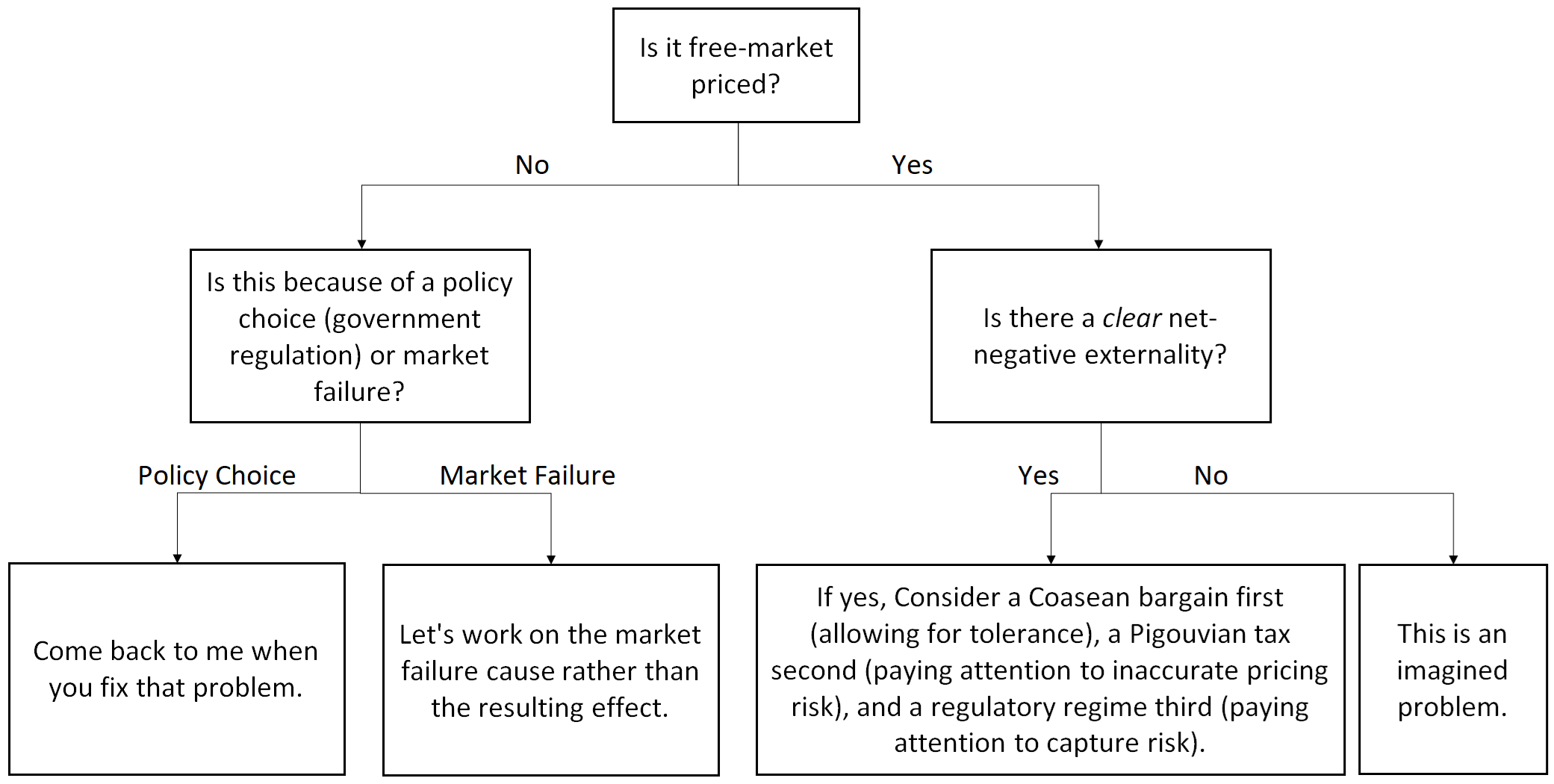
Here it is in word form with relevant links:
Is it free-market priced?
If no, Is this because of a policy choice (government regulation) or market failure?
If the former, Come back to me when you fix that problem.
If the latter, Let’s work on the market failure cause rather than the resulting effect.
If yes, Is there a clear net-negative externality?
If yes, Consider a Coasean bargain first (allowing for tolerance), a Pigouvian tax second (paying attention to inaccurate pricing risk), and a regulatory regime third (paying attention to capture risk).
If no, This is an imagined problem.
Sure, there is a lot of work left to be done in either of the true market-failure boxes (1b and 2a). Still, the biggest debate will come in answering the question posed in box 2. Net-negative externalities are elusive for those who are unwilling to think critically or are simply innumerate. And 1a lands us back at the top of the flowchart until people are willing to make hard choices.
Sigh . . .
Substack referenced: