

Live-sports attendance has been changing a lot in the 21st century. One of the trends is a decline in actual attendance—people in the seats rather than simply seats sold. And when people do come, they seem to leave earlier than in the past.
I say “seem” because our memories can deceive us. In this post I am going to focus on the University of Oklahoma’s football stadium. I think it serves as a good proxy for stadiums and arenas of a similar nature in both football and other major sports. That nature is large-scale venues for highly popular teams with long histories of success.
To provide some context, the OU Sooners football team has won more football games than any other FBS team1 since 1950 (3rd highest winning percentage over that span) and is tied for the second most wins since 2000 (3rd highest winning percentage here too). I have previously done further analysis showing how OU is among the elite of the elite in the modern era of college football any way you cut it.2 What’s more, no serious observer of college football excludes the Sooners when talking about the top programs. So when I claim that OU is a blue blood, I am not making a controversial statement.
I have attended EVERY home football game at OU since October 26, 1985—245 straight games over the span of 41 years and counting! And I have never left one early. While this means I have a large personal experience dataset upon which to draw, I admit my memory is fuzzy. So, I will try not to rely on it much to make my points.
I will and do lean, however, on my training in economics. As an example, I try to understand the substitution effect including the fact that people have competing options for how they spend their time, money, and emotional energy. While this is not unique to economists, the effect is often not properly appreciated.
Regardless if the effect is explicitly named, fans of sports teams widely recognize that their options have improved greatly over the past 40 years. Their living rooms now offer a very nice alternative to battling traffic, weather, ticket and concession prices, and the guy sitting in your section who is certain he knows more than the coaches on the field (hey, quit looking at me!).
Today a fan can sit at home and enjoy literally all the college football games played on a Saturday watching on a big-screen TV that can show multiple games at a time. Their food is to their liking. They don’t have to worry about bad weather. On and on, the benefits are stacking up in favor of staying home.
This is a helpful backdrop for why attendance is challenged today, and I think it is the leading reason why it seems to be much harder to fill stadiums and keep them full.
Let’s consider a few data points to see how different things are at OU than they were when I started my streak. These will be indicative of almost all sports teams beyond the blue bloods.
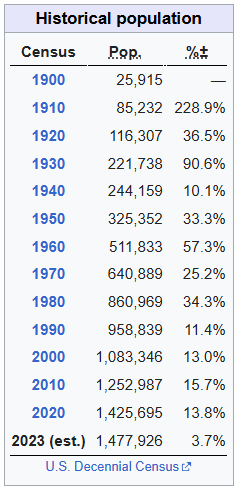
OKC MSA population history:
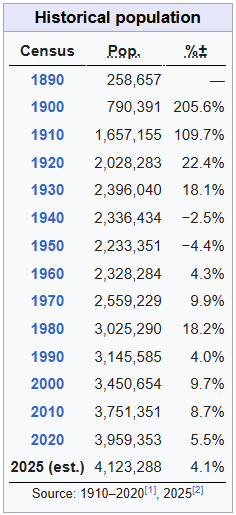
Population history for the state of Oklahoma:
Oklahoma Memorial Stadium capacity history:
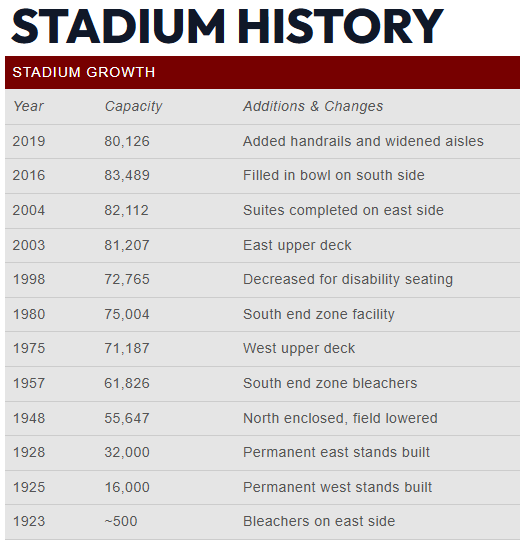
Since 1985 OU’s stadium has increased and then slightly decreased in size going from 75,004 to 80,126 today—a 6.8% overall increase. Over that same span the population of the OKC MSA has increased from about 900,000 to about 1,500,000—about a 67% increase. For the state the increase is about 34%.
Over that same span real (inflation-adjusted) median household income in Oklahoma has increased over 18%. So it should come as no surprise that the cost of attendance has increased considerably. In 1985 a regular season ticket’s face value was $90 for five games (an average of $18 per game). Adjusting for inflation, that equates to about $271 today (an average of $54.20 per game). However, in 2025 the average face-value price per game was $167.11 per game! That amounts to an average increase of over 208% in real terms (i.e., after the inflation adjustment).
To an economist this is simply an implication of the Baumol effect as applied to an output (provision of football game spectating in this case) specifically with a demand-side dominance (supply is not increasing as much as demand is rising). The Baumol effect (aka, Baumol’s cost disease) is a fairly straight-forward concept. When labor productivity growth is limited in a particular good or service as compared to the broader economy, then labor wages in that particular good or service will go up.
The prototypical example is a one-hour performance of a string quartet (four string-instrument players). In the 1700s it took four people to do this playing for one hour (obviously). In 2026 it takes . . . four people to do this playing for one hour (again, obviously). But in 2026 these people have vastly greater opportunity costs than in the 1700s. The music is the same, but to get the same quality you have to pay substantially more since they can do other things to make money that weren’t available to them in the 1700s. For example, the four people’s next best options respectively might be: managing a COSTCO, high-level computer programing, coaching lacrosse in the ACC, and playing violin in the San Francisco symphony. Only one of these jobs sorta existed in the 1700s, and it was very different even then. The only thing keeping this quartet’s wages lower than otherwise is the increased competition from a bigger labor market. (Notice the inherent threat AI poses to string quartets—a subject for a different blog post.)
Turning back to college football, the parallel here is that the supply-side growth (stadium size, quality, and number of games) has grown at a much lower rate than the base of demand (population and income). So it is a supply-demand story to economists as it so often is. But we have a specialized framework (Baumol) that can help us understand it. That framework suggest a need to increase productivity (output per unit of input) to get the cost down, which should ultimately lower the price for customers.
To normal people this is also simply just supply and demand (why must economists overcomplicate the obvious?). Supply is relatively fixed but demand has grown substantially. Something has to give for the market to clear. Price is the easiest mechanism, but it isn’t the only one. And it might very well be desirable for both the producer and the consumer that price doesn’t rise so much. No, I’m not suggesting implementation of queueing or random lotteries. I am suggesting an increase in supply.
Here is a stylized example of the market for OU football home game attendance over the past 40 years.
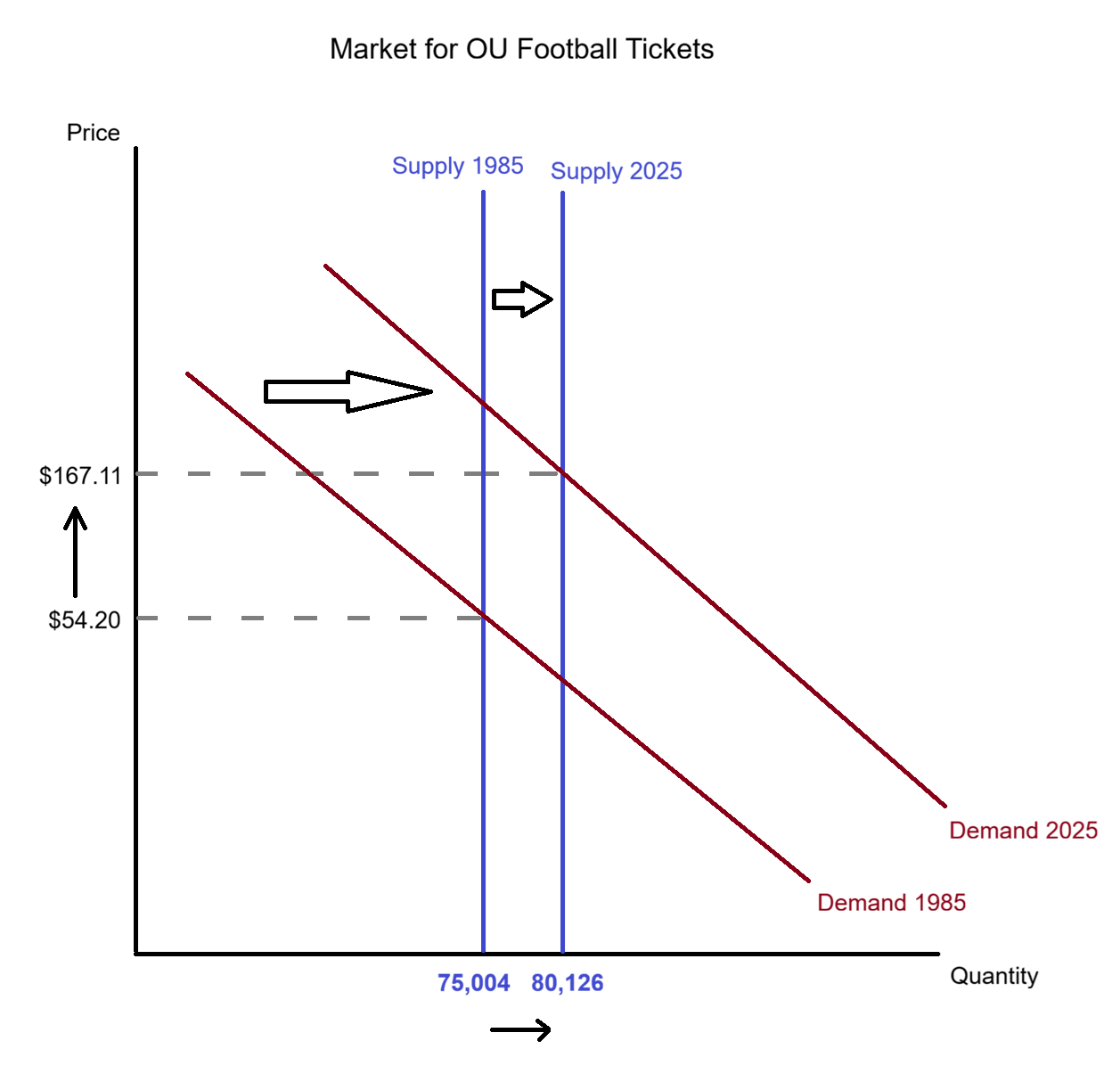
Before you argue that I am not capturing the demand curve accurately (see below on elasticity) understand that this is a simplified model for the average ticket price. If I were to model the total demand curve, it would look different since it would include customers (donors and especially mega-donors) whose inclusion would distort it. Therefore, the change in average price is capturing only a portion of the change in demand being so substantial. That price does not take into account the explosion in premium seats (e.g., clubs, loge boxes, and luxury suites) that have proliferated. Nor does it account for the increase in donation fees required to purchase many of the season tickets. Doing so would show that the true average cost is much higher than what it was in the past. I’m not saying these premium options or the price discrimination from donations shouldn’t exist, but this has been the primary means of finding the new equilibrium accommodating the surge in demand and the relatively small growth in supply. Perhaps more supply of seating would be appropriate as well.
Focusing on the blue bloods like OU, it is important to realize that their fanbase tends to be more “loyal” than most others. Economists would say they face a relatively inelastic demand, which is to say their fans will tolerate more hardship than most and still endure the cost of being a fan including attending the game. That hardship can be pecuniary in the form of higher ticket prices. It can be non-pecuniary in the form of relatively worsening conditions like their living room being nicer than their seats in the stadium. And it can be emotionally non-pecuniary in the form of the team not being as good as they expect it to be. Any increase in these hardships is an increase in cost (opportunity cost). The effect is directionally the same for all fans, but in the case of blue bloods the fans bare this cost more willingly than others.
I should know. In many seasons I suffered through bad weather and bad teams but still paid the price of admission (ticket cost plus all the other stuff that goes along with attendance). My living room is A LOT nicer in 2026 than it was in 1996 to pick a pretty dreadful year among a group of bad years for OU football. As a college student in 1996 my opportunity costs were not nearly as high as they are today. So it might not be the case that I would bare that cost if we repeated the 1989-1998 experience (let’s not run that experiment please!). Still, I was in the stands in 2024 when OU did not live up to its paltry (for OU) expectation of a 6.5-win season (6-7). Fortunately, OU did exceed the 6.5-win expectation the next year going 10-3 in 2025, which is part of why I stick it out in the bad years (or so I tell myself). I am undoubtedly on the far end of the distribution of fans, but this is still emblematic of what blue blood fandom is like—highly inelastic in the words of economics.
Sorry to be longwinded, but I think this is an important framework so those not in this specific demand curve can understand my argument.
A more complete though still simplified model would attempt to combine the family of demand curves that exist into one considering all the different customer bases. ChatGPT summarizes the various customer groups as follows:
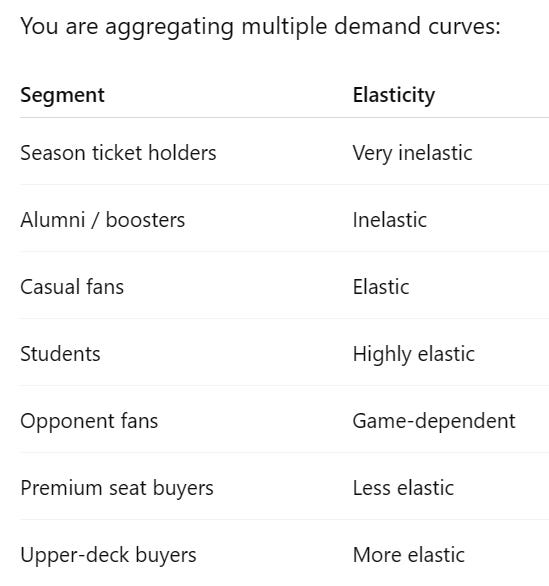
Depicting this more complete demand curve would result in something like this:
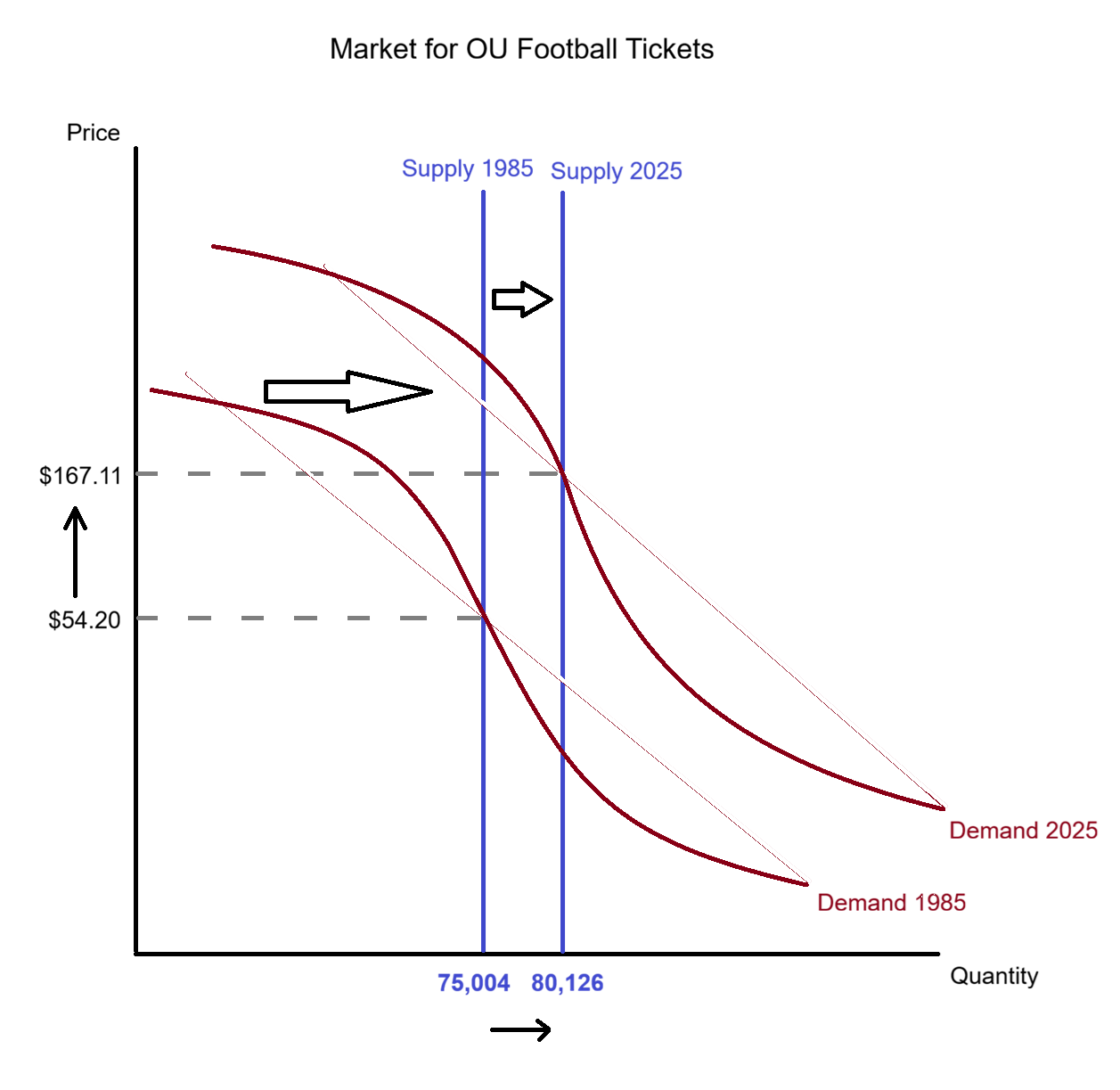
Notice how we now have more of a case for both better quality (so as to capture the inelastic customers willing to pay more) as well as higher quantity (so as to capture the elastic customers who are more price sensitive). Expanding quantity allows the economies of scale to work for the supplier (universities) as they attempt to capture the lower-price segments of the market. The key is price discrimination along more of the demand curve. If we can figure out a way to sell to the inelastic buyers including especially premium buyers (hint, hint better quality) and sell to the elastic buyers including very marginal fans because of income or interest limits (hint, hint higher quantity), we can greatly increase long-run profit.
I am still only showing the average ticket price and not attempting to depict what that new price equilibrium (where supply and demand cross) would be after a capacity expansion. So keep in mind that with a successful price discrimination strategy, buyers would be paying along many points on the demand curve making the “average price” even less meaningful. The producer (OU in this example) would enjoy capturing much of the consumer surplus (the difference between what would be the uniform price if a single price prevailed and what various buyers were actually willing to pay). To wit: the university would be getting more of Big Donor Don’s money and still have a cheap option for Casual Fan Joe.
I have been of the mind that the college football in-stadium experience needs to improve drastically to keep fans coming. That part is fairly obvious to even the casual onlooker, and I haven’t changed my mind on that. However, looking at the facts above (bigger population and even higher income) leads me to counter what I previously believed—that stadium quantity (in terms of number of seats) needed to shrink or at most stay the same while increasing quality. I no longer believe that. For teams like OU we should be able to have better and bigger stadiums.
From an economics standpoint, the supplier (universities) should be seeking profit maximization. And it is true that in a simplistic sense given what I’ve laid out (inelastic demand and near monopoly power) the profit-maximizing size of stadiums would be relatively smaller than if one or both of those conditions were different (elastic demand or competitor power). However, there is more to the story than that.
One important consideration is that stadiums can and do engage in high levels of price discrimination, and it is good that they do or their ability to build stadiums would be quite constrained leaving out the marginal customer. In other words the cheap seats would suffer most by not being provided or provided poorly.
Another very important additional consideration are the long-term benefits of even larger stadiums than what simple price discrimination would allow. These larger venues attract more diverse fans by making it feasible to their varying budgets. It cannot just be a playground for the rich or the long-term customer base will fall.
To use a personal example, I have indoctrinated my children in the cult of OU football not by corralling them in front of the TV making them sit and watch a four-hour game but rather by bringing them with me to the actual game. The difference in the connection is stark.
Add to this that a big part of the case for a college football team is that it is marketing to future students (the customers/output of universities). For public institutions like OU it is also desirable to be in good stead with the voters, who ultimately hold sway with how much support the university gets from the state’s resources, and locals in the city it resides. Not all of my neighbors here in Norman love the university they live right by. Don’t give them another reason to push back against it—that reason being the accusation that it is only for the rich and elite.
When it comes to profit maximization, here is what I mean in a formal and complete sense. Some may bristle at the concept specifically as applied to a state entity, but it is appropriate regardless of the supplier. When properly defined, profit maximization is the best attempt at satisfying the goal of using resources to their highest and best use. It is economically desirable because it is socially desirable including being environmentally desirable among other non-direct/hard-to-capture goals. If you want the university’s athletic endeavors to enhance university life, build social good will, be something for the common citizen, etc., that is fine. Simply define those goals appropriately (cost/benefit-wise) and add them to your profit function.
Therefore, I would define the profit function that we seek to maximize in the following, typical way:
Revenue minus Cost = Profit
Revenue (benefits) = explicit direct revenue + indirect (incremental) revenue + marketing value (to the university/state/etc.).
Cost = opportunity cost. Formally, this means considering the accounting cost (direct explicit costs + indirect (incremental) costs) as well as net foregone benefits for resources used that could be used elsewhere.
And all of this should be considered on an on-going, long-run basis.
Revenue should include how aspects of the football program would enhance student life and advertising for the larger university and perhaps the state since it is a state organization. If we were to expand this to the larger athletic department, this would obviously leave a lot of room for loss leaders in the form of basically every other sport offered.
Cost should include consideration for intra-department and outside the department alternatives. For example, if the direct revenue from an additional football game minus its associated direct costs yielded an accounting profit of, say, $1 million yet the same amount of direct costs applied to basketball would have netted $1.5 million, we should include the foregone additional $500,000 as the incremental opportunity cost of the football game versus the basketball option. Don’t get caught up in the specific hypothetical. I am just illustrating by example that to get a complete picture of cost we have to consider the next-best alternative foregone. That next best alternative might be outside the athletic department as well.
We have two general factors to consider beyond the naive approach that would simply suggest restricting supply (keep the stadium small and meek) in the face of inelastic demand. Those general factors are: (1) higher and growing opportunity cost for the customer, and (2) a marketing need to nurture and grow the customer base. Both of these push for enhanced quality and quantity—better/nicer stadiums and bigger stadiums. Bigger here means both bigger than they would otherwise be and bigger than the past given how for stadiums like OU the capacity growth has not matched the customer-base growth (population & income).
Quality would include better features that enhance the game-viewing experience, nicer facilities that make the visit more pleasant, and a large variety of options to meet the large, diverse customer base from the modest family to the ultra-wealthy. An exploration of the quality dimension is not the subject of this post. Here I am focusing on the desirable need for stadiums to be larger.
So how big should the OU stadium be staying with that example? I don’t pretend to know precisely other than to say: much bigger. Anyone claiming to know with precision is fooling themselves. But here are some relevant constraints:
Michigan’s The Big House is the largest in the U.S. at an official capacity of 107,601. There are nine stadiums with official capacities greater than 100,000. Perhaps these too could economically justify significant expansion. Regardless, I would take 110,000 as a fair first approximation as an upper-bound limit.
Similarly, all of those above while big probably could be bigger if we started from scratch today. It is probably not reasonable to consider building anew; so we are bounded by working with what is there in all cases. They are constrained as all are by the reality of the original stadium footprint.
In 1985 OU’s stadium capacity was about 8% of the OKC MSA population. Obviously a rough figure to work with. A little less rough would be the average of capacity as a percentage of population from 1975 (12.4%) through 2025 (5.3%). Looking at it every 5-years, this calculation yields an average proportion of 7.4% implying a stadium size of about 111,000. This doesn’t fully adjust for how demand has grown, though, since income has risen over this period (18% in real terms or about 0.4% per year). Even increasing stadium size to 111,000 might still mean average prices in real terms would be higher since the customer base is richer. Yet maybe not. As opportunity costs for that base have also risen, the difference between the two would offset one way or the other. The objective isn’t to get average ticket prices equal to what it was in 1985. But it is important to consider that the profit-maximizing stadium size probably does keep that figure from growing too much given the factors mentioned above that make it a mass-market good.
There’s a risk of overbuilding since we don’t know what the future holds. Too big of a stadium in down years (unfortunately, there will be down years) becomes a very costly depreciating asset to manage. Additionally, there is both an aesthetic as well as a marketing angle to selling out the stadium—being known as a hard ticket to get. Be careful how much weight you give this, though. Sellouts are nice, but they are not the ultimate objective. In fact stadiums that always sell out are indicative of either under pricing or being undersized. OU has been particularly proud of their streak of “sellout” crowds (currently at 153 through the 2025 season), which basically all fans scoff at knowing the stadium wasn’t totally full in all of those cases. The only part that keeps it honest is that selling all tickets is not the same thing as filling every seat. They indeed probably do sell them all with big donors stepping in to buy blocks of them at a discount to give away to charity when needed.
This doesn’t mean all stadiums should increase in size by any means. The new landscape in college football is definitely pushing people in one direction or another. It really is a barbell world.
Many teams are not in a position today to expand, and it is likely fewer still could meet the expectations that come with significant increases given the investment required to achieve it. Every team needs to settle into their own equilibrium. There is value in a good, smaller stadium experience.
With OU as the example as I continue to focus on blue bloods, an expansion to 100,000 seats would be quite possible from a realistic cost and engineering standpoint—just fill in the north end zone with an upper deck and perhaps expand the soon-to-be-renovated west upper deck. That would be approximately a 25% increase in the stadium’s capacity. Given the parameters of the 67% increase in the population in the OKC MSA along with the 18% increase in real income, this seems realistic as well from a demand standpoint.
The specific increase is not my point. I am just arguing that a meaningful increase in capacity is easily substantiated. I would like to see this explored, but alas that is not the direction things seem to be headed. I will have a post in the future with specific criticism of this as it relates to OU football. The gist of that will rest on how asymmetric incentives might be leading to bad decisions—the easy and short-term profitable approach is to keep the stadium small and increase the quality and appeal to the big donors.
I believe this is regrettable not just as a fan who might get priced out or priced into a marginal experience. I think this is not in the long-term best interest of the university or the football business.
This refers to the current Football Bowl Series level, which used to be called Division I.
The other teams in this short list are Ohio State and Alabama.