


In many, many cases, Tyler Cowen is way more right than wrong in his often counter-conventional wisdom views. When it comes to his theory of the proper government, so-called state-capacity libertarianism, he rankles many (another Cowen staple). As a libertarian, he always seems to fail the No-True-Scotsman test, but that is often a fine thing. He is trying to live in a realistic better world rather than a utopia.
Still, as someone who is quite sympathetic to anarcho-capitalism but usually settles in as a minimum-state libertarian, I have found his argument incomplete or perhaps even hand wavy—I have always agreed with Bryan Caplan’s critique.
Dealing with this tension, I offer this exercise—a healthy process to consider what priorities the state should have and how much capacity it should have in executing them.
Consider this a method of organizing one’s thoughts about what kind of government activity one ideally wants. Obviously, first principles will legitimately lead people to different conclusions.1 What matters is if their conclusions can be justified. Are they logically consistent with the first principles they espouse? Do they stand up to scrutiny including passing a real-world test.
This is not intended as a definitive analysis. As such, it is a fluid list—sometimes these functions or agencies will be in one category, and then sometimes an entirely different one. The military is a great case in point when it comes to ethics. We don’t have to support a particular war or even the troops always and equally under any circumstances. When it comes to efficiency, the FDIC is really good at closing banks but really bad at preventing the need to close banks.2 In other words there is good and bad (and ugly) execution as well as good and bad (and ugly) endeavors.
It is also, obviously, not a definitive list. Many functions are absent for the sake of time and length. My choices are based on my own understanding—educated guesses with limitations and subject to revision. I am also trying to limit this to roles under the cabinet level since those departments are so fraught and expansive—no single rating would make sense. The military is the exception here as explained in the note below.
I wanted to get at those roles that touch people’s lives more directly to show how it’s not so simple to say government is bad or good or whatever. So, again, consider this a framework of general thinking.
Categorizing government functions and agencies along this spectrum (G-B-U) considering efficiency (cost-benefit analysis), effectiveness (getting the job done), and ethics (is it rightful for the government to do what it is doing how it is doing it?).
How is the G-B-U spectrum useful?
For one it is intentionally vague. That is in keeping with the goal—call it vibes if you must. This serves the purpose of giving answers that allow for room to maneuver—the broad, vagueness implies (begs) for deeper inspection. For another it does force categorization to the extent of a label. Labels can be dangerous, but they are often useful. Here I hope they are.
I want to answer the questions: “What is the government doing here?” and “How is it doing it?” and “Should it be doing it (at all, in this way, etc.)?”
What determines G-B-U, and what do they mean?
Think of it this way. The Good is as it sounds. The function or agency is achieving success for the specific metric: efficiency, effectiveness, or ethics. The Bad is likewise obvious—a failure in the metric. The Ugly is when it is very possible to have success but failure results in spite of this. Immigration is an example as shown in the notes below.
Notice how combinations are tricky. A good war fought badly is unfortunate (ethical yet inefficient and/or ineffective). A bad war fought well is a tragedy no matter the success on the battlefield (unethical despite efficient and/or effective). So contra Cowen and in support of Caplan’s critique, we want effective and efficient when ethical. And we actually want ineffective and possibly inefficient when unethical.
The Grid:
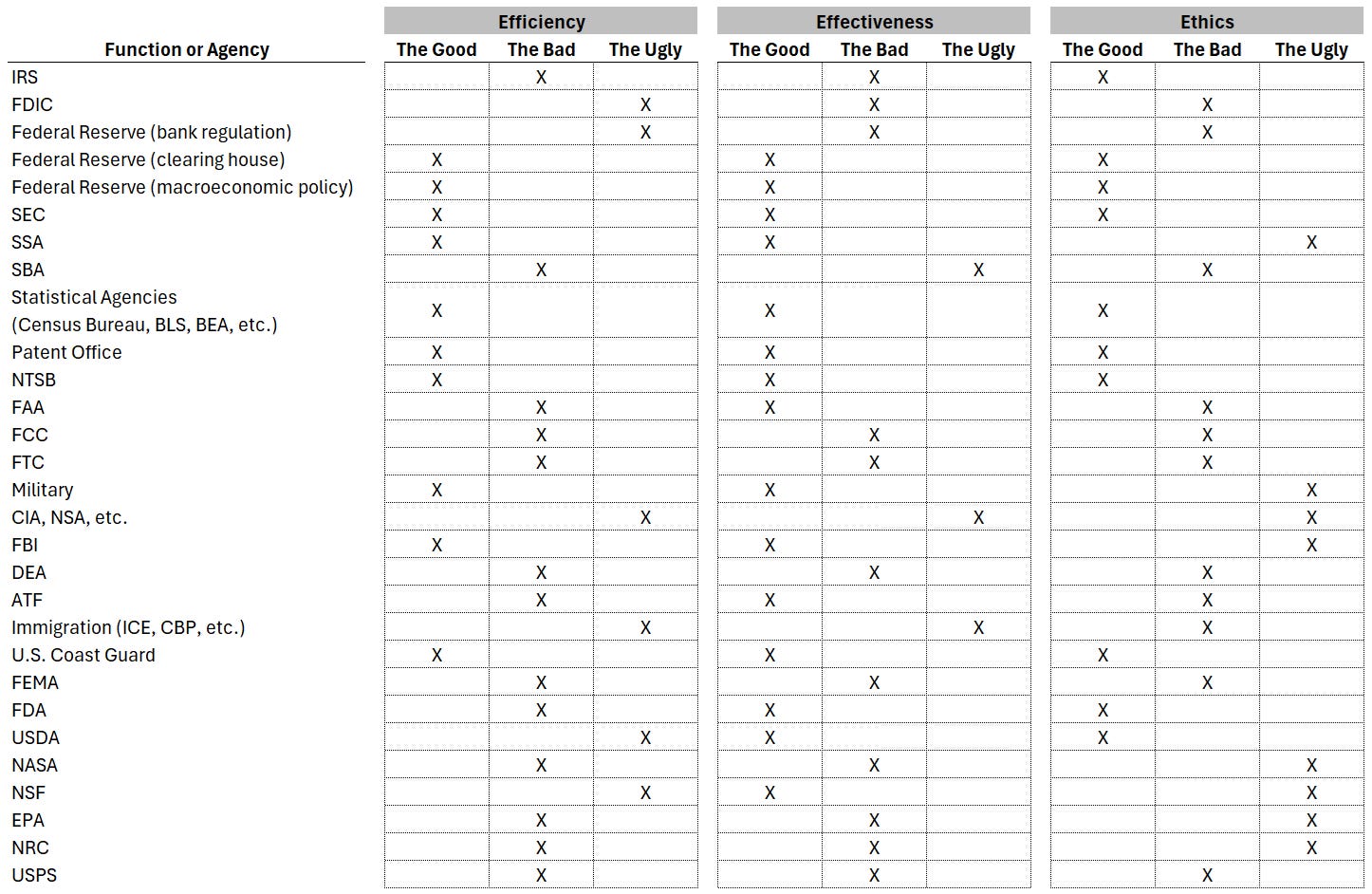
Notes:
IRS - Our thoroughly messed up tax regime is the fault of Congress. So I’m not blaming the IRS for either the economically destructive complexity or the economically substandard tax system (e.g., taxing income rather than consumption). Where I do find fault is in how utterly bad it performs in administering the existing tax code as it stands. Sure, the mistakes in policy don’t make it easy nor does the lack of necessary resources give it a fighting chance (but do I really want them well staffed?). In ethics it gets The Good rating because if you’re going to have enormous government spending we as a nation seem to demand, it has to be funded. It makes me feel squeamish doing that, but truth be told the IRS is generally just the messenger who gets shot.
FDIC - Like I said above, it is good at closing banks when they fail. It is bad at supervision—beyond my anecdotal personal experiences, time and again it systematically fails to prevent the next set of failures. It is also ethically rated in The Bad because this role can and should be done privately. I am leaving aside FDIC insurance as this policy, which is firmly in The Bad on efficiency, effectiveness, and ethics, is the fault of Congress.
Federal Reserve (bank regulation) - Same ratings as the FDIC for similar reasons.
Federal Reserve (clearing house) - The Good across the board even though, like with the FDA but to a lesser degree, private options are possible.
Federal Reserve (macroeconomic policy) - Another unanimous The Good. Sure it makes major mistakes and could be doing a better job, but in the broadest sense (am I grading on a curve?) it gets a good job done well.
SEC - Finding fault here would be like with the IRS—a mistake of blaming the soldier carrying out the mission for the general’s errors in strategy. And yes, I do think a lot of this could and should be done by the private, free market. I just don’t think it is so bad in and of itself as this is a justifiable government function.
SSA - Perhaps it is surprising that I rate it high in effectiveness. It has a very good reputation in terms of getting the checks delivered, the major function, as well as in dispensing guidance to those nearing/entering program disbursement. Ironically the DOGE fraud findings were themselves done with legal violation. SSA is not where the fraud lies. When it comes to ethics, SSA gets rated in The Ugly because a second-best world has the government providing anti-poverty protection in a form like this. However, most recipients of SSA do not need the welfare they are getting from their Social Security checks on top of the fact we cannot afford to give it to them.
SBA - The government is not necessary nor capable for lending money efficiently or effectively. So it should be no surprise that SBA falls into The Bad for efficiency. It does get funds to entities that do often enough find some market success yielding The Ugly for effectiveness. Still there is no ethical case for this role.
Statistical agencies - These get flying marks. Yes, I think the free market can and should do this instead (somewhat or in total), but I’m not about to go to the barricades over this government function—especially since it does do a pretty damn good job.
Patent Office - No complaints here. I do have thoughts on patent law as well as copyright, but these IP matters are a discussion for Congress not the agencies carrying out the missions.
NTSB - From my limited vantage point, this group does its job and does it well. As with some others on this list, arguments about better, private alternatives are small considerations.
FAA - They get the job done, but it is very inefficient. In contrast to the FDA below, an even stronger case can be made that this function should be privatized—so much so that I rate it on ethics as The Bad. Notice that this is in contrast to how well I rate the NTSB both on efficiency and ethical justification.
FCC & FTC - Both of these groups overstep a proper role and are quite often captured either by political actors from within a given administration or beholden to industry incumbents (traditional regulatory capture). The ethical case for an FCC was always weak and now has evaporated. The ethical case for the FTC was never there. Put me on record that defeating monopoly power and stalking antitrust are chasing ghosts and fighting mythical dragons.
Military - This is the biggest single role examined. I think it appropriate to consider, though, because it is nearly singular in purpose much like those others on the list. Regarding ethics, every era has its own placement for this item with the occasional positioning being The Good. Sadly I think the enemy defines where it lands rather than good leadership and good values guiding its direction meaning it gets a rating by luck of the opponent fought rather than by virtue of its principles followed. Some examples like WWII, the Civil War, and the cooler parts of the Cold War allow The Good outcome (with plenty of The Bad within those). More often examples from wars against native peoples to WWI to Vietnam to the War on Terror to the current war on Iran (naming just a few) have given it opportunity to disappoint most horribly. I am not saying any of the opponents were actually “the good guys”. I am saying that the badness of the opponent cannot alone justify engagement against them. The military is perhaps now irretrievably in The Bad realm baring a major libertarian revolution in the public’s general sentiment regarding what constitutes national defense. On efficiency and effectiveness it is The Good—does the job well and gets it done. Nation building is a fraught and often inevitably failed endeavor, but that blame lies with the king’s decision rather than the soldier’s attempt, and it comes after the war.
CIA, NSA, etc. - This is a necessary role at some limit. The groups charged with performing it is The Ugly all the way down.
FBI, DEA, & ATF - This is a mixed bag, which is why I separated them in the grid. I give high marks on efficiency and effectiveness to the FBI though actual mileage does vary from case to case. That variance is all the more so when it comes to its ethics. For the other two they fall outside ethical justification. The only time those two get a placement in The Good is for effectiveness of the ATF. The DEA in particular is set up for failure and definitely accomplishes it. We do need to some extent a national police force. What we get and what we deserve are two very different things.
Immigration related (ICE, CBP, etc.) - As an avowed open borders guy, it might seem strange that I put this under The Ugly rather than The Bad on ethics. Here is my reasoning: Assuming we do need some version of immigration control including at the minimum vetting for transmissible disease or criminal dangerousness (I agree with this), immigration activities can be ethical. However, these groups very much aren’t doing the job ethically, and that is before we consider recent performance. The same result then bleeds over to efficiency and effectiveness.
U.S. Coast Guard - Perhaps I’m naive, but I think this role is appropriate and well done.
FEMA - Here is a classic case of government doing bad things that sound good (and doing them poorly). This can and should be done at the state level if not just through private, free markets. Never forget that Walmart > > > FEMA (also see the long version).
FDA - The silent graveyard, like so many examples of over-reach in the name of safety, demonstrates too much effectiveness, but effectiveness to the mission nonetheless. It fails on efficiency on its own terms, though, for the same reasons. Ethics I reluctantly rate as The Good because this is a role we can in principle defend even though it is a second-best-world solution at best. A better option would be competing private alternatives along with insurance markets plus tort law.
USDA - Again, we see probably too much safety. Yet it is doing the job. And activities like screwworm eradication are 99% invisible yet 99% effective. This public good is the model we should follow assuming we are too dumb to use the better alternative of private, free market solutions.
NASA - Once upon a time the only way to get to space was to spend so much money on it that only an entity as wasteful as the government could do it. If you’re reading that correctly, you’re seeing that I am saying the ethical case for NASA was never very strong and they weren’t ever very good at it on the other two measures. Then Space X came along and proved the point.
NSF - A case can be made that this role needs to be performed by government. That case works in theory but not so much in practice. The seen of things getting done hides the unseen of alternative solutions. Hence, The Ugly for efficiency while The Good for effectiveness. And the same gives it a rating of The Ugly for ethics.
EPA - The economics literature is full of strong theoretical cases for environmental regulation. That’s why it falls into The Ugly for ethics. It gets The Bad on the other two because the execution is so poor.
NRC - The NRC is a special case of the EPA in form and function as well as outcome. The policies it carries out (not entirely its fault) and the over-regulatory way in which it does them (definitely its fault) have been one of the most damaging own goals in regulatory history. This should have already been the nuclear age.
USPS - Nope, nope, and nope. The weak argument for this being done through a public entity ended many decades ago. When you can only exist by virtue of endless subsidies and laws barring competition, you cannot justify yourself.
Improving this picture would in some cases mean building state capacity. In many others it would be through thoroughly stripping it away in the name of proper state priorities. Not all hills are worth dying on—I want the last battle to be over statistical agencies. Yet some are, literally!
When it comes to the federal government, sure, sometimes let’s do it well. But often let’s not do it at all.
It is important to note that not all “first principles” are actually first principles, and even when they are, sometimes they are abhorrent.
This is likely because it is an impossible task and their very activities thwart the effort due to moral hazard among other contradictory incentive effects. And I don’t consider the lack of closures for so long (only 38 closures from 2015-2025) to be evidence of success. It should have closed SVC and others in 2022, and the lack of new banks because of onerous regulations (Dodd-Frank, the Fed, etc.) gave us a very big Type I error.