

The topic of paying college athletes seems to be on every sports fan’s mind. And everyone seems to have a strong opinion on it.
In this post I will be ignoring the search-for-cosmic-justice trap so many fall into when thinking about this issue, but perhaps this process will enlighten those so confused by the question. However, I can’t do much for the problem of envy clouding one’s judgment.
Well, how did we get here?
While the chaotically evolving structure of explicitly and openly paying college athletes is not (yet) congruent with how professional leagues compensate players, it is not as different as the naive onlooker might suppose. Professional leagues have contractual payments to players that come directly from team revenues after individual negotiations all within the confines of a larger ownership-union negotiation. Additionally, players engage in private (external to the league) negotiations for name, image, and likeness (NIL) deals, which are more plain-vanilla advertising endorsements in comparison to their college counterparts.
In contrast, payment arrangements for college athletes seem and somewhat are different. But in reality basic economics dictates that it cannot be entirely different.
The brave new world of paying college athletes beyond room, board, and tuition plus a miserly stipend began in the form of allowing NIL rights.1 Originally college NIL compensation was basically independent from the university teams who “employ” the athletes. By design the college teams were not to have any direct involvement. This was of course a farce in practicality and almost immediately and progressively rejected for good reason—just like how under-the-table deals (that were going on for decades before all this became “legal”) actually worked, teams were inevitably going to want to have some say in how their players would be compensated. And all other parties generally would want this too including especially the donors/boosters who would be making the payments. They would want to know they were spending their money wisely.
Wisely in the professional leagues means getting good value from the endorsement value of the players—firms simply want an economic return for paying a player for his NIL. This can be from direct sales or aesthetic brand enhancement keeping in mind that sports sponsorship is a status good. All the hard work of knowing if the player was going to be productive as a player is taken care of by the teams themselves via the contracts they sign with the players. And professional players are more proven products both from the nature of being drafted into the league and from any prior production they had achieved in the league. In this way the teams serve as a de facto underwriter.
Thus, the NIL money for professional players doesn’t have as much risk as it does in college of a player not panning out or moving/being moved to another market (team). And those risks that do exist can be contracted around with contingencies. Those type of arrangements, as I understand it, were not available at the college level at least initially. Because of the (foolish) desire to not tie pay to performance, NIL money from donors/boosters was and still to a degree is structured as up-front payment with little in the way of any guarantee.
And college NIL payments are much more a substitute for player compensation rather than a quid-pro-quo in terms of endorsement value. The local auto dealership or more commonly the local rich donor doesn’t expect to get financial return from contributing to an NIL fund for his favorite team. He is just wanting to help the team win just like he is/was doing in making large contributions directly to the college’s sports program (and also if he was previously part of any under-the-table arrangements). So in this way it is different between the professional and college levels. NIL at the college level is much more just a substitute for the university paying the players directly. However, the economic constraints remain, which implies that despite the incidence of where the payments come from, the entirety of the transaction (payments from donors/boosters and payments from colleges themselves) has to meet up with reasonableness.
Part of the on-going changes in this new era are to have the colleges themselves compensate players directly from their own revenues. The more this shifts from external NIL deals (donor/booster to player) to internal deals (team to player), the more closely it will resemble the professional model. But even if all the funding came from the external-type arrangement, the pie is still ultimately fixed. This introduces some interesting economic lessons for colleges who presume they can just keep things as they are plus add in revenue-expense amounts for the new world of paying players.
The big lesson is something has to change (tradeoffs!), and that change is revenue going from coaches, administrators, facilities, fan amenities, etc. to players. This is where I see universities making big mistakes. I am still planning a post on the University of Oklahoma’s own potential problems. It will be a cautionary tale applicable to all college teams. Every dollar you ask from your customers (be they big donors or casual fans buying a single ticket) to provide payment to players is one less dollar you can ask for them for everything else. You don’t get to live in the fantasy land of “our expenses just went up now that we have to pay the major labor component of our business; so we’re passing the cost totally on to you.”
College coaches make a much larger percentage of team revenues than do their professional counterparts. The reason why this was the case should now be obvious (players were basically not paid), and the reason this will soon not be the case should also be obvious (players are now paid and that money comes from the same source as all the other team revenues, customers)—i.e., demand curves slope downward and budget constraints are real.
This is not my beautiful house.
Answering the question posed in the title starts with the lay of the land.
Begin with the fact that the revenue splits in professional sports are all very close at 50% between player compensation and everything else.
Realize that basically the revenue that college teams have to work with is now only larger than it was before to the extent that the prohibition on paying players was a binding constraint. While a lot of under-the-table compensation was always going on, it is likely considerably less than what will now be available. So the constraint was meaningfully binding. However, it was not as if the teams weren’t able to capture a lot of that for themselves. Willingness to pay doesn’t care that much about what happens to the payment once it leaves the customer’s wallet.
The binding part that wasn’t able to be captured by the team (through charging more/demanding larger than otherwise donations) would be limited to the degree to which a person willing to make a payment to players (either directly or through an NIL group) thought it wouldn’t be marginally beneficial when funneled through the team.
Let me reword that more simply. Suppose I want to help my team win and am willing to pay to achieve that. But I cannot (previously) make payments to players (legally). The college can ask me for a bigger donation or higher ticket price to do that work for me only to the extent I think that additional amount will bring about that result. That’s the amount they capture. They use it to pay more for coaches, administrators, facilities, fan amenities, etc.
This has interesting implications. My willingness to pay has gone up in a world where I can more directly pay players even if that payment is going first to the college. But not only is 100% of that increase flowing eventually directly to players. So too is some of what I was previously willing to give to the college for use in ways not going to players—the previously captured portion.
Finally land on an assumption that the willingness to pay goes up by 25% as a result of player compensation becoming legal—a fairly optimistic assumption from the perspective of the college teams.
Into the blue again, after the money's gone.
With that grounding, here are my approximate answers to the question.
Jeff Fuller recently tweeted various total revenue for the major college athletic departments.


The top ten were (in millions):
Texas $343.1
Ohio St. $295.3
Notre Dame $289.6
Tennessee $285.4
Penn St. $254.4
Alabama $244.6
Michigan $236.4
Texas A&M $235.5
Oklahoma $234.4
USC $234.0
The average of the top 30 is about $219 million.
Let’s assume that football accounts for half of this total on average. In the case of the University of Oklahoma it is more like 69%. While not all teams are as football dominant, I think assuming just 50% for football is more than appropriate to derive a conservative estimate of reasonable player compensation.
So now we’re at $110 million for football alone for the average top 30 program (rounding $219 x .5).
Fans and donors do not entirely account for the revenue since media rights and their own team NIL deals are significant revenue streams. For the major programs the amount directly from ticket sales and direct donations (the fan portion) is about 70%. Let’s reduce that, again for conservativeness, to be 50% so we can apply the increase in willingness to pay that was not previously fully captured by the team.
Applying the assumption from above that the new arrangement adds 25% from higher willingness to pay results in $124 million for the average top 30 program’s football revenue (rounding: $110 x .5 = $55; $55 x 1.25 = $69; $69 + $55 = $124).
The last application is to apply the assumption that players will be paid roughly 50% of the team’s revenue (the same as the professional share). That gives us a total of $62 million for player compensation on average by major team. Keep in mind both the conservative assumptions I’ve built in along the way along with the fact that the biggest program is about 57% larger than this average.
Already we are up to a large figure for the average player. Suppose we want to pay all the players who make the team. That is now 105 players. Or perhaps we will only pay the number of players who make the travel roster—about 75 players on average. Or perhaps we will only pay players who see actual playing time in a season—about 55 players.2
Those payment rules would imply these average amounts paid to each player:
105 players = $590,476 per player
75 players = $826,667 per player
55 players = $1,124,273 per player! Every single one from the starting quarterback to the punter and the guy who finishes out at safety in a 56-3 blowout.
We can do better, though, making this more realistic.
Let’s assume that college football players by position are about as equally important for their team as are their NFL counterparts. In other words, a quarterback is as important to his team in college as in the NFL, and so on.
Now, let’s apply the NFL distribution of compensation by position to college considering the average of $62 million we have to work with.
I asked Claude’s help to breakdown the NFL numbers specifically with this prompt:
What are the average contract salaries (total team compensation) for NFL players by position? Please break it down for the entire 53-man roster.
I’ve summarized and added calculations to the results in the following table starting with Claude’s figures:
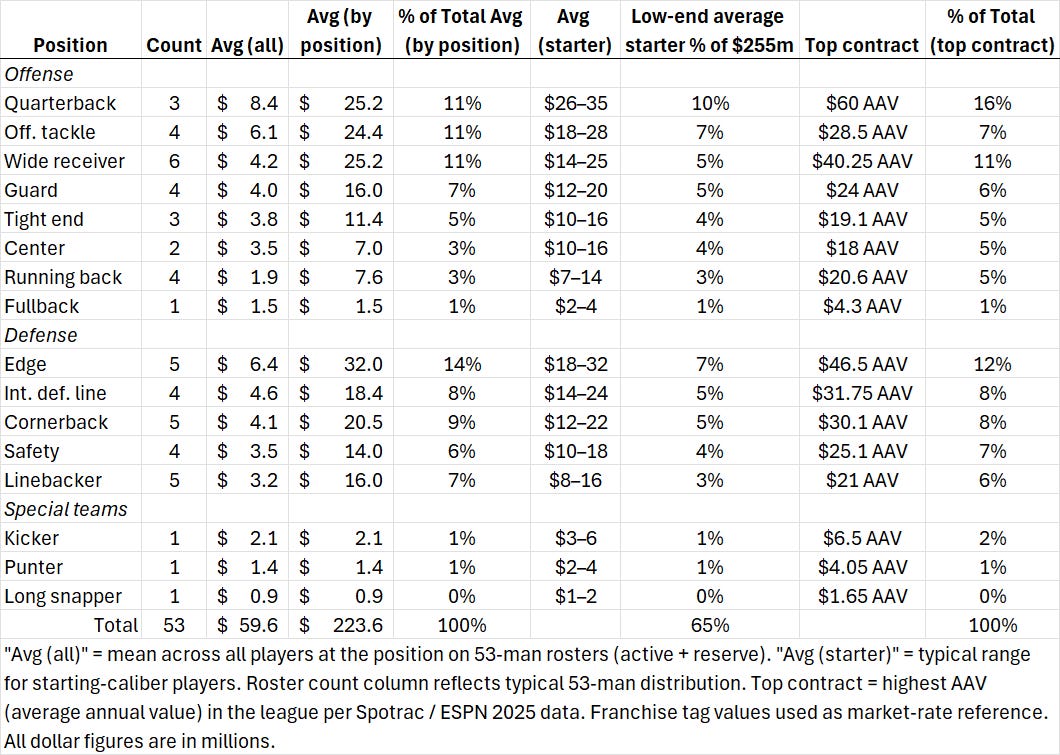
Don’t get confused by the total average by position being $59.6 million. This is a meaningless number resulting from totaling the averages. The league’s salary cap is $255.4 million (2025), and most teams get very close to it. The total for average by position gives a more reasonable figure of $223.6 million.
Notice that the low-end starter average is about 65% of the total team salary. Both this and the ranges of how much each position group commands of the salary cap are fairly similar to what we’ve learned about NIL deals in the college football ranks. This lends some credibility to this methodology right off the bat.
Applying the NFL percentages by position for the average player by position on each roster and the average low-end starter percentage of the total salary cap for a 105-man roster with $62 million to use for salary, gives this result for college:
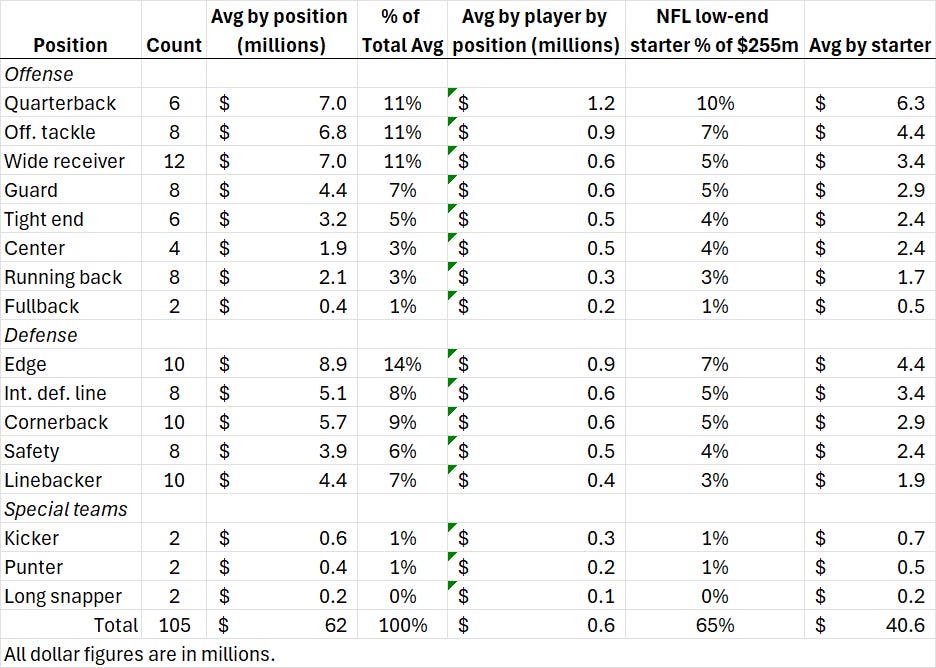
So the average starting quarterback would command $6.3 million. Quarterbacks in total including backups would average $1.2 million with those starters bringing that average up a lot. The average starting lineman would expect about $3.2 million on offense and about 3.9 million on defense.
Keep this analysis in mind the next time somebody offhandedly says, “college player pay is out of control” or “detached from reality”.
The reality is that at the top programs these young men are easily worth hundreds of thousands of dollars for their product and in many cases several million dollars each and every year they take the field.
I should say “allowing” since it took a 9-0 loss at the Supreme Court after numerous losses in lower courts for the NCAA to arrive at this point.
This is unlikely since other players who don’t play contribute in practice and include young players who are expected to be starters in the future. But we are just looking at rough averages at this point anyway, which we know is unrealistic. The realistic part comes next.