

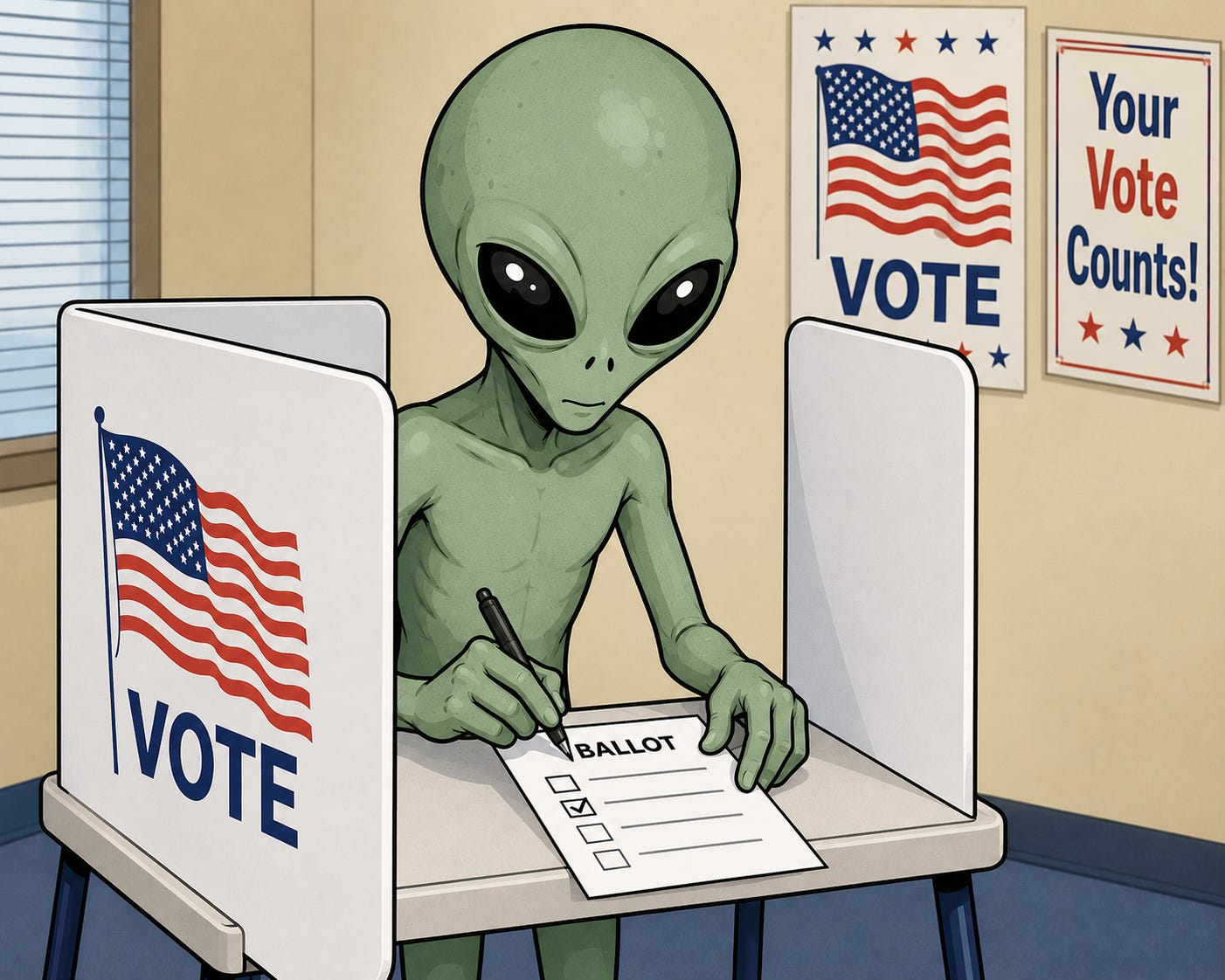
I have noticed an interesting parallel between those who simply “know” that aliens are real and those who simply “know” that elections are being stolen. Both are clinging to faith as a substitute for evidence.
Whenever people draw conclusions in any area, there is a chain of reasoning involved. Not all reasoning is good, of course. Beyond bad premises and fallacious reasoning in the structure of an argument, many arguers go too far with how strongly confident they hold their conclusions. Some people conclude “maybe” where others say “it must be”. The latter group see what they want to see and cannot grasp that they are self deceiving.
To be sure there are thoughtful people in both domains—those who are concerned about election fraud as well as those who believe the evidence points to (somewhat) probable alien involvement. Robin Hanson and Tyler Cowen are two such cases regarding extraterrestrials. Both are assigning higher probability to aliens than I do. But both are careful in their reasoning distinguishing themselves from those who see a video and scream, “See, aliens!”
Regarding election fraud, I don’t know of a case where a careful thinker is concluding election fraud has occurred to the point that a prominent election was stolen. I do know thoughtful people like Walter Olson who are very aware that there certainly are cases of fraudulent voting—it would take complete Pollyanna to not realize there are both fraud and mistakes in virtually every large election in the U.S.
When it comes to the truthers and the denialists, all reasonable bets are off.
Ironically, “aliens” are invoked in both cases. For those who think elections are being stolen, it is very likely they think there is illegal alien (non-citizen) voting as a key component. This hints at some motivated reasoning behind the election fraud believers. Their dislike for illegal (if not legal) immigrants leads them to see fraud in every election outcome that doesn’t match their preferences.
Similarly, nonhuman-alien enthusiasts are motivated to confirm their priors whenever they see or hear about something strange. They so much like the idea of aliens that they fall for everything that might suggest aliens.
I bet the Venn Diagram of alien truthers overlaps strongly with non-religious people who believe ghosts are real. Which suggests and interesting digression: Can you be an atheist and believe in ghosts?
Most religious people, especially Christians, on some level believe in ghosts. And this isn’t a game of semantics where the Holy Ghost is very different than the Blair Witch or Casper. Divine intervention, life after death, and guardian angels are all a form of ghostly belief. Read the Catholic prayer to St. Michael the Archangel. The Catholic Church literally believes in fallen angels and demons who attempt to turn humans away from God.1
If you believe in ghosts in the haunted-house version can you maintain atheism? Maybe you can in denying a belief in a living God, but you’re getting most of the way there otherwise. This hints at the struggle adamant atheists fall into when their scientific/reason-based atheism eventually comes up empty with what we don’t (yet?) know like in the case of the Big Bang.2 God of the Gaps is at least as much a problem for atheists as it is for believers.
Pulling back from that digression, thoughtful people of faith know where their faith is doing the work where reason alone cannot bridge the gap. That is literally what faith means. So we’ve stumbled upon another interesting parallel—that between those who “know” in a reason sense that God and/or ghosts exist and alien truthers/election denialists. You cannot reason your way to these absolutist conclusions. To be without waiver or caveat requires faith.
Substacks referenced:
Another digression might be how difficult it is to fully grasp this belief since a true understanding of it is beyond human comprehension. Just as we cannot know the fullness of God, we cannot fully grasp these types of elemental parts. As an imperfect analogy: I very much know and understand quantum mechanics better than Isaac Newton ever did, but I very much do not understand quantum mechanics. Whether or not humans can ever fully know quantum mechanics is where the analogy either continues to work or breaks down. As Earthly creatures, we will never fully know God.
Remember that the Big Bang Theory, originally proposed by brilliant physicist and a Roman Catholic priest Georges Lemaître, was strongly rejected by atheistic scientists who thought it was an attempt to smuggle theological creation into physics.