


The kids these days don’t know how good they got it. And the olds these days don’t know how bad they had it. Both can be true while the opposite is often claimed by each respective group.1
Here are some arguments with evidence to support my view.
Start with John Cochrane sharing an expanded version of his recent article “The 1950s: A Not-So-Golden Age.”
Many people say was the 1950s, when, as the fable goes, the economy was growing robustly, manufacturing was strong, there were good union jobs for not very skilled people, and a man (sorry, it was a man) could buy a house and support a family on such a job.
Not so fast.
Look at standards of living. Real gross domestic product per capita, which is also national income per capita, sat below $19,000 in 1955. In 2025 it approached $69,500. These figures are expressed in 2017 dollars, thus accounting for inflation. The average American is about 3.7 times better off today than in 1955. It’s not even close.
He cites a wealth of meaningful statistical measures along with many qualitative facts that are equally impactful. He counters and busts numerous myths held religiously by progressives or conservatives and sometimes both.
Next comes Zvi Mowshowitz who ponders the question “When Were Things The Best” looking at a large number of facets.
He makes a lot of arguments for today as the best version of these various things but not always. Some of them are quite compelling while others I have my doubts about. Sometimes it’s definitions and framing that might make today or some other period the unarguable answer. This is a nuanced topic.
We don’t have the best everything [today]. There are exceptions.
Most centrally, we don’t have the best intact families or close-knit communities, or the best dating ecosystem or best child freedoms. Those are huge deals.
But there are so many other places in which people are simply wrong.
. . .
The Best Cars
Today. We wax nostalgic about old cars. They looked cool. They also were cool.
They were also less powerful, more dangerous, much less fuel efficient, much less reliable, with far fewer features and of course absolutely no smart features. That’s even without considering that we’re starting to get self-driving cars.
. . .
Not everything is getting better all the time. Important things are getting worse.
We still need to remember and count our blessings, and not make up stories about how various things are getting worse, when those things are actually getting better.
To sum up, and to add some additional key factors, the following things did indeed peak in the past and quality is getting worse as more than a temporary blip:
Political division.
Average quality of new music, weighted by what people listen to.
Live music and live radio experiences, and other collective national experiences.
Fashion, in terms of awesomeness.
Roads, traffic and general infrastructure.
Some secondary but important moral values.
Dating experiences, ability to avoid going on apps.
Job security, ability to stay in one job for decades if desired.
Marriage rates and intact families, including some definitions of ‘happy’ families.
Fertility rates and felt ability to have and support children as desired.
Childhood freedoms and physical experiences.
Hope for the future, which is centrally motivating this whole series of posts.
The second half of that list is freaking depressing. Yikes. Something’s very wrong.
But what’s wrong isn’t the quality of goods, or many of the things people wax nostalgic about. The first half of this list cannot explain the second half.
Compare that first half to the ways in which quality is up, and in many of these cases things are 10 times better, or 100 times better, or barely used to even exist:
Morality overall, in many rather huge ways.
Access to information, including the news.
Logistics and delivery. Ease of getting the things you want.
Communication. Telephones including mobile phones.
Music as consumed at home via deliberate choice.
Audio experiences. Music streams and playlists. Talk.
Electronics, including computers, televisions, medical devices, security systems.
Television, both new content and old content, and modes of access.
Movies, both new content and old content, and modes of access.
Fashion in terms of comfort, cost and upkeep.
Sports.
Cuisine. Food of all kinds, at home and at restaurants.
Air travel.
Taxis.
Cars.
Medical care, dental care and medical (and nonmedical) drugs.
That only emphasizes the bottom of the first list. Something’s very wrong.
. . .
Once again, us doing well does not mean we shouldn’t be doing better.
We see forms of the same trends.
Many things are getting better, but often not as much better as they could be.
Other things are getting worse, both in ways inevitable and avoidable.
This identifies important problems, but the changes in quantity and quality of goods and services do not explain people’s unhappiness, or why many of the most important things are getting worse. More is happening.
As he makes clear in the post, not all is grand, but not all is lost either. And rightful hope springs eternal.
He followed that post up with another considering “The Revolution of Rising Expectations.” This one serves as an attempted reconciliation of the debate between those you claim "life sucks, you can't get ahead" and those who claim "but every measure is better than ever."
Thus In This House We Believe The Following
We live in an age of wonders that in many central ways is vastly superior.
I strongly prefer here to elsewhere and the present to the past.
It is still very possible to make ends meet financially in America.
Real median wages have risen.
However, due to rising expectations and rising requirements:
The cost of the de facto required basket of goods and services has risen even more.
Survival requires jumping through costly hoops not in the statistics.
We lack key social supports and affordances we used to have.
You cannot simply ‘buy the older basket of goods and services.’
Staying afloat, ‘making your life work,’ has for a while been getting harder.
This is all highly conflated with ‘when things were better’ more generally.
All of that is before consideration of AI, which this post mostly excludes.
For those who like a data-rich examination with helpful charts, I direct you to the American Abundance Index from Human Progress.
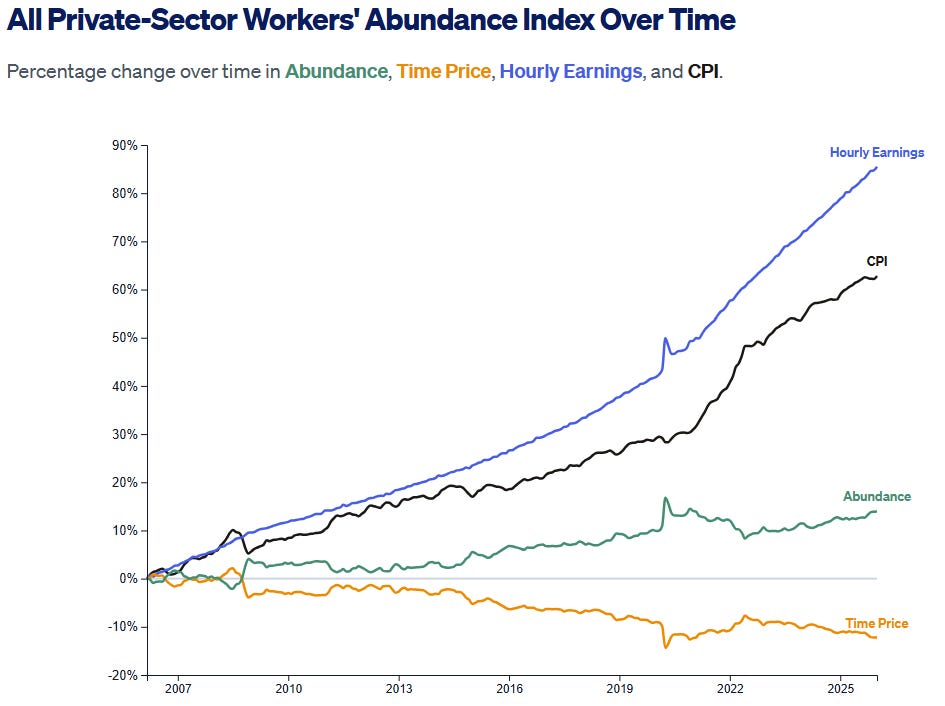
No, not everything is great much less perfect. But it’s getting better . . .
It’s kinda funny how the older generation (eternally true for every generation from the time of Caesar to the time of my coming grandchildren) will selectively claim “we had it soooo hard” or “it was better in my day” when it serves their purposes. Memory and nostalgia are harsh mistresses.