

A majority of Oklahoma’s who voted Tuesday proved wise in rejecting the state question on raising the minimum wage Tuesday.
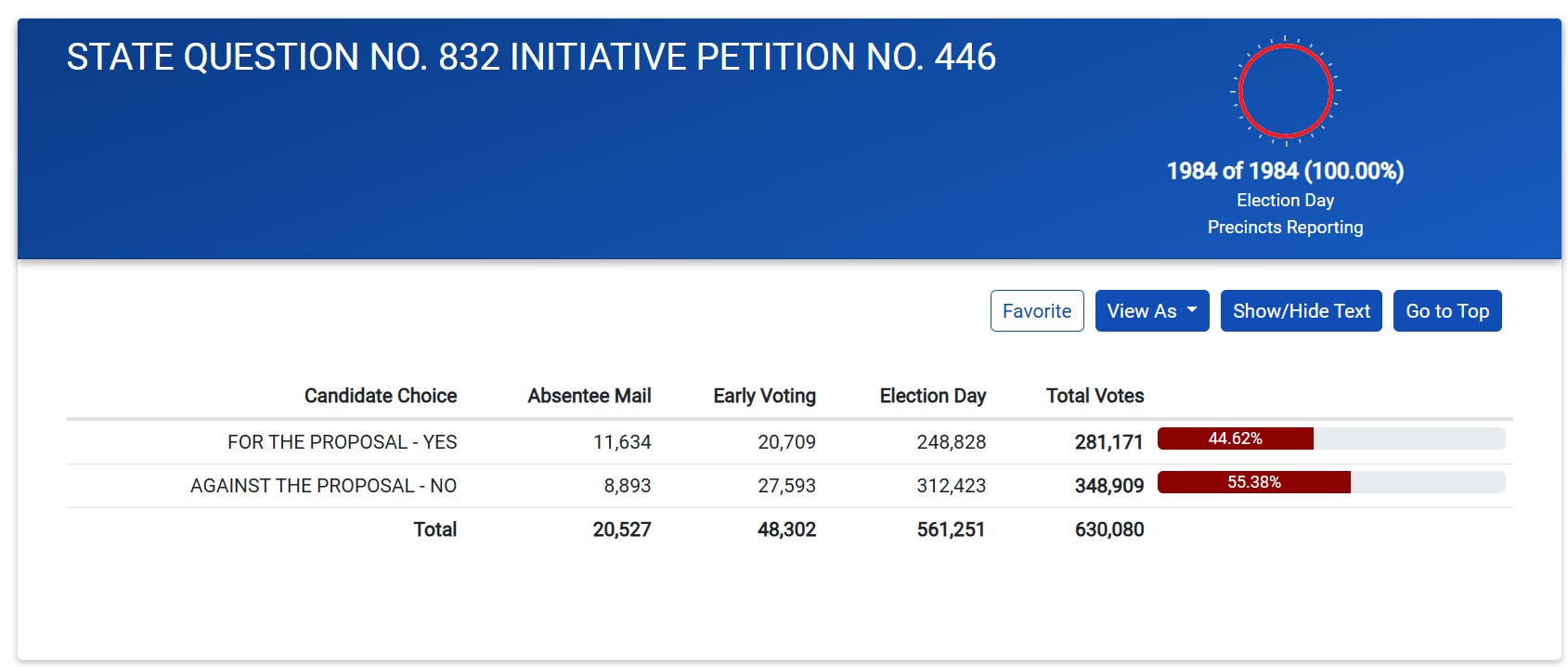
Roughly 55% of voters said no to the proposal to raise the minimum wage from $7.25 currently to ultimately $15 in 2029 with two annual increases in between.
Of course, there are two problems in that result. One, it was only 55% opposing leaving 45% (>281,000 voters) siding in support. Two, undoubtedly many of the voters in the majority were not actually doing so out of economic wisdom as I’ll explain below.
Many of my neighbors had signs in their yards promoting the increase. I refrained from making my own that would have read “Don’t make employing low-productivity workers illegal. Vote NO! on SQ 832”. It would have only been a signal to them that my intentions didn’t match their own. The fact that I understand basic economics would have been lost on them.
This got me thinking about who does and doesn’t support such efforts.
Minimum wages are about as useful at helping raise wages for the target group as is rent control at delivering affordable housing to needy people. It doesn’t work in theory, and in practice it is a disaster.
That is the correct economics, but, as we know, the zeitgeist doesn’t care about being logically correct as much as it is driven by social-desirability bias seeking what feels good over what is good.
I would like to suggest the following 2x2 framework of intentions versus economic understanding.
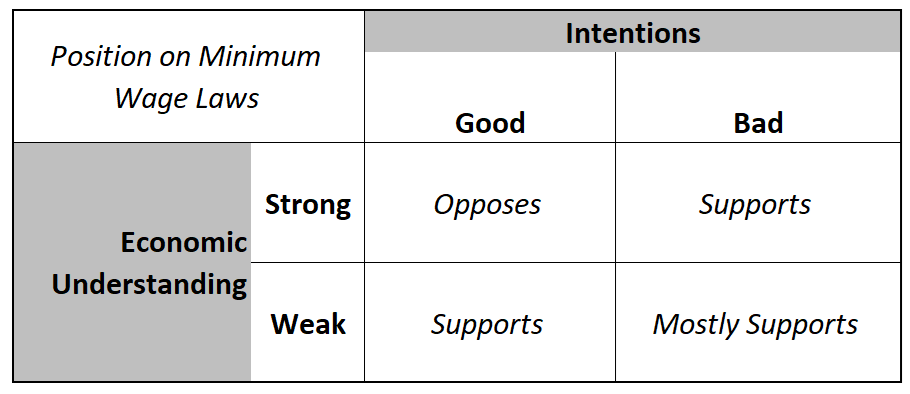
My explanation of the grid is the following:
Good | Strong = Opponents of minimum wage laws—those who are at least courageous enough to vote for something unpopular (sounds bad but is good).
Good | Weak = Supporters of minimum wage laws—those who mean well but are misguided (classic social-desirability bias to the point of promoting that which sounds good but is bad).
Bad | Strong = A combination of supporters—those who seek to manipulate the situation realizing that higher minimum wages will make less productive people less available to compete with more productive people along with some true ugly bad actors who simply wish harm on the less fortunate. I would estimate that the former group greatly outnumbers the latter, but all are supporters.
Bad | Weak = A mixed bag of supporters and opponents—those who seek gain at the expense of others (employers and consumers and other workers) being the supporters and those who happen to be right for the wrong reasons being the opponents. I would estimate the supporters greatly outnumber the opponents here.
Sometimes opposition to minimum wage laws comes from a place of bad intentions—the people who happen to be right for the wrong reasons. Sometimes support for minimum wage laws comes from a place of bad intentions—the people who want to stick it to the man (socialists of all parties). These are very small groups, however, greatly dwarfed by the supporters who tend to be well-meaning but are acting foolish in a destructive way.
Obviously these are not absolutely determinative positions. There are indeed people with a strong understanding of economics who nevertheless support minimum wage laws in good faith. Yet these are few and far between, and I would argue it is a hole in their understanding more than congruent with it. Spare me some elaborate theory of monopsony in a hypothetical company-town world that exists in the real world for about as long as does antimatter in a particle accelerator. This is an attempt to use a solution in search of a true problem.
It does matter that minimum wages only affect about 2% of the population. That demonstrates that while at the same time this in an esoteric issue, it is one that comes at little cost to the advocates but great dismay to the actual participants at the margin. It is a reverse of the classic case public-choice problem whereby with minimum wages we have mostly concentrated costs with mostly diffuse benefits. The costs are borne by those priced out of the market by minimum wages along with the rest of us deprived of their labor. The benefits accrue to three groups: the few that do enjoy higher wages (yet they likely suffer bearing a worse non-pecuniary work environment), the market manipulators mentioned in bad|strong like union employees, and the sea of voters that get a small psychic benefit from thinking they are doing the right thing.
The upshot is that minimum wage support gets traction because of the economic ignorance that prevails combined with the cheap benefit of virtue signaling (even if much of that signaling is internal—it makes you feel good) along with a boost from the bad actors who benefit from the policy.