

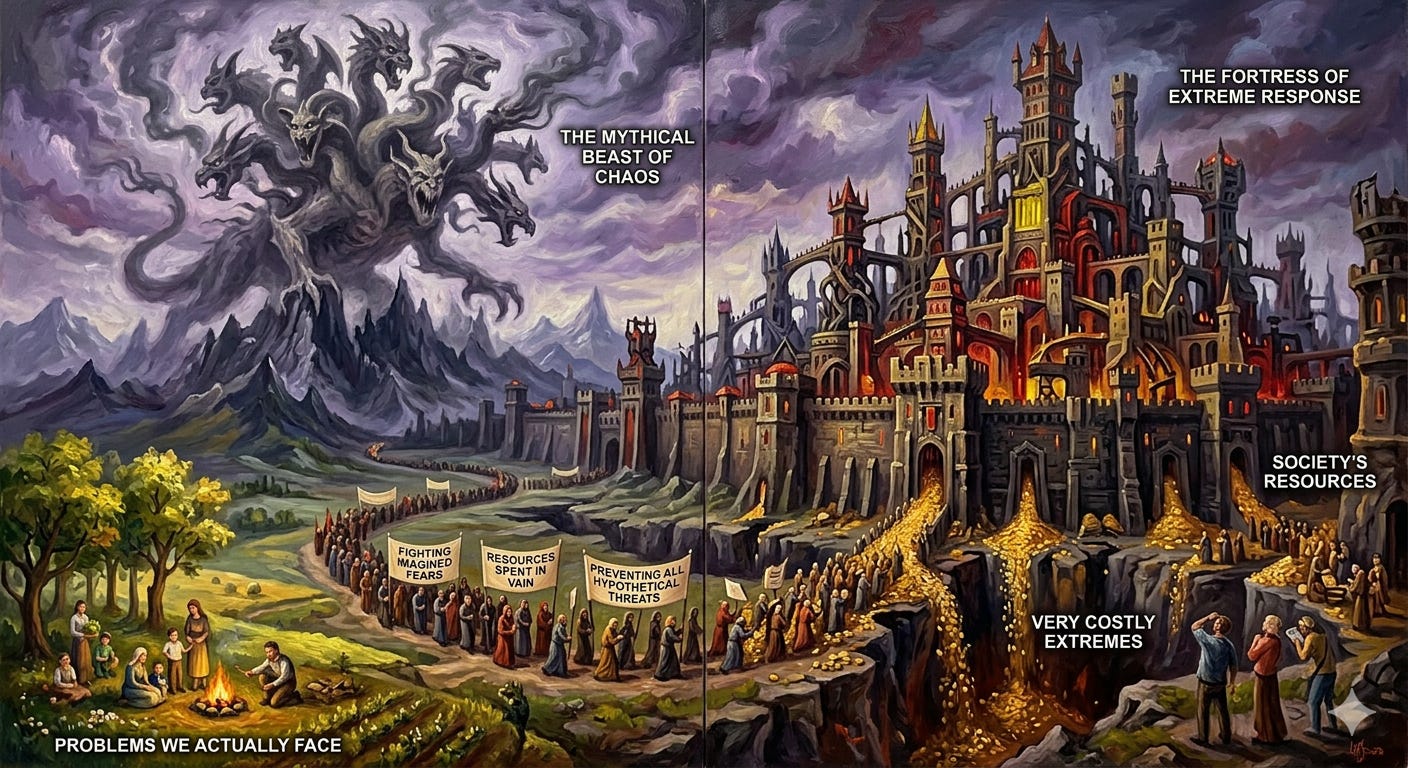
People hate chaos and chaotic situations. This is natural and understandable. Evolution has probably primed us to know chaos = bad outcome. So avoid chaos at all costs.
The problem with this inference is right there in the last sentence above: “At all costs.” Just like it is never time to panic, nothing should be done at all costs. Assuming so means you have miscalculated the cost-benefit analysis leaving out costs, overstating benefits, both, or misdiagnosing the situation altogether.1
Yet our human nature overrides sound judgement time and again. We see chaos, interpret it as a threat with dire implications, and then (re)act upon it in ways that do more harm than good.
Some examples:
The drug war - Drugs are dangerous. All of them without exception. The dosage makes the poison. Too much salt will kill you. So will too much water. Too little salt (and too little water, obviously) will also kill you. All pain relievers carry risk. Caffeine will change your body and behavior in ways that can be beneficial and in ways that can be harmful—bad decision making, etc. Some people can actually highly function as a regular heroin user. Many cannot. We see the ugly side of drug use/abuse as chaos. And it is.
So what do we do? We ban the “bad” drugs. We regulate the “good but could be bad” drugs. Banning and regulating ultimately is done with violent force. That isn’t a choice at that point. It is an inevitability.
The result is a very costly war on drugs that is unwinnable on its face even before we consider all the knock-on effects that are so very costly. We somewhat learned this lesson with alcohol prohibition. Yet, we continue to have to relearn it time and again.
With regulation of the “good but could be bad” drugs we just get a different version where pain management is crowded out for sake of avoiding chaotic risk with the biggest burden falling on those who suffer chronic pain but are denied the drugs that can help them. We mistakenly assume stricter regulation will reduce the overdose tragedy. And there is another facet to this...
Food and drug safety - This ranges from the FDA to local government restaurant inspectors. These government solutions are second best to private, free market solutions like insurance and private firms that would certify safety or efficacy as well as tort law. But people can’t get their minds around that. Instead they use (and misuse by misremembering) the thalidomide case from 75 years ago and the mythical stories from Upton Sinclair’s fictional book The Jungle, which was eventually embraced by . . . wait for it . . . major meatpackers who realized they could use it to increase regulatory burdens in an effort to suppress competition. Regulatory capture for the win.
The most costly effect from this is the invisible graveyard. When the FDA delays approval, people die who would otherwise not. The number is tragically high—millions of people. COVID was the a stark recent example with the number in the hundreds of thousands. Sadly, this is but one of many examples.
Immigration restriction - This is intentionally not plural. The very concept of restriction is the issue. One can argue that we need some restrictions. But just as in the drug war, asking the state to do the thing leads to one version of cruelty or another. The lesson begins with be careful what you ask for. The deeper lesson here is to consider if the presumed cost from the chaos we are trying to avoid is in fact avoidable or a cost at all.
Border chaos is what gets the most animation, but so too is any perceived or imagined disruption to the local environment. From “there goes the neighborhood” to “there goes the country,” people are very sensitive to too much change from new entrants. Mythical fears range from cultural change to threats to democracy. In the latter category falls both the myth of illegal immigrants voting to the great replacement theory.
This is not limited to international migration. Too much migration from within the country raises the same concerns. I hear it here in Oklahoma about Californians and others moving in. Yet it is international immigration that receives intense focus.
The solution becomes harsh draconian policies. Some are subtle having developed over decades. As Jonah Goldberg often quips, “The best immigration policy is the have one.” On that we have gradually failed.
Now the failure is in the sudden draconian approach of rounding people up and discouraging them from being here to begin with. Notably this is not the first time this country has done something awful in this regard remembering in particular Operation Wetback. Time and again the disturbing chaos leads to disturbing policy. Ironically it is the chaos that technology and social media allow us to see that might lead to a mitigation of the policy response as that same source spreading fear is spreading the word on the solution’s cruelty. Despite this hope, the long-term harms done to people and to the economy will sadly be overlooked and forgotten.
Investor protections - Nobody likes to lose money. Many people would prefer a lot of safety (low risk of loss) for most or all of their savings. They are comfortable and understand giving up a higher expected rate of return in exchange for the safety. What they don’t appreciate is the inherent risk that remains.
One of these risks is inflation—not having as much purchasing power in the future as they would like or expect. That one is not the concern here. The one that is of concern is counterparty risk—that your money saved is lost by the agent asked to save it. This can be a bank, credit union, insurance company, money market fund, among others but also bonds purchased, money lent to, a government or company.
The problem lies in the chaos of having that institution fail to return some or all of the saver’s capital. This is what I might call extraordinary volatility. Some volatility investors are comfortable with—stuff that feels normal. Some high volatility investors are still comfortable with volatility when they know that is still “normal” like how much stocks move up and down most of the time. A colossal market crash is chaotic, and for that investors clamor for SEC regulations, rules about who can make these types of investments, and limits on who can be in the market before the fact. They also embrace government bailouts after the fact.
When it comes to the chaos of a bank losing a depositor’s money, we have the FDIC. They play two roles here. First is the potentially helpful role along with state examiners and the Federal Reserve in monitoring bank risk. I say “potentially” because they are not perfect by any means and have the blood of many failures on their own hands. Second is deposit insurance, which FDR brought into existence against his better judgement. We are now talking of expanding it once again.
The commonly made objection that regular people cannot make good decisions about risk (credit and otherwise) is a ridiculous strawman betrayed constantly by the world we see around us. It also ignores the role expert advisors can play to offer guidance. Without the government playing the role, there would be a market for private insurance for banking. The choices made by large, sophisticated investors would be constructive here too when those investor faced a real risk of loss. Time and again we ignore this helpful instrument.
So beyond regulatory failure, the bigger issue is moral hazard—when a bailout of one kind or another (like FDIC insurance) allows those involved in the investment decision to sluff off risk onto third parties. Ironically this creates a market failure externality—something we rightfully look for government to prevent when possible. Banks are stronger when they have the risk of capital loss for investors. Money market funds work better when their underlying investments are properly marked to market rather than pretended to always be sound.
The War on Terror - Terrorism is real. It is also fairly small in the scheme of a risk-filled world. This is in no way meant to diminish the tragic loss of life terrorist acts have caused. But we should take a measured response to risk in all places including here. Unfortunately, we do not.
Perhaps no other event in my lifetime has been as chaotic as the morning of 9/11/2001. All what emerged from that chaos was very costly far beyond the terrible costs suffered that morning or the actual threat posed going forward. The excessive costs obviously start with the Afghanistan War then follow with the Iraq War and then so many other, smaller conflicts. Beyond that were the illegal and immoral responses from justifying torture to spying on Americans. And while it might seem trivial, there were real-world costs to all the safety rules implemented all in a vain effort that was no more than security theater that continues today. Taking off shoes at the airport is a classic example.
The myth here as with all of these in this partial list is the size of the risk actually faced.
Those are just a few of the ways we let chaos create mythical problems. The chaos is bad. The solutions to it can be worse—especially so when we are slaying dragons that do not exist.
To take a religious example for the last type of mistake, I could see a man of faith saying “I will support God and stand up for my faith at all costs.” Fair enough and I agree, but only to the extent that it is very cut and dried like in the situation that Blessed Stanley Rother faced when confronted by his executioners/murderers. Rother fought back but did not back down from his faith with both his return to Guatemala and in his final moments. When we expand the situation to include seeking out those who had put him on the death list before the murder with the intent of creating the confrontation, we see it is not worth that cost. In fact that would be a cost incurred that would contradict God and his faith. That’s what I mean by misdiagnosing the situation.
You are a wise man, and I appreciate your writing more than I can easily say. I only wish far more people were seeing it.
I appreciated this article very much. Your point is important and, in my view, deeply right: people see chaos, panic, mythologize the danger, and then support “solutions” that often create worse harms than the original disorder. That pattern shows up again and again. And for me I'm very personal ways.
What I especially value in your writing is that you do not just react to the surface of things. You keep asking the harder question: what is actually true here, and what is the real cost of the response? That is rare judgment.
Anyway, I just wanted to tell you this piece was excellent, and so is the mind behind it.