

This from Mike Munger and the associated podcast, TAITC, is the truest thing you’ll encounter today.
Latesters leave 21 minutes before the meeting. And they will actually wait around, sitting on their ass at home, watching videos on the ‘Gram, so they won’t “waste time being early.”
They assume they will make up time by driving fast, there will be no traffic or school buses, and that they can park right beside the elevator. And then, when that is not true (again, because it is never true and they are always late) they say, “You wouldn’t believe the [{thing} that everyone already knows, because everyone else was on time because they accounted for {thing}].”
David Friedman on Hotel Breakfasts [emphasis added]:
I have been unable to find clear evidence of whether the explanation is true but it fits a general pattern: Anything odd on the market is either tax evasion or price discrimination.
This is a great general principle to remember when encountering something that seems at first blush to be at odds with logic and then continues to be odd once more fully understood. The last step is crucial, though, because so much of what appears odd to a casual onlooker is actually quite reasonable once particular details and nuances are taken into account.
So maybe the more generalized principle is this:
... If a practice by a person or firm seems strange much less “stupid”, consider first if you simply do not understand what is actually going on (i.e., assume you are the stupid one). This is the price discrimination explanation.
... Upon further investigation and if the oddity remains, consider if it is truly a bad practice (rarely will it be) or the consequence of poor or malicious incentives (one of these being much more often the case). Poor incentives would be what government actors and non-profit actors suffer under as well as to a much lesser degree for-profit actors. Malicious incentives are the tax evasion explanation in many specific circumstances, but it also includes more general cases such as the principal-agent problem (of the intentional variety).
Roger Pielke, Jr. on Energy Transition:
First, global climate policy does not drive decarbonization as the decrease in carbon intensity of the global economy long pre-dates the climate movement (which started as coordinated global policy in 1992 with the Rio Earth Summit); economies growing wealthier and using more energy more productively have driven that trend.
Second, and less comfortably: since the climate-policy era began in 1992 the background rate shows no acceleration. Hitting deep-decarbonization targets requires this straight line to bend down. It has not done so.
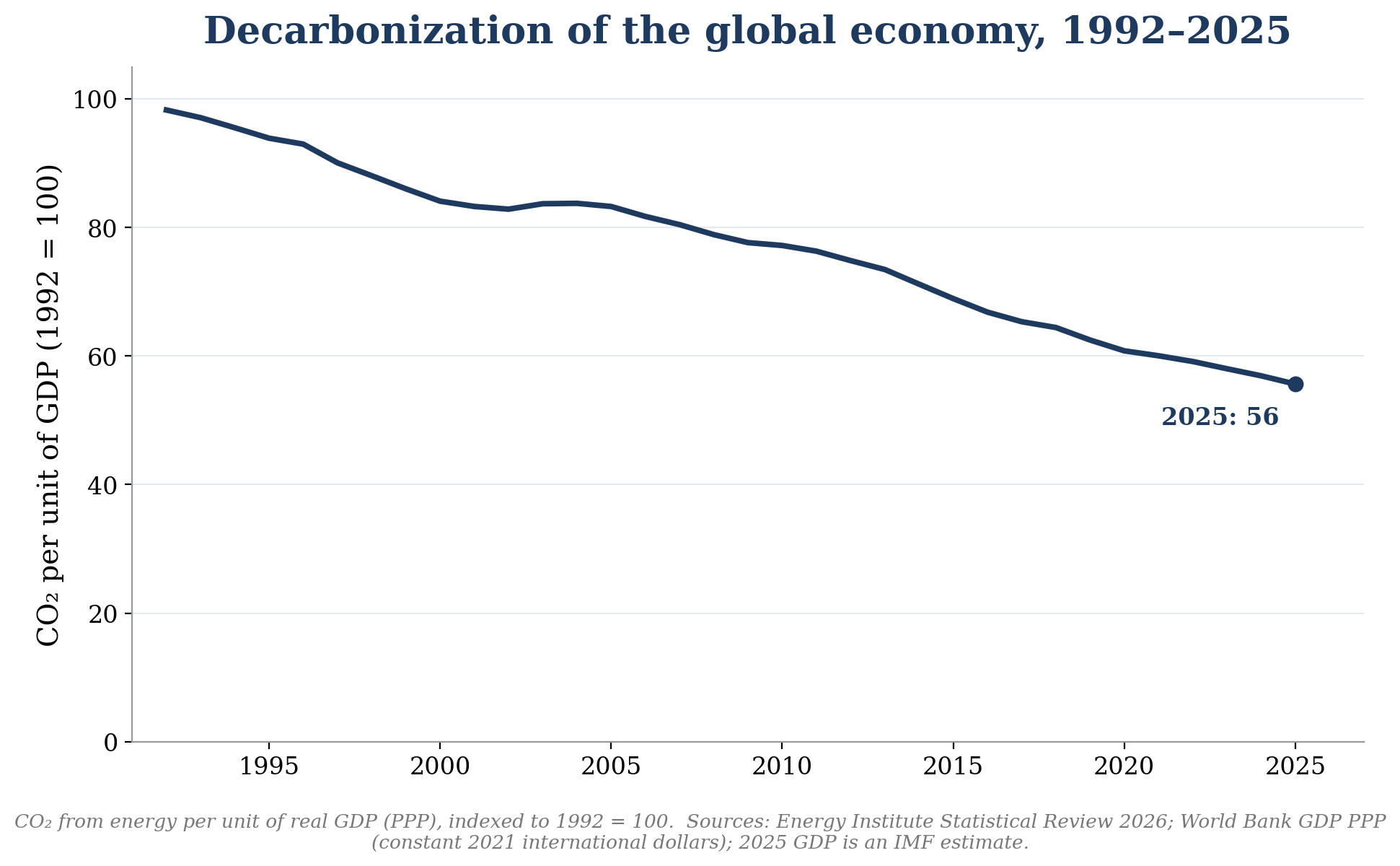
Decarbonization continues its long, improving trend despite not because of climate policies much less sensational worrying.