Here are three under the theme of counter-conventional wisdom — proper perspective edition.
I.
Kevin Kelly writes,
When a human student is studying, they might learn from a book they purchased or from a book they borrowed from a library, which we consider fair use. We don’t judge their learning based on whether they paid for the source, or whether the sources were borrowed or rented. Likewise if an LLM is trained on borrowed copies from a library (fair use) that should not impact our judgement of its knowledge.
He is making a series of points forming a larger argument for treating AI use of published works as fair use. I think his overall case is very strong. Judging how AI is using information requires a new perspective than simply thinking it is reproducing other’s work.
II.
In rereading this post from Kevin Erdmann my attention was drawn to this quotable:
There has been a spurious correlation between declining interest rates and rising home prices for 40 years. That led many supply-siders to falsely believe that a secular decline in mortgage rates was due to cyclical interest rate cuts by the Fed and to vastly overestimate the effect of lower mortgage rates on home prices. The variance in home prices across time and business cycles, across regions, and across income levels within regions, driven by similar variances on all those margins in rents, has vastly more explanatory power than interest rates do in home price outcomes.
Remember that the next time you read or hear the financial press drawing sharp predictions/conclusions about a recent move in interest rates (especially when it is not mortgage rates themselves) as well as when your local real estate agent spouts off.
The larger lesson is that proper perspective matters. Subject-matter experts within a specific part of a domain are not themselves experts on the entire domain. If we wanted to know about potential or historic ocean sea levels, we wouldn’t ask lifeguards.
III.
Speaking of sea levels . . .
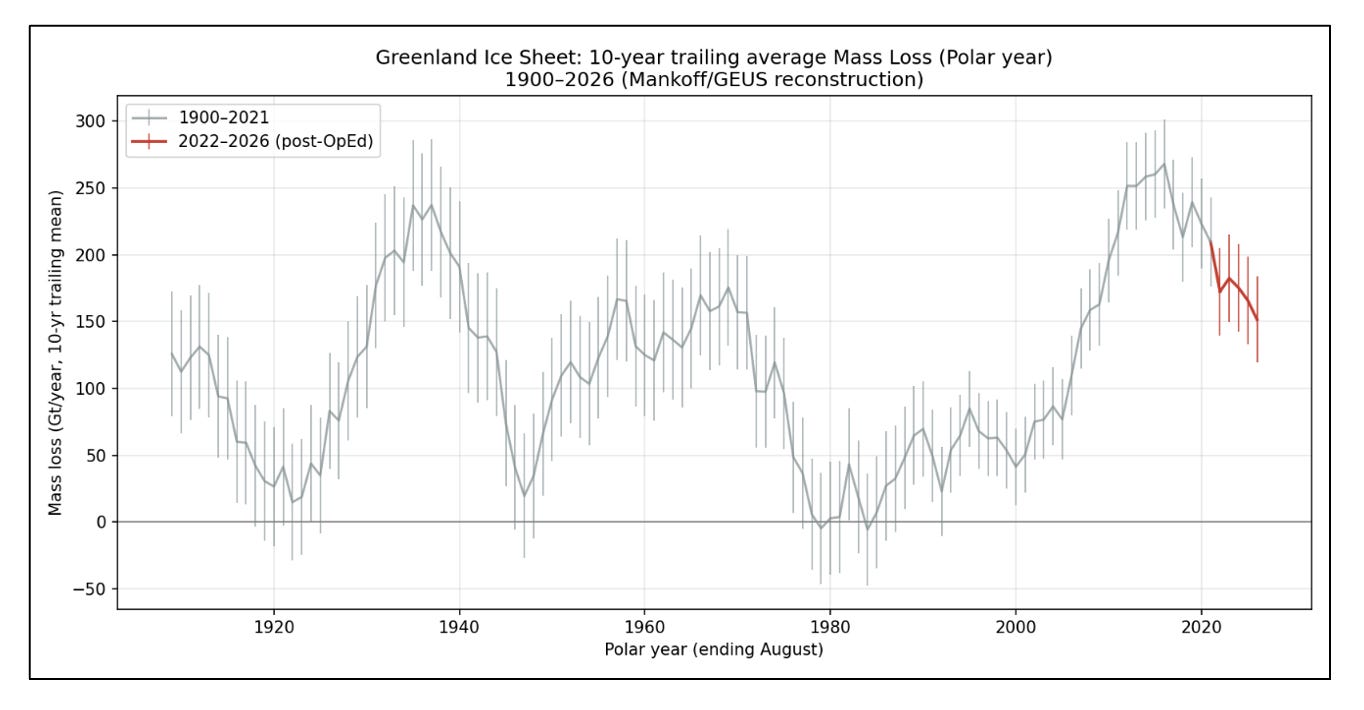
Steven Koonin revisits his pushback, which itself drew pushback, from four years ago concerning Greenland’s shrinking ice sheet:
The point of my piece wasn’t to deny that the ice sheet had been losing mass since 1900. It was that headlines describing a dramatic, unprecedented acceleration since 1990 were misleading. In fact, the graph belies the simplistic notion that humans are melting Greenland.
Since human warming influences on the climate have grown steadily—they are now ten times what they were in 1900— you might naively expect Greenland’s losses to march upward in lockstep. Instead, there are large swings in the average annual ice loss and it is no larger today than it was in the 1930s, when human influences were much smaller. Moreover, the annual loss of ice had been decreasing in the past decade even as the globe continued to warm.
. . .
A substantial body of research has linked Greenland’s mass loss fluctuations to the North Atlantic Oscillation (NAO), a pattern of air pressure and related atmospheric circulation that changes over decades. For example, a 2025 analysis found that Greenland’s mass variability was 75 percent correlated with the NAO.
It’s too easy to portray natural variability as an accelerating anthropogenic signal. If you choose a time window that starts near a trough and ends near a peak, the resulting “acceleration” can look alarming. The ongoing effort to promote a sense of climate catastrophe often exploits such selective framing to obscure natural variability and imply an ever-worsening trend.
The full record tells a more interesting story than Human activities are melting Greenland. The ice sheet has been shrinking for more than a century at a rate that rises and falls with natural weather cycles and the average annual mass loss has slowed in recent years, not accelerated.
This last quotable is an example of perspective humility/honesty. Cherry-picking perspective because it fits a preconceived narrative makes a fool of the picker and audience.