I.
I think that libertarianism is generally closer to the truth than any other political philosophy held by a substantial number of people. It is also the case that libertarianism attracts a lot of individuals inclined toward grifting, conspiratorial thinking, bigotry, and authoritarianism.
Those are the opening lines of Richard Hanania’s “Thoughts on Elite Versus Populist Libertarianism.” He continues,
These are two very different tribes, and it’s an interesting question of how they can both identify with the same political label. What exactly does the Cato Institute or George Mason University have in common with “The Redheaded Libertarian”? To put it another way, how does a philosophy that prioritizes nonaggression and individual liberty above all else so often end up represented in politics and the media by collectivists and authoritarians?
Also this:
Ultimately, elite libertarians are driven by ideas, while populist libertarianism is a strategy for gaining a large audience and a mode of emotional catharsis for those angry at the world.
This is something that I have wrestled with. Namely, I always have felt that the weirdness of those in the libertarian movement and the Libertarian Party in particular was a combination feature with buggy byproducts and something that comes with the territory. Now there are clear fissures. “End the Fed” has become “Crush the Others.” It is a bad development. As Arnold Kling says directed in this case at the libertarian movement, “Have a nice day.”
II.
That the libertarian community if filled with contradictory actors is not exactly counter conventional wisdom for those paying attention. As for something that is CCW for those not paying attention, I offer this from Eli Stark-Elster:
For instance: did you know that daily social media use increases the likelihood a child will commit suicide by 12-18%? Or that teenagers are far more likely to visit the ER for psychiatric problems if they have an Instagram account? Or that a child’s amount of social media use, past a certain threshold, correlates exponentially with poorer sleep, lower reported wellbeing, and more severe mental health symptoms?
If that was all true for social media— and again, none of it is — you and I both would agree that people under 16 or so should not have access to platforms like Instagram or Snapchat. Imagine allowing your child to enter any system that would make them 12-18% more likely to kill themselves. That would be insane. You wouldn’t let your kid anywhere near that system, and the public would protest until it was eliminated once for all.
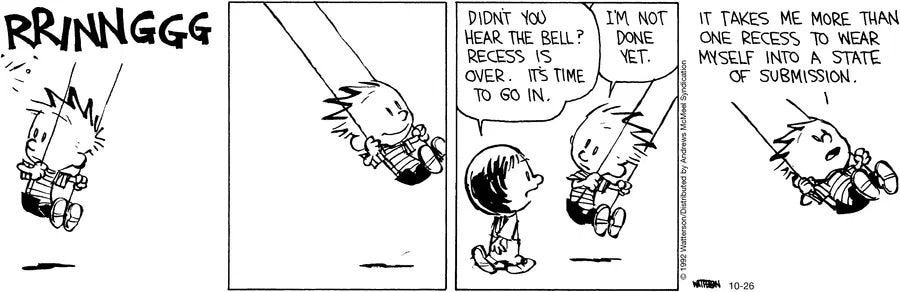
Great. So let’s get rid of school.
That is from his recent piece, “School is way worse for kids than social media.” The post is filled with substantiating facts and nuance. I find it problematic that the predictable knee-jerk reaction is a moral-panic when it comes to social media and kids. This will all be the subject of a future post in the Pessimist Archive Newsletter.
I find it additionally problematic and frustrating that the failures of schooling as we’ve made it are being overlooked while social media use is scapegoated along the way as an excuse for education failures. This is similar to how the go-to solution in education is “all this would be fixed if we just had [even more] money.” Money alone won’t solve it. We spend enormously on school already. And blaming social media use by the young won’t either.
From his conclusion:
But schooling is a system, and ultimately, it is the system itself that is ruining the minds of young people. Well before 2012, children were still committing suicide in the fall. Fundamentally, school is not what kids have evolved to do: they’re supposed to play freely with their friends, not spend their childhoods performing for adults under constant supervision.
Yet this is our brave new world. For the last fifty years, adults have opted to put their children in a panopticon. Social media bans are yet another brick in the wall.