

This post is an advice-column piece in which I extoll the reader to correctly discern the game you are actually playing separate from the supposed game you either wish to be playing or that conventional wisdom would say you were playing.
Lean on the wisdom found in The Elephant in the Brain. Look beyond the superficial. Realize that many people have a desire to maintain illusions, including yourself. Don’t fall for false premises. Be willing to keep up appearances, but not at the sacrifice of ethics.
At the risk of becoming cynical, one must question what is actually going on here at all times.
“I don’t have to outrun the bear; I just have to outrun you.” — the street smart hiker
One definition of street smarts is knowing the game actually being played. Three-Card Monte isn’t a find-the-obscured-object skill game. It is a scam. It doesn’t matter how good you are a following the shuffle. Pursuing that is a fruitless effort.
This isn’t confined to the realm of fraud. Often there is just a game within a game.
Here is an analogy. Like many people, I compete in annual March Madness bracket games. The contest seems straightforward and generally is: Pick the winners of all the games (usually limited to the traditional 64 games) in the college basketball NCAA post-season tournament. Whoever gets the most correct wins the pot.
It turns out there is more to it than that. The game isn’t just how many can I get correct. It is really how many can I get correct in comparison to other entrants in my pool. I am not playing against the uncertainty of 63 potential winning basketball teams. While I am trying to pick the best bracket, I’m not playing against those basketball teams or even necessarily the probability involved in those independent events. I’m playing against the other people who are all picking brackets—the field of my pool. That is a deep and critical nuance.
Almost always the scoring is a progressive scale by round where one scores more points for correct picks in subsequent rounds since that winner is predicated on a team having advanced (won game(s) previously). What I need to do is figure out who they are likely to pick as much as who I think will win. And the former is often easier than the latter at least down the stretch of the tournament—I know more about what team(s) you (the field) will pick to win than I know which team will actually win. So my objective function has two components:
Concentrate risk along as few dimensions as possible. A gambler is bound to lose to the casino in, say, roulette by continually playing the game. While the expected return from a single-number bet on American roulette is about 95%, the expected return from 20 consecutive single-number bets is only about 34%. The longer you stay, the more you pay. Similarly, I am trying to limit the number of things that must go right for me to win.
Find the path that is least likely to have competition. It is easier to win a race against fewer runners. Even if the basketball-winner pickers in my selected group (subgroup of the entire field that is clustered around my same bracket) are probabilistically better than me on average, I likely have a better chance against them than the larger field. I am narrowing it down to this subgroup by making choices I think are different enough from the general field congruent with point 1 above by, say, picking that the overall favorite will not make the Final Four. That leaves me a smaller group to have to outsmart/out predict.
This strategy works okay for a single entry, but it works marvelously when multiple entries are allowed. In those cases I can box out most competition isolating a few scenarios where if they play out in my favor, I am certain to finish in the money.
The simple pickers of games even with some diversification among several entries are typically no match for my coordinated attack. They have to be very accurate where I only have to be mostly accurate.
“Shut up and take my money!” — a FOMO investor
Consider investing. Are you trying to beat the market when you really should be trying to reach an objective financial goal unique to you? Having your financial goal be “making lots of money” is as meaningless as a company’s mission statement being “make a profit”. You’ve done something worse than burying the lead. You’ve assumed the result without defining how to reach success or what success actually is.
No one’s personal financial goal is or should be to “beat the benchmark” when the benchmark is something so simplistic as the relevant market alternative (e.g., the S&P 500 Index for comparison to your equity portfolio). Sure, we should strive to achieve comparable returns for comparable risk with the broad market being our bogey. But that is measuring if one is getting an appropriate return as compensation for the investment risk being taken. It is just a measure of efficiency and adequateness in one’s investment choice. It says nothing about the larger risk picture or what people actually want to achieve.
You can’t eat a Sharpe Ratio. The game for a portfolio manager or financial planner is to beat the competition and the relevant market index(s) where the competition is other firms in the business trying to do the same. The game for 99.9...% of the rest of us (clients) is to reach a financial outcome that balances current desires and future desires, to smooth consumption over time, to maintain purchasing power, and to provide for oneself and one’s beneficiaries as best and realistically possible incorporating emotions along with practical constraints. “Financial freedom” is still too vague, but it is a lot closer to the true game than is beating the S&P 500.
“I’ll tell you something. This country is going to the dogs. You know, it used to be when you bought a politician, that son of a bitch stayed bought.” — Roy L. Fuchs
This can be applied very meaningfully to politics, or politics can be used as a great analogy to help understand this concept. If you’re not evaluating, say, presidential decisions, under the framework of power and corruption, then you are completely misunderstanding the game that’s actually being played. This is particularly true under Trump, but it is not unique to him.
In truth I have to admit I’m all too often awful at this. Perhaps I’m too idealistic (perhaps a very charitable assumption) or too naive (obviously an uncharitable one). Or perhaps I’m too stubborn or lazy to do the work of discovering what’s really going on in order to play the real game. In all cases it seems the choice is to either rise above the petty subterfuge (vote for character rather than promises) or fall for a sophisticated trap.
“On our phones our friends try to act like celebrities and celebrities try to act like our friends.” — Arnold Kling
Consider social media. Is it a product that you are using or are you the product being used? Legitimately there could be a mixture of both. It’s okay to be a passive consumer, but you risk allowing it to take you on a journey that you otherwise would choose against.
It is important to keep in mind that all of us are ALWAYS in a status game—even the Buddhists.
“Anymore, simply acknowledging the issue is a moral victory.” — Calvin’s tiger friend, Hobbes
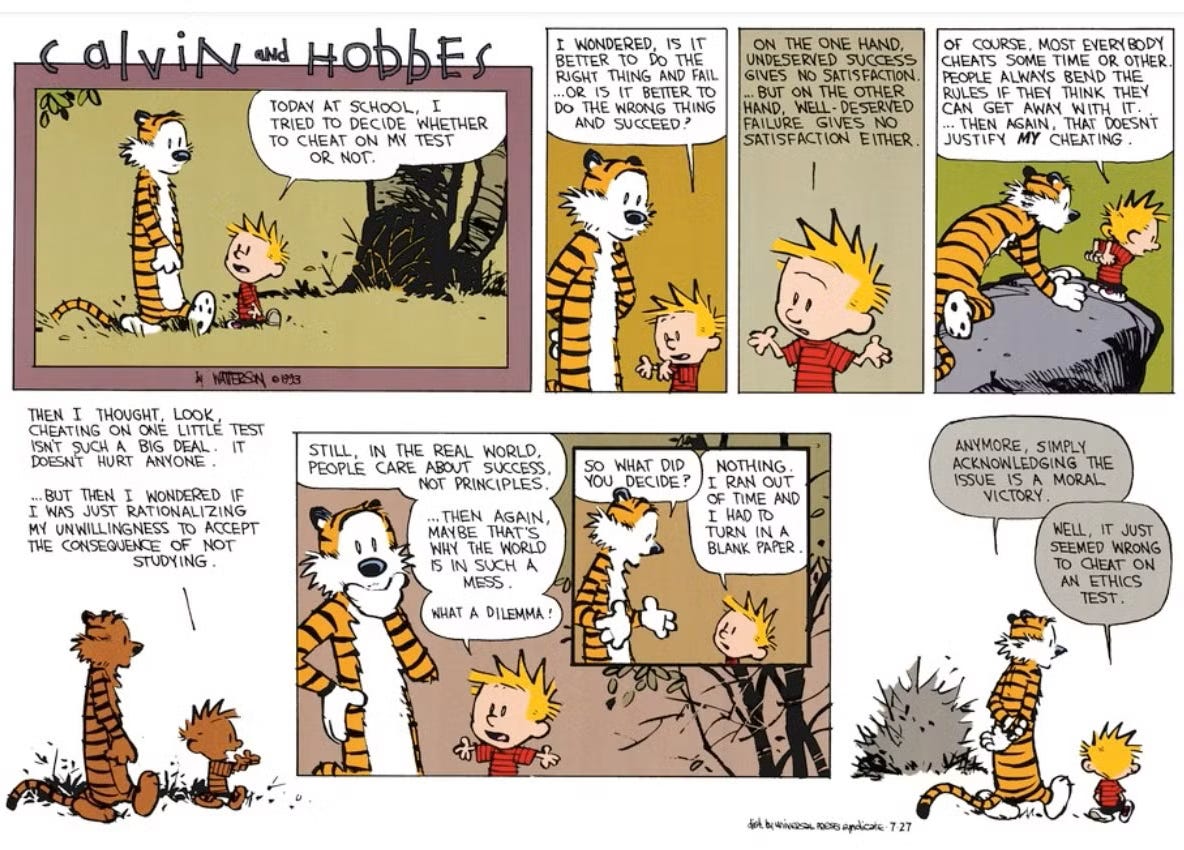
The original Hobbes was right about the state of nature when human ingenuity and culture are missing. It is nasty, brutish, and short. So often you are playing a game of scarcity. And even when there is abundance, it’s just a relative measure as resources are always scarce, and there are always opportunity costs.
When one of the things that is scarce is your awareness of the actual situation at hand, you’ll find yourself continually lost.
PS: “Is 90% of what you see on the internet fake…” Zvi’s entire post is related to this one.
Substacks mentioned and referenced: