

[As a reminder, all paid posts go free after one month.]
This is not strictly a prediction. It is a plausible story of a predictive nature assuming some conditionals. Obviously, all of that wouldn’t fit neatly in the subject line.
What I am going to lay out is a potential path to a much higher degree of socialism (state ownership of private capital) from a financial downfall within AI firms.
When people have negative takes on the economy or market, Tyler Cowen likes to ask in a provoking kind of way, which I fully endorse, “are you short the market?” In this case I am, directly to a small degree and indirectly to a large degree.
I have virtually none of my investable assets in large U.S. stocks. That is the indirect, large degree. Additionally, I have a short position in the ETF VUG, which is the Vanguard Large Growth Index Fund, in the form of a long-dated put option. That is the direct, small degree.
To be clear, I am not an AI doomer. Rather than AI taking all the jobs (please!) or killing us all, I just suspect that the AI firms among many large U.S. companies are priced way too highly. The anticipated gains from AI, which will be enormous, are inappropriately being assumed to flow to today’s current AI firms—and assumed to do so quickly. I don’t think either of those are good assumptions. It is hard to pick long-term winners in an emerging industry, and regardless of that almost all gains from new tech go to consumers of that tech (end users as well as other businesses in this case). So don’t confuse my investment position to be either anti-AI or a full endorsement of the idea I am about to suggest.
Consider this narrative an intentional weaving of two major concerns: the rising allure of socialism coming out of both political parties and the risk posed by AI companies growing so large, so fast with such great valuations.
Here is the basic outline of my story:
Socialism and economic fascism1 are having a moment in the zeitgeist.
AI firms are expanding greatly with capital expenditures (CAPEX) that dominate new investment in the U.S. economy.
As their cash runs low, AI firms are using leverage to fund their continued expansions.
A slowdown alone much less a large pause in AI investment would have significant negative consequences for the U.S. economy generally and for those firms in the industry as well as their lenders specifically.
The Trump Administration has already shown great desire to make direct government equity investments in companies.
The government very much wants and legitimately (to a degree) needs involvement with AI development and capabilities.
TBTF never dies; so a bailout of troubled firms is certainly possible. The obvious version this go-around would be ownership of private firms to supply them capital and “proper guidance”.
This quickly evolves to a very undesirable outcome of the government having a very large, direct ownership and influence into AI.
AI CAPEX in perspective
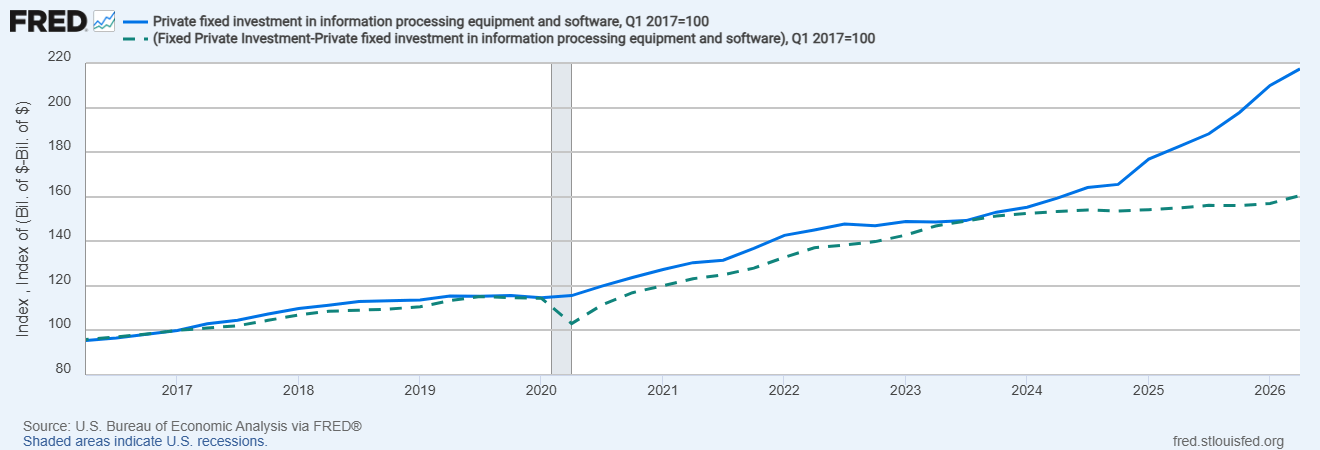
AI investment continues to grow while all other private investment barely creeps up in the past few years:

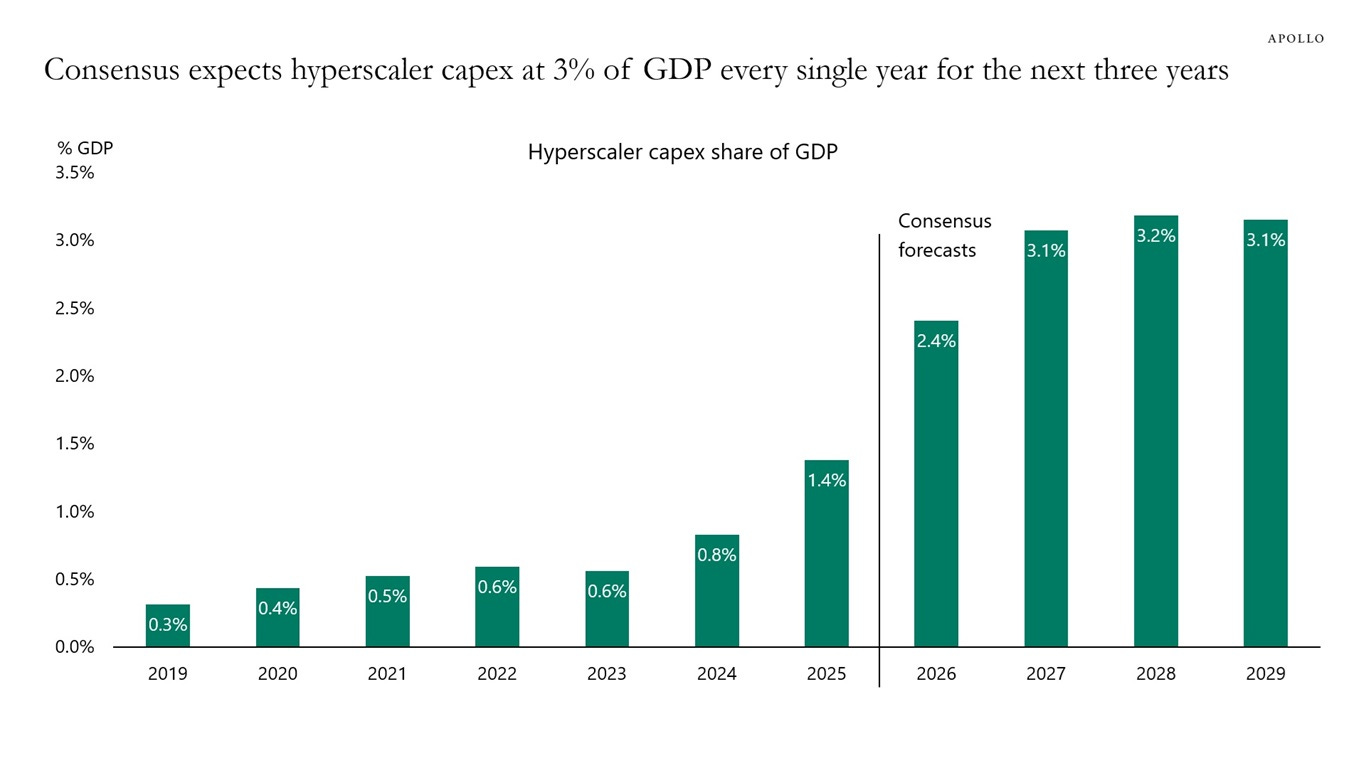
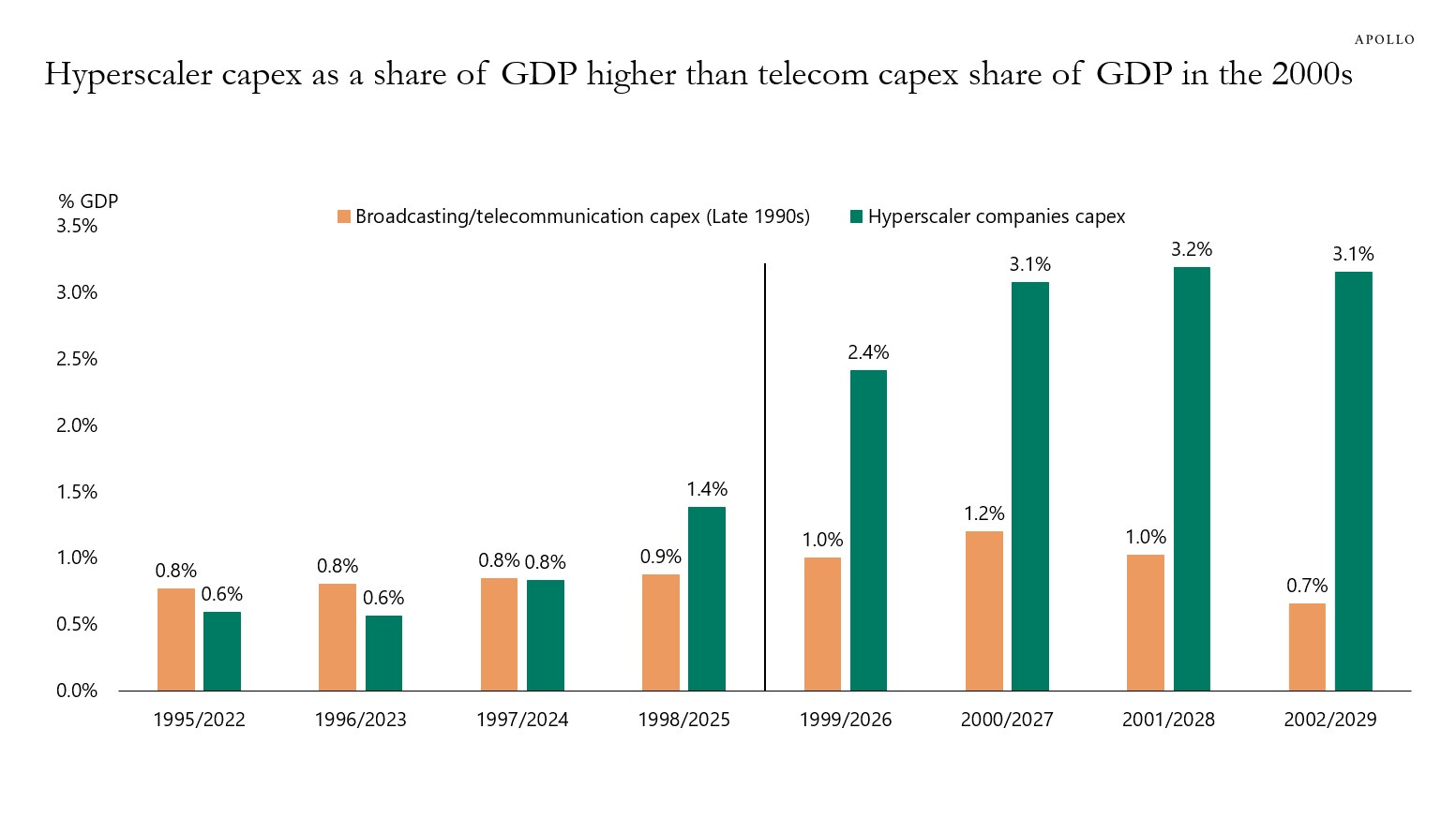
And those investments are very large:
FCF & leverage
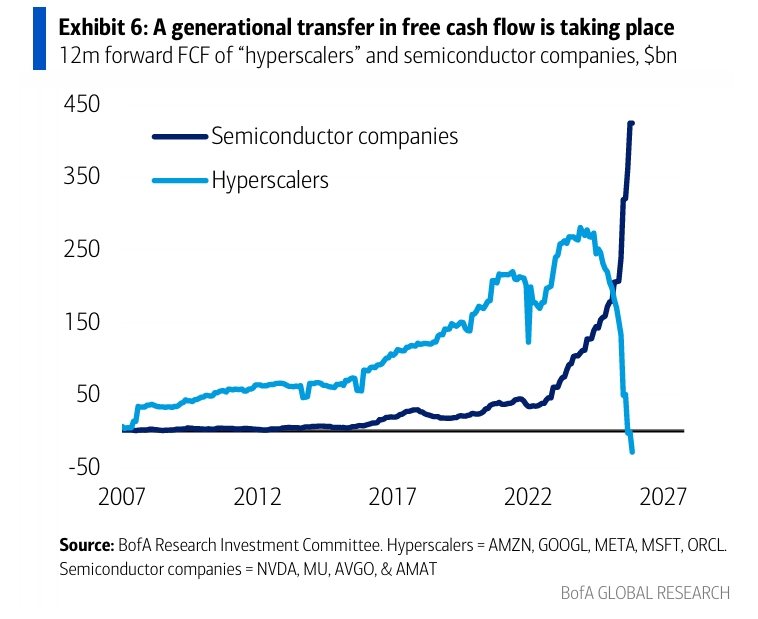
You may have seen this chart circulating about a month ago:
Here is another:
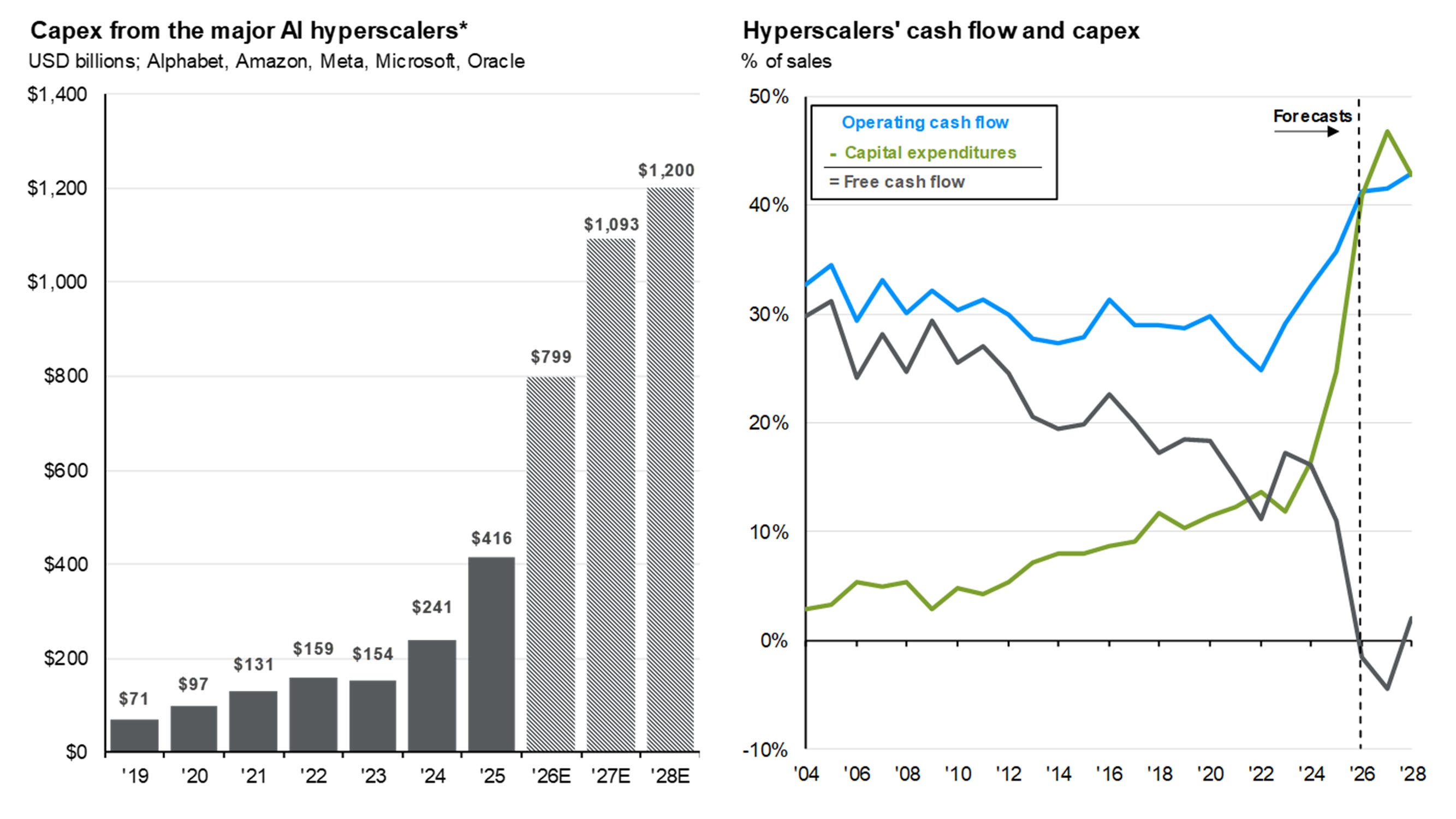
Note that these show a projection of free cash flow (FCF) turning negative in the near term for the hyperscalers. Even if it doesn’t completely come to pass, the negative trend is real. And the warning sign for the current beneficiaries of the hyperscalers’ spending, semiconductor companies, have to take it as a potential threat since trouble for their enormous customers would be a big concern for their profits.
To fund their ever-growing need for more compute, the AI firms are turning to the bond market.
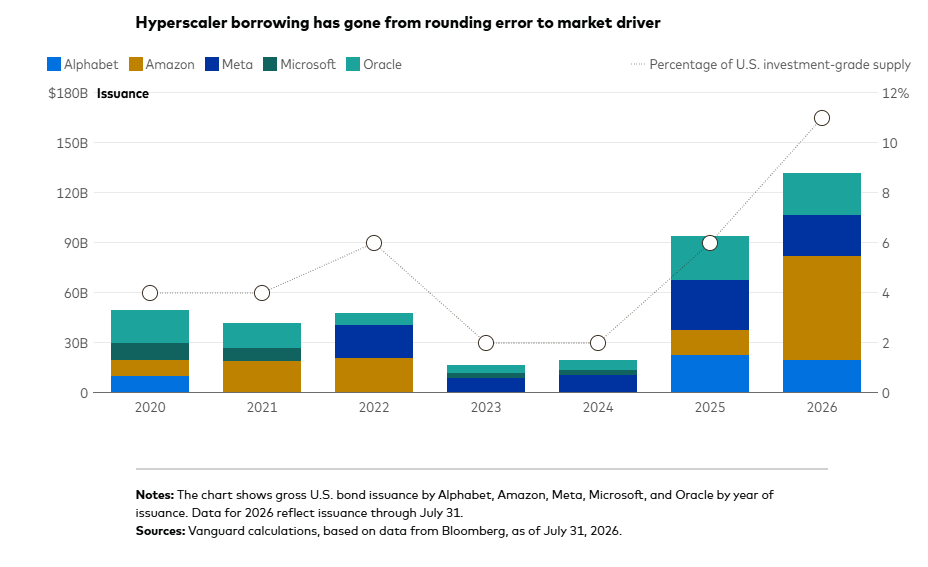
Now class, what does leverage do? That’s right, it adds risk. A firm funded by equity that comes into trouble has more options than one funded by debt. The more debt, the fewer options when conditions get tight. Stockholders can be told to wait. Bondholders get paid first. Leverage creates a shot clock effect where the buzzer means abrupt bankruptcy risk.
In a sensible world that is all fine—it is part of the bargain. But we do not live in a sensible world. We live in a world where powerful people, bondholders and stockholders, don’t have to take their lumps and walk away. No, they will paint dire pictures of “systemic risk” and calamity to befall all mankind if they don’t get help (i.e., a bailout). Which is just one side of the same coin (horseshoe theory for the win yet again) emerging from . . .
The Socialist Urge
If there is one thing the more extreme ends of the right and the left agree on it is that government needs to be powerful and engaged with our world including in a way that is socialistic. AI is an obvious threat to government power as well as an alluring possibility of extending its powers. It is The One Ring of our day.
As Cato’s Jennifer Huddleston writes,
President Trump is exploring ways to give the public a financial stake in leading AI companies. Sen. Bernie Sanders (I‑Vt.), meanwhile, has gone much further, calling for the government to own half of the largest AI firms and to receive board representation.
So my hypothesis is AI firms fall on difficult times most likely just because the cash flows and profits cannot keep up with the expectations. Because of the leverage they have taken on, this becomes a more substantial risk than just a typical revaluation.
Add to this that these very large companies’ very high valuations put them at risk for a substantial drawdown. The headline result is a steep fall in the S&P 500, et al. Most people are in fact investors, and most investors have a lot of exposure to these companies. This will not be happy times.
Add to this that Trump evaluates himself by capital market performance more so than is typical. Partially this is because we all evaluate government in light of capital market performance to a degree (and that is somewhat appropriate). In the case of Trump however he puts undue emphasis on it.
Add to this that Trump may see this as a way to consolidate power via AI ownership and that the rest of the political class won’t disagree with the strategy even in the cases of those who don’t want Trump or the right in general to be at the helm of it. They logically expect they themselves will one day be on the throne; so it is a pill worth taking.
Add to that the fear factor that AI companies themselves have been propagating. The American public is fearful of AI, and chaotic, negative turmoil won’t ease those concerns. In times of extreme stress, the people have a bad habit of looking to the powerful for simple answers.
In which case for all of this . . . have a nice day!
To be sure, it is not altogether clear what this hypothetical story would mean for existing equity investors (shareholders and management) of AI firms. Do they take a massive haircut? Get wiped out? Are themselves bailed out with immediate rescue by Uncle Sam as the buyer keeping the firms’ prices from collapsing? The same can be said of bondholders.
All of this is anyone’s guess, but mine would be IF this plays out, it won’t be pretty.
I put my likelihood that this hypothetical is substantially realized at 5-25% depending on severity (more severe realization is less likely). And my confidence in the narrative is only about 50%. By this I mean I can be right about some or a lot of this and still have gotten it completely wrong, or I can be wrong on all counts.
To understand how likelihood and confidence work an analogy would be I think there is a ~100% chance the sun will rise tomorrow and I am ~100% confident in that prediction whereas perhaps I think there is a 25% chance the Erdős conjectures in mathematics will be solved in the coming decade but I am only 10% confident in that prediction (there is strong reason to doubt my grasp on the subject such that my 25% prediction isn’t worth much). Another way of saying it is how much money would one risk (confidence) on a fair bet where, for example, a fair bet on a 25% likelihood is a 4:1 payout if correct.
Please do not confuse any of this with investment advice.
Other forms of fascism are also having a moment, but that even uglier part isn’t germane to the narrative above.