

This post is side one of a joint, two-sided argument supporting housing reform. The message today is that IF reform has costs, those costs are manageable and temporary. The message of the other side (that I offer in a subsequent post) is you don’t want what you may think you have a right to.
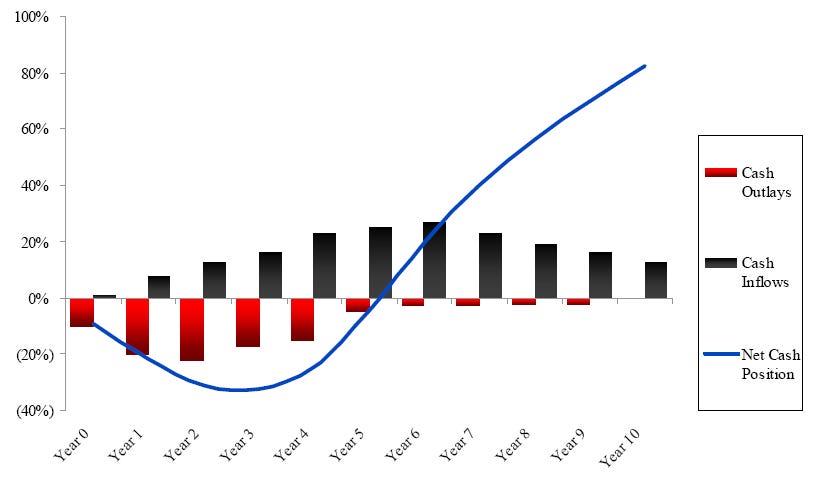
There is a well-known phenomenon in private equity investment called the “J-Curve”. In short this is the behavior of the net cash flows or returns over the life of a fund (typically 10-12 years) whereby the initial years have more outflows than inflows due to capital drawdowns, operating costs, and management fees. After this period, it is hoped that the operational improvements and valuation appreciation start contributing more and more to overcome this initial decline. When the investments are successful ultimately with profitable exits, this gives rise to the upward slope to complete the J-curve.
Here is a stylized charting from Wikipedia:
I would like to use this concept to introduce an analogous J-curve, local-maximum problem for housing prices elaborating on how problematic this could be for the cause. Nat Eliason has a succinct explanation of the local-maximum problem for those who need a refresher.
Who is the oppositional audience?
NIMBYs come in many flavors. Some simply think they have an ephemeral property right in other’s actual property. Before we can confront this mistaken understanding of how property rights logically work in principle, we face the obstacle that they probably don’t care because the supposed negative outcome for them helps blind them to having such a conversation. And to be frank, if I can just get them over their fears, the battle is probably won. Which is good because they probably aren’t capable of having the more nuanced, ethics conversation about rights anyway.
This is similar to my battling against drug warriors in the drug war where fears of bad outcomes trump any concerns or appreciation for a rights debate. I firmly believe that principle comes before pragmatism, but most people effectively see it the other way. So I think I’m stuck arguing the practical side in most of these type of debates.
That is not to say the task is any easier. My J-curve approach is the best I can offer those who fear reform means they lose. It takes some vision by the opponent, and perhaps the J-curve concept is concrete enough they can believe in it. So I am assuming some degree of good faith and numeracy on the part of those I seek to convince.
To be sure, I am conceding ground by starting with this approach. I don’t actually think most reform has tangible, negative outcomes in reality. Many reforms just make things better from the start (where better means both for the existing homeowner as well as the market overall), and often the feared impact is illusion—your home’s value can only be impacted by negative externalities within small limits. Are you sure the current world is optimal such that anything that might change in the surrounding area is significantly negative for you? Do you not believe positive externalities exist including many not yet brought to fruition? Again, some people are just too innumerate or illogical to have a reasoned debate with. This is for the others.
Beyond the truly superficial like “it will be loud when they build a house next door”, people opposed to reforms like dezoning and greatly reduced regulatory obstacles genuinely fear these will harm them economically including in aesthetic value. This is an effort to meet people where they are—a starting point with the (perhaps bad) assumption that reform (change) means hardship.
The housing version of the J-curve
The message of the housing J-curve is simple: In most cases it has to get worse before it can get better, but it will get better. The research literature actually points in the opposite direction tending to say that prices increase from deregulation and then come back down over time (a reverse J-curve from the point of view of current homeowners who want to maintain their properties’ values). For example, consider the cost from permit regulation where it has been shown land preapproved for development commands a strong premium over land not yet permitted for development. Reduced regulatory burden should and does increase the value of the regulated asset. This is the demand effect coming before the supply relief—see below for more on this.1 But there are two important caveats to keep in mind.
First and apropos to this post, the opposition I am targeting don’t see it that way. Second, we haven’t really had an experiment like we’ve been running for the past three decades where we progressively made additional housing illegal plus made wide swathes of mortgage access illegal. To wit: recent experiences in Austin, where housing has been greatly expanded, et al. look more like the J-curve I am proposing. I think where we are today creates a new situation where this J-curve effect will potentially come into play.
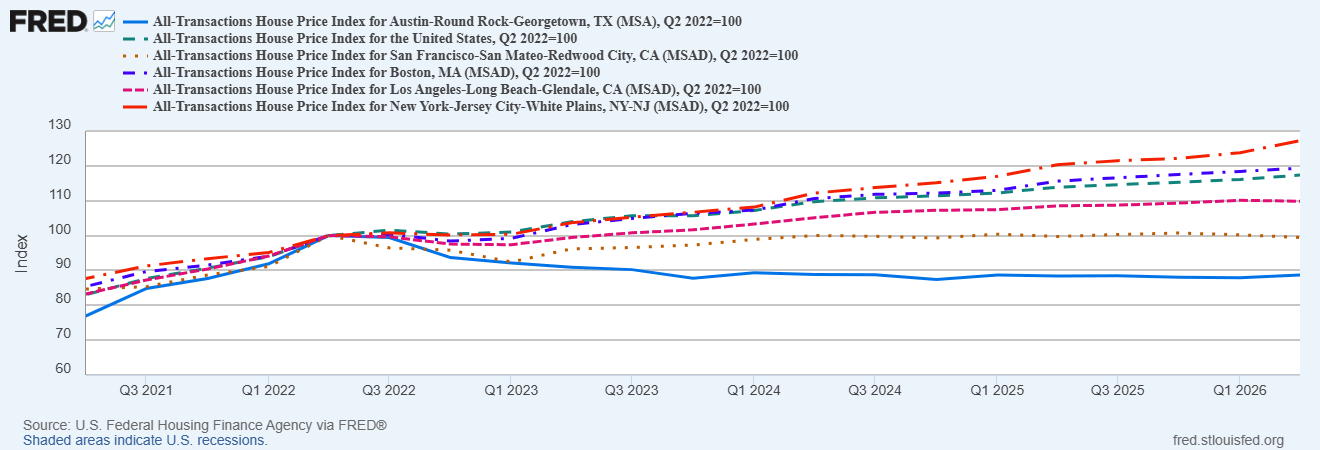
The hypothesis is that prices for existing housing initially fall with the disruptions that come from new developments and their immediate increase to supply. The argument concedes that many of the limits on development do work to keep property values up artificially when viewed in isolation from the growth effect. Simply by limiting supply competition, the price is higher than it would otherwise be, ceteris paribus. But all else is never held constant in the real world. In the not-so-long-run the growth effect comes to completely dominate the disruption effect.
We cannot and should not ignore the growth effect. Doing so is falling for the local-maximum trap. Only considering that the first step is a degression is being shortsighted. It prevents the change that unlocks even higher, better outcomes.
That better, now-possible world is the correct aspiration. Stagnation is not. Part two will have a lot more on this, but it can be fairly easily seen if you try. We don’t have to imagine it, evidence is all around us. The highest property values are attached to the most desirable places both within cities (best neighborhoods) and among cities generally. And this point of view has plenty of room for preference variation. The key isn’t density or agglomeration or all the little things zoning presumably attempts to keep sacred and safe including anti-density. It is simply allowing supply to meet demand with an appreciation for Say’s Law2 (supply creates its own demand).
Before NIMBYs object “don’t [thing they don’t want] my neighborhood”, they should understand that this isn’t arguing a 20-story condo is going up in suburban Oklahoma City. Nor is the idea that your house on the edge of town with five acre lots as far as the eye can see suddenly is going to get fifty starter homes popping up. Nor is it assuming a Section 8 apartment complex is going to be built in the middle of [insert wealthiest local neighborhood]. More of the same but better is almost always what actually gets developed. The zoning rules and other constraints aren’t the only thing holding back local upheaval.
It is actually really hard (and not just for the raw profit-loss reasons) to drastically change the composition of a given place. Culture is sticky. Things like this might happen. And certainly small, creeping changes will occur. But no one promised you nothing will ever change. Just because you moved to the country doesn’t mean you own the entire country—true for “country” in a nation sense as well as a colloquial term for rural living. The city came to you is a tale as old as time. The cost is either dealing with the new surroundings or selling to move farther out. The good news is the compensation you’ll get for the transition is now likely much higher than before. See the next post where I touch upon this more principled point of view with a practical spin. It should help alleviate the dread you have about what change might look like.
The J-curve might be an extreme case
Kevin Erdmann often writes about the complexities in housing economics such as how the demand response to deregulation can have an initial impact that raises values. Likewise, M. Nolan Gray offers some alleviation for my J-curve concerns. He offers a rich, nuanced perspective leaning on the actual experience and the research. The addition of housing stock might simply sustain valuations while helping in aggregate. This is certainly in keeping with the research.
Some of this is the compositional effect, a form of Simpson’s paradox [footnotes excluded from the excerpts below]:
From a composition effect perspective, the home-value NIMBY shouldn’t care either way, except to the extent that the new housing creates a disamenity that makes their home less desirable. Yet this disamenity would need to be high enough to offset the increase in land value associated with the market discovering that higher-density housing is legal and feasible on the homeowner’s lot.
This probably explains why the empirical literature finds that building market-rate apartments near existing detached single-family homes variously has either no effect on the latter’s price, or even a small positive effect. It is thus entirely possible that building new housing can lower overall housing prices without necessarily lowering the value of any given existing housing unit.
And some is the interaction of two other effects especially in a gentrification situation:
When new housing is built, it has two effects: On the one hand, it has a demand effect. That is to say, it drives up demand to live in a neighborhood. New units draw in new households at higher incomes, who in turn make the neighborhood nicer by patronizing good restaurants, calling 311 about disorder, and demanding better public services. This in turn attracts more demand, which could raise prices in the area.
. . .
The good news is that development also has a supply effect that mitigates the unwelcome aspects of gentrification. By absorbing the demand that was heading to the gentrifying neighborhood either way, new development provides new arrivals with a place to land, thereby reducing price pressure on the existing housing stock. Hence Noah Smith’s classic characterization of new market-rate development in gentrifying neighborhoods as “yuppie fishtanks.”
Which effect wins out? The weight of the evidence suggests that while the demand effect is real and shouldn’t be casually dismissed, the supply effect ultimately wins out. 11Yes, new development changes neighborhoods and increases demand; but by bringing new units online, it concurrently absorbs enough of that demand to keep prices under control and ultimately reduce displacement.
In the short-run the demand effect might very well dominate until the supply effect could be fully realized, which would militate my J-curve model.
Maxwell Tabarrok makes an adjacent point in this post discussing the different effects from adding housing and adding roadway.
First of all, it might not be true that demand for housing is inelastic, especially in particularly desirable cities. Indeed many models predict that housing prices rise as housing supply expands. This is because, through some combination of higher labor productivity, easier access to goods, knowledge spillovers, high fixed-cost amenities, and larger social networks, which economists summarize as agglomeration benefits, each person’s own willingness to pay to live in a city rises with aggregate demand. Being the marginal entrant to 200,000 population Sioux Falls is worth much less than being the marginal entrant to a 10,000,000 population NYC. Duranton and Puga predict that expanding housing supply to add 8 million residents to New York City would increase housing prices because of how much higher incomes would be (with a large net increase in welfare).
Consider what I am constructing here to be a theoretical bad-case model to show that even with this assumed to be true (that there is a J-curve effect), the end result really isn’t that worrisome. At an extreme level of development, I believe my model would in fact come into play. At the more modest and sadly small levels we actually get to hope for, Gray’s version likely dominates.
Substacks mentioned:
This should look either like a strange puzzle or a complete mistake to a student of basic economics. How can an increase in supply lead to an increase in price? It is not because demand went up—it did not. The increase in quantity from increasing supply would be an increase in quantity demanded—movement along the demand curve. And that should mean price goes down if demand slopes downward. The puzzle is solve upon realizing the demand curve is shifting outward as well probably from an investment substitution effect. The returns from housing investment are now higher relative to alternatives. In fact, the demand shift probably comes before the supply shift, which makes sense because lower regulatory cost doesn’t create supply as much as it invites it.
Say’s Law is more than the obviously true version of the classical economic principle that the production of goods and services generates the income and purchasing power necessary to create an equivalent demand for other goods and services. It includes that supply unlocks and creates demands we didn’t know existed before. I think I get the pithy version from Mike Munger (paraphrasing perhaps): “Until ten minutes ago, I didn’t know this existed, and now I cannot live without it.”