

I will start with the good news before the bad surprises.
I. Oil
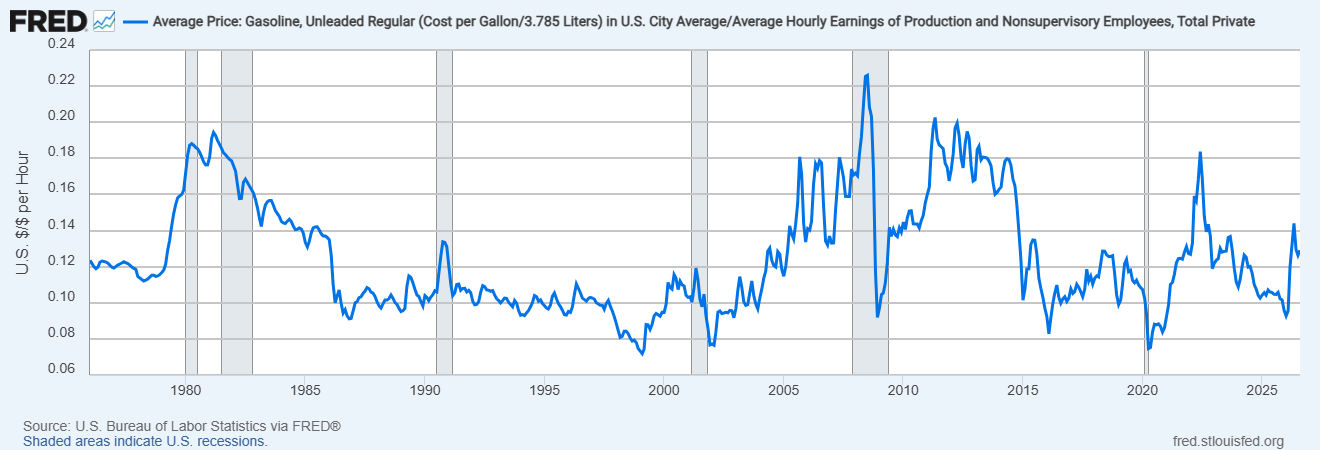
The current bump notwithstanding, Gale Pooley reminds us that the real price (cost) of oil continues on a long-run decline.
The true price of oil is measured in time, not dollars. In 1900 oil was only $1.19 a barrel, but blue-collar workers were only earning 14 cents an hour, putting the time price at 8.5 hours. In 1900 oil cost less in dollars, but much more in hours. The time price eventually fell to just 0.46 hours in 1970. Then OPEC showed up and pushed the price to over four hours by 1980. The price fell back to 0.7 hours in 1998 and then back up to 4.14 hours in 2011. Today the time price is barely over two hours, nearly half the 2011 peak.
Almost no one falls for the mistake of thinking something like oil was actually cheap in one’s grandfather’s day. “In my day a gallon of gas was a quarter . . .” is almost always followed by, “Yeah, but what is that adjusted for inflation?” As Pooley’s post and larger body of work shows, that is just half the battle. The better way to look at it is adjusted for wages.
While grandpa’s complaint is rightfully brought into perspective, how many would realize gasoline today is still about half as expensive as it was 15 years ago?
II. Housing
America’s housing market does not have good news to share. Not too surprisingly but still a surprising statistic, is shared by Joey Politano:
In 2025, Americans spent more money on home improvements and renovations than on building new single-family homes — a historical first, excepting a brief period during the Great Recession. Total renovation spending now exceeds $430 billion per year, an increase of 36% in inflation-adjusted dollars over just the past decade.
The entire piece contains many shocking stats.
III. The DSA’s Proposal for Government
Adam Michel offers a stat two-for-one:
In the US, federal, state, and local governments spent almost 40 percent of GDP in 2024. The average across the European Union is 49 percent, ranging from 58 percent in Finland to 22 percent in Ireland.
Using the lower-bound estimates, the DSA agenda would raise US spending to more than 57 percent of GDP. Among large, industrialized countries, only Finland would have a larger government. France comes in a third of a percentage point under the US’s low estimate. Add the high-end estimates, and US government spending would reach 92 percent of GDP.
No comparable country on Earth spends anywhere close to that amount. The DSA agenda’s spending could give the government a claim on national output much closer to estimates of state control under Soviet-style communism than to today’s European welfare states.
And:
The DSA suggests that the richest Americans and corporations will pay for all these new outlays. The problem is, there simply aren’t enough resources at the top to make this plan work.
The 400 wealthiest Americans were worth a record $6.6 trillion in 2025. Confiscating all of their wealth would cover only about 9 percent of the low-end revenue requirement and 3 percent of the high-end estimate. Their wealth could be seized only once, and attempting to liquidate trillions of dollars in assets would, in turn, drive their value down.
Domestic corporate profits after federal taxes are projected to be about $35 trillion over the next decade. Seizing every additional dollar of corporate profits would fund half of the low-end estimate and 17 percent of the high end. This also assumes that firms continue operating normally while the government takes every cent of profit. Without a profit motive, businesses would cease to exist.
The tie-in for these is that oil is more expensive than it has to be as a result of the war in Iran, but fortunately free-market capitalism has provided cushion from this blow.1 Housing markets have not been allowed to function freely. As a result we have perverse outcomes like those Politano illustrates. And if you like what government intervention into oil and housing markets has created, you’re gonna love what the DSA has in store for us.
Substacks mentioned:
Liberty Taxed: A Blog on US Tax Policy
To be sure the war and actions from both sides are an attack on what free markets strive to provide—mutually beneficial gains from trade. The desirability of conflict must be weighed against this cost. And the beneficial position our historical economic success has generated should not be used to justify conflict.