

We start with the wonderful decline in infant/child mortality as captured in the animation on the Substack of Steve Stewart-Williams. The link has a lot of other interesting stats and facts. Below is a screenshot of where infant/child mortality was in Africa in 1950. Click through to watch the rate by country basically cut in half and then in half again.

It is refreshing and surprising to see how far we’ve come in so short a span of time.
We live in a time of abundance as most importantly seen in the link above. You can also witness it metaphorically and literally by looking at light.
The light that cost 10,800 seconds in 1830 costs only 0.0735 seconds today. The time price has dropped by 99.99932 percent. For the time it took to earn the money to buy 1,000 lumens for one hour in 1830, workers today earn 146,980 hours of light today. That’s a 14,697,900 percent increase. Light abundance has been increasing around 6.3 percent annually on a compound basis, doubling every 12 years.
That is from Saul Zimet at Human Progress. It is hard to overstate the importance of being able to overcome darkness.
Here is more good news:
The FBI will likely report the lowest murder rate it has ever recorded when the Reported Crime in the US for 2025 comes out in the second half of 2026.
That is from Jeff Asher at his Substack. This decline in murder is seen not just in the United States as London had a record low 97 homicides in 2025.
Still more good news: Poverty in the U.S. is probably a lot lower than you probably think it is.
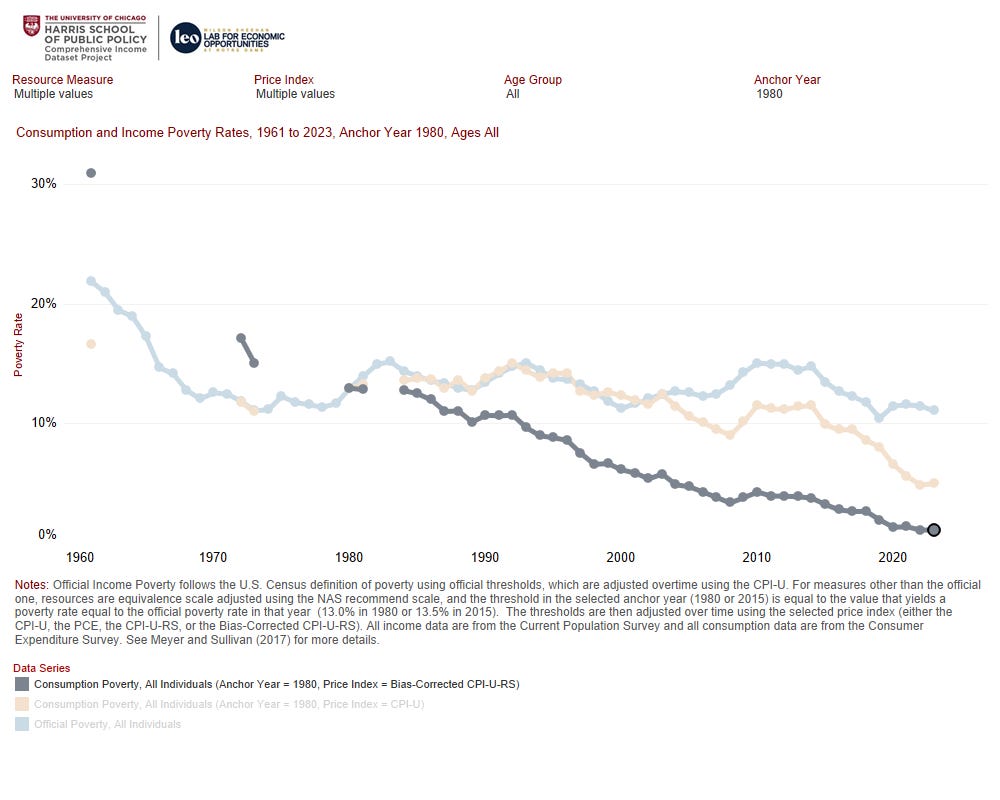
When measured by consumption, the much more appropriate method of assessing poverty as opposed to income especially given our generous welfare state, the poverty rate in the United States is a very minimal 2.4%. It should be noted (1) that this is still a representation of a lot of people not enjoying as much consumption as we would like for them to have, but also (2) that it represents a level of consumption much of the world would find to be quite desirable.
The source for that is Timothy Taylor relating finds from the Aspen Economic Strategy Group.
Another source, PovertyMeasurement.org, finds the figure of consumption poverty is about 1.1%. This was part of a great post in The Free Press by Cliff Asness and Michael Strain. I believe the differences between the two lies in the inflation adjustment. Regardless, this is great and perhaps surprising news. I share the chart of this progress below.
Lastly, you may have heard that the U.S. income level poverty line starts at $140,000. That would be surprising news for sure. Fortunately, it is completely wrong as thoroughly debunked by Scott Winship, Jeremy Horpedahl, Scott Lincicome, and Noah Smith among many others.
Substacks referenced in this post:


