

We begin with Alex Tabarrok on “Colorado’s Funeral Mistake”.
This one starts as a surprising stat and then transitions into a pithy quotable.
Today about a quarter of the US workforce are required to have a license to work in their chosen profession, up from just 5 percent in 1950. Almost always the trend has been to add occupational licensing over time, but in 1983 Colorado did something unusual: it delicensed funeral service workers such as funeral directors. Brandon Pizzola and I analyzed what happened in our 2017 paper, Occupational licensing causes a wage premium: Evidence from a natural experiment in Colorado’s funeral services industry.
What we found was that delicensing reduced wages, reduced prices, and caused a shift towards cremation rather than the more expensive mortuary services preferred by funeral directors.
. . .
But that is not the end of the story. In 2023 a series of gruesome abuses came to light involving the sale of body parts, rotting bodies, and worse. Newspapers repeatedly noted that Colorado was the only state not to license funeral service workers. As a result, Colorado is relicensing funeral service workers as of 2027.
The problem is that there is no evidence that abuses were worse in Colorado. It’s easy to find similar abuses—including sexual abuse of corpses—in states with heavy licensing.
. . .
People want what cannot be guaranteed: good behavior in all circumstances. And they will reach for a licensing regime if it promises that, even when such promises are empty.
Next comes a positive story of improvement from Innovate Animal Ag (HT: Human Progress):
Original research conducted by Innovate Animal Ag shows that as of June 1, 2026:
40% of the EU’s commercial egg layer flock was sexed with in-ovo technology–a 6-point penetration increase from April 1, 2025.
Since 2021, over 281 million male embryos have been removed before hatching globally.
In Europe, in-ovo sexing technology has reached a production rate of 100 million female chicks per year, climbing from 500k chicks per month in 2021 to well over 8 million female chicks per month by the publication of this report, a CAGR of over 75%.
In-ovo sexing is beginning its market-based rollout in the US with over 4% of the country’s commercial layer flock having publicly announced a transition to use the technology as existing flocks are retired.
In Switzerland, where in-ovo sexing technology kicked off in 2025, in-ovo sexing penetration climbed rapidly and now sits at around 85 to 100% of the country’s layer flock. In Norway, in-ovo sexing has hit a 52% market penetration.
The global penetration of in-ovo sexing is forecasted to continue its sharp growth in the next few years, led by expansion in the US, continued strength in Europe as a consequence of Italy’s ban on male chick culling, growth in markets where the technology has recently entered such as Australia and Brazil, and potential penetration into greenfield markets like Canada and China.
This is a very significant and morally-relieving trend. For those who don’t know, for both layer chickens, those used for egg production, and broiler chickens, those eaten for meat, males hold no value. Hence, they are culled at hatching—billions each year. Often this involves tossing the newly emerged baby chick into a shredder. By being able to sex-determine the chicks before hatching, the male embryos are removed before developing.
While you might not have known that baby chickens were being brutally slaughtered like this, you probably do “know” that AI datacenters use lots of electricity—and are worried about that. Good news, a little bit of perspective courtesy Our World in Data might alleviate your concerns:
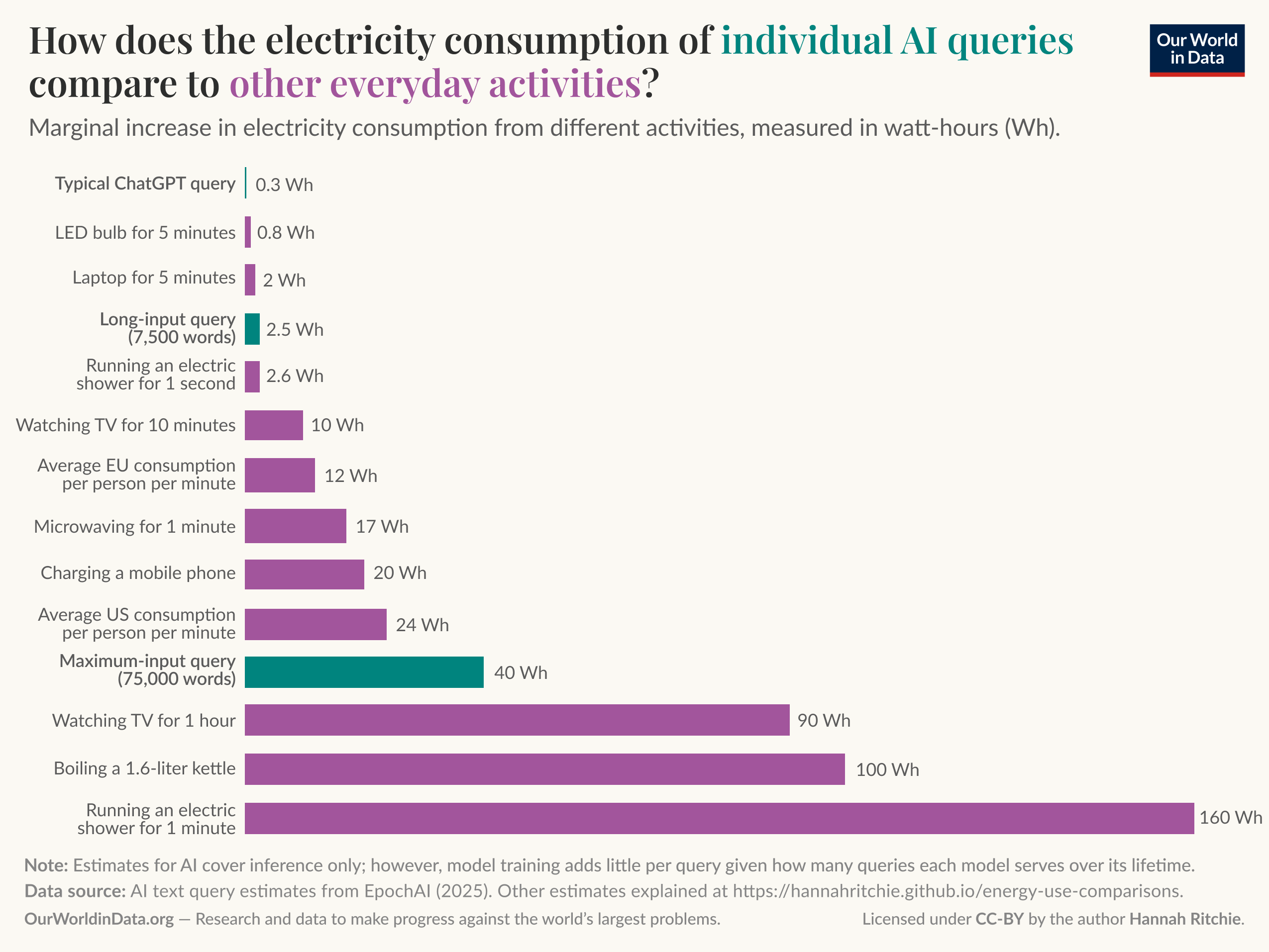
So unless you’re ready to go to the barricades to protest hot showers, TV viewing, and microwaving popcorn, you should probably relax regarding AI electricity use.
Finally, this from Jeremy Horpedahl regarding the cost of air travel doesn’t surprise me, but it may surprise some [emphasis added]:
In 1970, a roundtrip flight on Pan Am from New York to London was $420. First class was $750. To put those numbers in context, the average wage in 1970 was $3.40, meaning it would have taken 124 hours of work to buy the coach ticket, and 221 hours to buy the first class ticket. The average wage today is $32.31, meaning that the coach ticket is the equivalent of almost $4,000 today, and the first class ticket is over $7,000.
A theme throughout this post is that things are getting better if we let them. Encouragement takes a delicate, nuanced touch, however. Just simply trying to legislate it often fails as in the case of licensure (first link above) or regulation (hidden implication in the fourth link since removal of regulation led to this improvement). So too might it in the case of animal welfare (second link). Forcing change upon the food industry could simply lead to supply chain changes to even worse conditions, which would be bad for animals,1 or reductions in food supply, which would be bad for humans and maybe bad for animals considering the substitution decisions that might result.2 And do we really want to retard the innovation that promises medical advances previously only dreamed of (the third link)?
For example, keeping male chickens alive where all the birds are in worse shape than is currently the case or moving production to places with lower standards of care for animals.