Commenting on the economic miracle unfolding in India, he writes,
Moreover, India is now growing faster than China. At 6% per-capita growth, living standards double every twelve years. Another decade and a half of this and India is a $20,000-per-capita middle-income country, looking more like today’s Brazil or Mexico than the India of Mother Theresa.
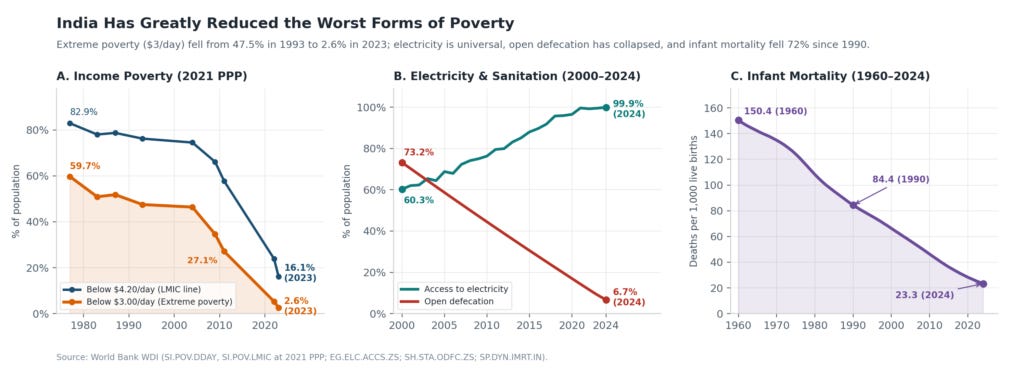
Indeed, India’s growth has already greatly reduced the worst forms of poverty, as China’s growth did previously. Extreme poverty in India fell from 47.5 percent in 1993—and 27.1 percent as recently as 2011—all the way down to 2.6 percent in 2023 (using the World Bank’s extreme poverty line, $3.00 a day in 2021 PPP). Hundreds of millions of people climbed out of destitution in a single generation.
A regulation that raises gasoline prices makes people angry but when regulation prevents an industry from ever existing, most people never learn what they lost.
Consider nuclear power. Overnight construction costs for early U.S. demonstration reactors fell 81 percent between 1954 and 1968. For reactors begun between 1967 and 1972, costs rose 187 percent. The 1971 Calvert Cliffs decision and then the reaction to Three Mile Island in 1979 accelerated the cost increases and slowed construction even more.
What might have happened had the earlier learning and deployment trends continued? Peter Lang’s 2017 paper in Energies estimates that nuclear power would have cost about one-tenth as much by 2015. The additional generation could have avoided as many as 9.5 million premature deaths.
This is part of a larger point about the hidden but very real costs of delayed and prevented development. Tabarrok is discussing Niko McCarty's recent piece in Works in Progress where microbes are the main subject. Both are worth reading in full including watching Tabarrok's short video version (below and in his original post).
Magnitude Matters is a reader-supported publication. To receive new posts and support my work, consider becoming a free or paid subscriber.