

I.
We start with Alex Tabarrok.
In 2024, for example, one individual alone submitted 20,089 complaints, accounting for 25% of all complaints! Indeed, the total number of complainants was only 188 but they complained 79,918 times (an average of 425 per individual or more than one per day.)
What I learned recently is that it’s not just airport noise complaints. We see the same pattern in data from the US Department of Education’s Office for Civil Rights which enforces federal civil rights laws related to education funding. In 2023, for example, 5059 sexual discrimination complaints came from a single individual–from a total of 8151 complaints. Thus, one individual accounted for 68.5% of all sexual discrimination complaints in that year.
In the first case he’s talking about noise complaints at Reagan national Airport. So he is making and I am echoing a complaint about complaining. Or more accurately, we are complaining that we should not let the squeaky wheels have so much influence.
The granting of veto power from vocal, vested constituencies contributes strongly to development problems. These range from energy development (opposition to solar, nuclear, etc.) to housing development (NIMBYs) to immigration (xenophobes).
Everyone’s opinions matter (to a degree). But almost no one’s opinion should be unduly powerful much less decisive.
II.
When the complaints get strong enough, the proper answer is often exit rather than voice. And many are reasonably accepting that as pointed out by Jason Sorens:
Some of these rates are quite large! New York, for example, is losing fully one percent of its population to other states every year, on average. At the other extreme, Idaho, South Carolina, Montana, and Delaware are growing by more than one percent of their population moving in from other states, on average per year.
He is discussing the U.S. Census Bureau’s recent state population data release and the latest version of his and William Ruger’s analysis of it. Their claim is that relative levels of freedom (personal and economic) explain the migration trends quite well.
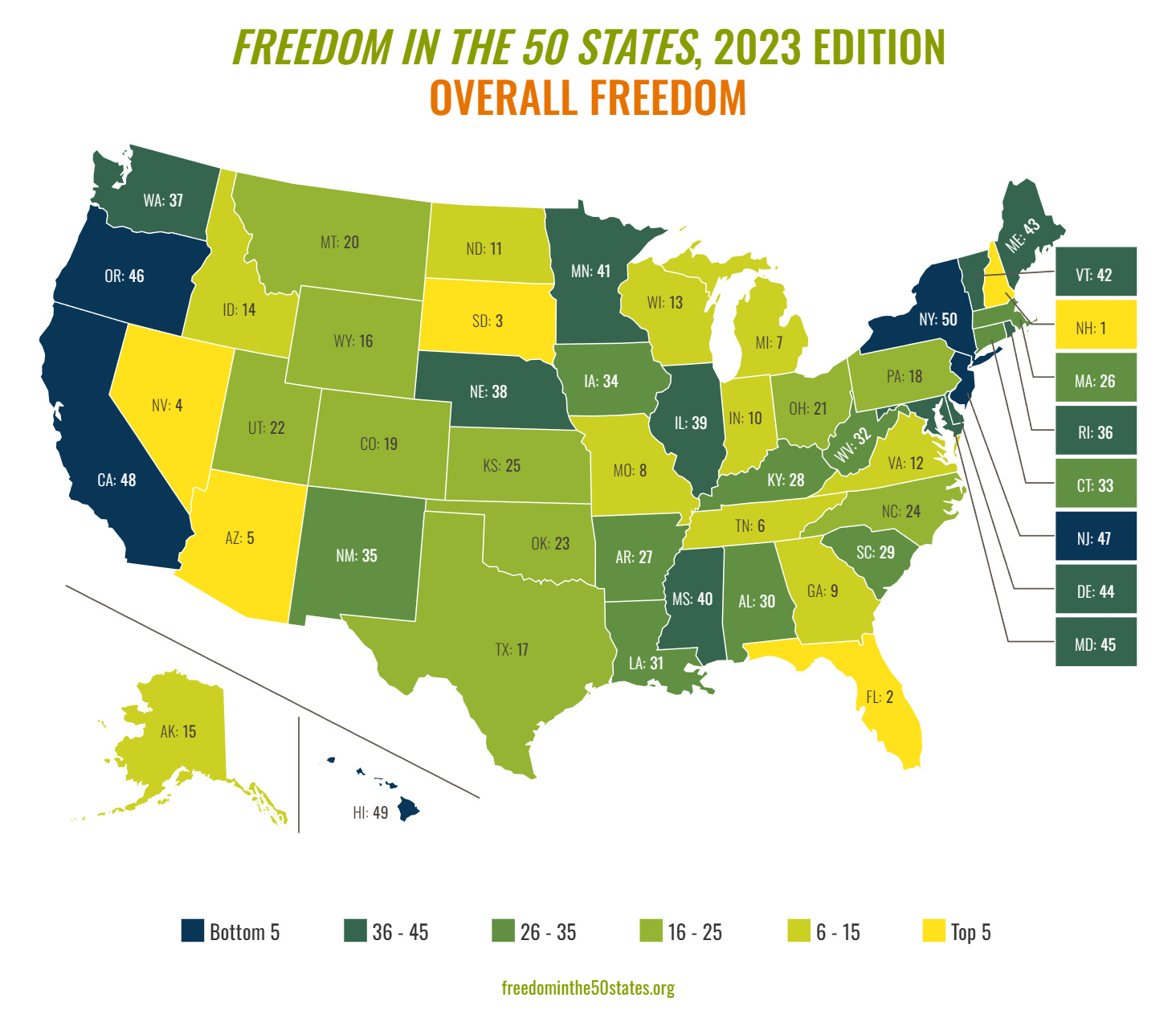
The states as 50 laboratories of experimentation are yielding a wealth of wisdom. If we would only take it to heart letting it guide policy . . .
III.
On the other hand, experiments that should not guide us include non-randomized observational studies on food.
Neither of our pleas changed anything. I asked Claude to estimate how many observational nutritional studies have been published in journals since 2017, limiting to Impact Factor > 2. The answer: 45,000-85,000 studies.
That is from Dr. John Mandrola where he is complaining from authority using a recent study that claims to show that coffee consumption prevents dementia to make a broader point. As he and others scream protest into the vast abyss, these “studies show . . .” keep churning out of the research-publishing factories. The incentive problem is clear: They are rewarded for telling us what we want to hear.
As delicious as the results seem to be, they unfortunately do not stand up to logical scrutiny. As he says,
You should pause there to Stop and Think. Dementia and cognitive decline are highly complex conditions caused by many different conditions, ranging from either vascular disease, bleeding conditions, genetic disorders, toxic exposures or the combination of these. Your Bayesian prior that exposure to one food (coffee) could influence this sea of complexity should be very low.
Another surprising stat:
We at Sensible Medicine had the great fortune to have a discussion with Dr Dana Zeraatkar from McMaster University regarding the way these studies are analyzed.
Her group famously showed using a meta-analysis of meat consumption’s effect on mortality, that there are literally a quadrillion different ways to analyze the data—and doing so yields different associations. Brian Nosek’s group has also shown this phenomenon. [emphasis added]
His conclusion could have made a pithy quotables link:
The three take-home messages are a) don’t be fooled by these studies, b) encourage researchers to resist the urge to perform these studies—especially with taxpayer money from NIH. And c) discourage journals from publishing these studies.
Tying these all together, complainers always have a point. Sometimes those points are valid but insignificant. Other times the magnitude matters.
Substack mention: