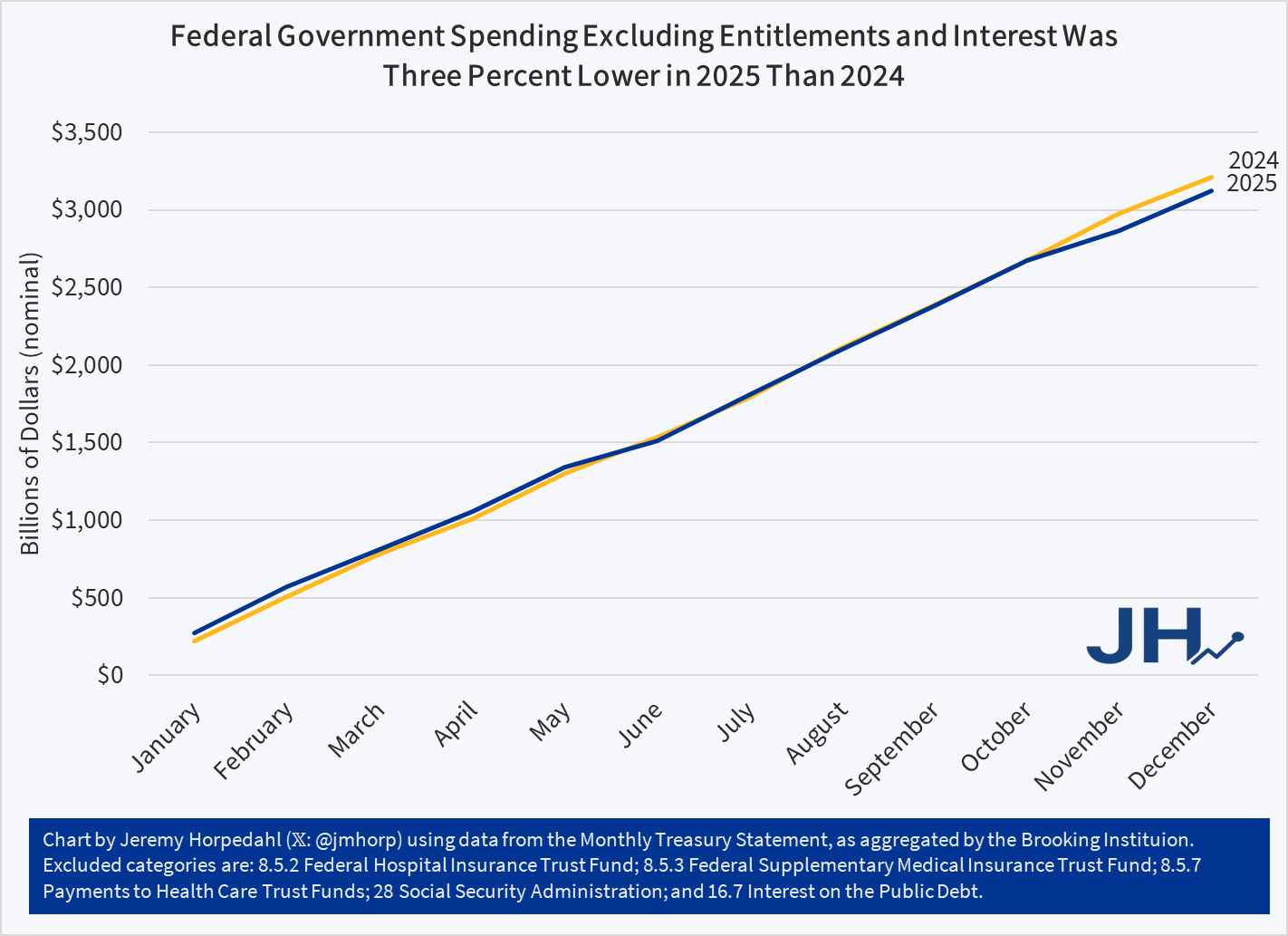
It may be more useful to remove some spending from the equation. In particular, entitlement programs and interest spending are very large spending categories that aren’t subject to the annual budgeting process. Of course, any program is ultimately under the control of Congress, so it’s a little bit of a cheat to remove Social Security and Medicare, but those programs are on autopilot with respect to the annual federal budget process. They are worth talking about, but they are probably worth talking about separately (especially because they have their own funding mechanisms). And interest on the debt isn’t something a President can control directly: it can only be reduced in future years by closing the budget gap today.
Removing those programs — which constitute about $4.8 trillion of the $7.8 trillion in 2025 spending (so a lot!) — gives you this chart:
Federal spending by this measure was about $160 Billion lower in 2025 than the prior year, or about 5 percent. And that’s in nominal terms: it is an even bigger cut if we adjust for inflation.
Horpedahl is answering the question: “Did federal government spending shrinking in 2025?” This is a fair presentation, and one that counts as a win for Trump. Though as he notes in the post, the cuts, which total about $200 billion before accounting for some increases, are certainly one-time hits and low-hanging fruit. The next 5% will be that much harder to find—probably requiring the help of Congress (RIP). And to make even the first 5% last, Congress probably needs to enshrine those executive orders into law. Otherwise the next president can simply restore those categories Trump eliminated with the stroke of a pen.
Biden’s pardons eliminated roughly $680,000 in financial penalties (fines, restitution, and forfeitures) owed to victims or the government. In contrast, Liz Oyer, the former lead pardon attorney of the United States, has calculated that Trump’s second-term pardons have forgiven criminal debts of more than $1.5 billion. This staggering sum—composed of money owed to crime victims and to government treasuries—has been zeroed out by presidential edict.
Neither Greenberg nor I are so much worried about the monetary value, per se. It is simply a signal of how egregious and problematic Trump’s use of the pardon power has been. It has been a very useful tool enabling his scheme of corruption.
All presidents have abused it—read the article for more details. But Trump, true to his character, takes it to new heights. People must come up to him tears in their eyes saying they’ve never seen pardons like this. In the spirit of this post, that thought cuts both ways.
The examples in this brief post are a good microcosm for how I see the Trump administration especially in this second term—small gains at huge costs. To say the juice is not worth the squeeze is quite the understatement.
Magnitude Matters is a reader-supported publication. To receive new posts and support my work, consider becoming a free or paid subscriber.