

This is inspired by a request from a friend and reader.
Minimum wages are perhaps the quintessential example of Bryan Caplan’s pithy axiom, which goes in part: “Governments do the bad things that sound good.”
His own rejoinder to that point is: “Markets do the good things that sound bad.”
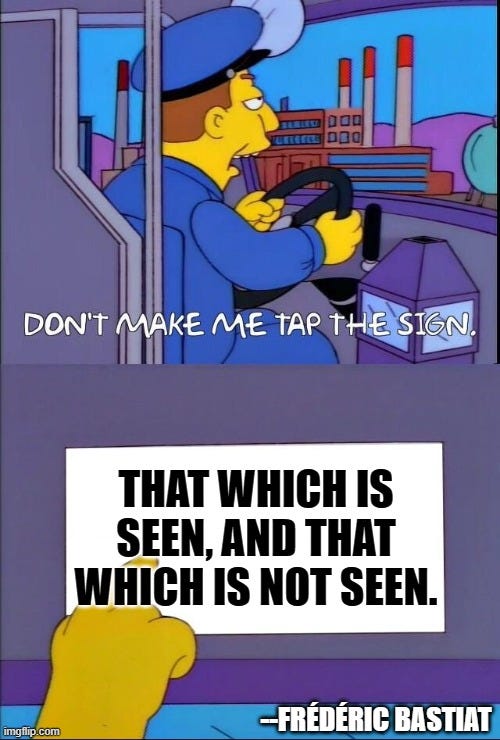
Minimum wages are attempts to achieve good intentions with a tool that doesn’t work in theory and predictably fails in practice. The kicker is that theory is hard (for most people) and teasing out reality in practice is quite tricky indeed (yet again, the seen versus the unseen).
To be sure, I really don’t find this to be a very divisive issue from the standpoint of the style of arguments being repugnant to one side or the other. I think reasonable people on each side will still find the arguments targeted for the other side to be persuasive to them as well. I will allow that those arguments won’t resonate strongly, but they won’t be repulsive. So the instructions below are not as important in this case as others.
Still, as always:
****DON’T READ THE MESSAGE NOT MEANT FOR YOU****
Conservatives Only
The desire for minimum wage laws is driven by a sense of fairness, but this is precisely where minimum wage laws fail.
Before any discussion of the practical outcomes of a government policy, one must first determine if the government has the right to make the intervention proposed. Some good outcomes must be foregone if they are nonetheless illegitimate. The principle that the ends do not justify the means reigns here.
Minimum wages might lead to desirable economic outcomes—the evidence is scant and relies on fairly esoteric theoretical positions that are not likely found much less sustained in the wild. Regardless, our first question is “does the state have the right to prevent two consenting parties from reaching certain employment agreements?”
Historically there has been a great tension in the United States between a sentiment that employers have asymmetric power in the employment arrangement and a fundamental adherence to freedom of association and contract. The push and pull of this ranges from special legal privilege for unions to at-will employment generally and right-to-work specifically.
How this relates to the fairness issue with minimum wage laws is to consider both sides of the employment agreement. Even if there is asymmetric power in the dynamic, that alone should not override either party’s ability to compromise in order to come to a mutually-beneficial solution.
Proponents of minimum wages will take issue with the ability for a mutually-beneficial solution when in the presence of asymmetric power. Let me grant them their premise so as to still show that minimum wages violate fairness and that mutually-beneficial outcomes do emerge at wages below a state-imposed minimum.
The only element of force rather than persuasion in the employment agreement at issue here is when government imposes a minimum wage. The employer might be is greedy in his negotiation. So too is the employee. The employer (I am granting) does have more information and/or power in the negotiation. Yet, the would-be employee is neither forced nor coerced to accept or continue with what the employer offers. That the employer might be able to offer more (in wages), might have to offer more if not for his asymmetric power, or might want to offer more if he knew more himself (see efficiency wages) are not themselves reasons to force him to offer more. His freedom matters more than his bad decision making—bad in either the case of an outcome we might socially want (higher wages for employees) or economically want (if the higher wage at the employer’s expense was better for society in general however that might be defined).
So too is the freedom for the would-be employee. He has the right to make his own contracts. His freedom includes a freedom to make choices that might be mistakes from an outsider’s point of view. This is true even before the very strong argument that the outsider is likely not in a position to second guess the person making the decision. Imposing force even if done for his own good to prevent his right to exercise his freedom of contract is a violation of his rights. Falling back on the assumption that it is in his best interest is fundamentally illegitimate, hence unfair, before the consideration that it is economically dubious.
Yet many will be unpersuaded by this fairness argument. Those opponents are likely in the progressive camp for which the arguments below are crafted. But so as to arm conservatives with the needed armor against such attacks, I offer this.
It takes second-order thinking to realize that hard-to-fire leads to hard-to-hire. It should be, but sadly is not, easier to understand that expensive-to-hire-must lead to hard-to-hire. Price controls introduce economic distortions. Those distortions cannot be assumed away.
NO ONE knows exactly what the economically correct wage should be in each and every general circumstance much less highly specific ones. The more fine-tuned a minimum wage law is crafted, the more absurd it becomes to believe it is accurate. Yet the more general one is applied, the more gaping holes it creates damaging both the economy generally and targeted beneficiaries, low-wage/low-productivity employees, specifically.
Setting one policy for a nation as large as the U.S. quite obviously ignores cost-of-living differences between regions and economic margins between industries. But every step one might add to adjust for important considerations like these adds bureaucratic costs and, more critically, manipulative opportunities to exploit the nuances for personal gain by those with power (assumed to reside with the employers).
This hints at a problem for those who wish to impose minimum wage laws. Consider the oft-made implied argument of “why not set it at $100,000?” This is presented as a slam dunk by those opposed to the minimum wage, but it falls flat. It falls flat not because it is unsound as a reductio ad absurdum, but because minimum wage proponents don’t think that what they are proposing runs into the obvious problem a wage floor that high would create.
So they reject $100k in favor of . . . fine tuning . . . moving it down to a “living wage” without offering much in the way of showing how that doesn’t have the same problems just at a smaller scale. A good reply would be that if you lower the minimum wage low enough to prevent or minimize those problems you eventually aren’t able to help anyone at all. To wit: only about 2% of wage earners fall into the minimum wage category and many are only there temporarily as teenagers.
Here is where proponents inadvertently twist themselves up. Raising the legal minimum wage will at some level start to have the $100k problems. Their task then becomes being able to either live with the damage for the greater cause of forcing employers to pay more or assume both that some magical level exists at which those economic problems don’t exist and that they can determine it—memorializing it into law across time and place. Now that is one hell of a fine-tuning feat.
If they bite the bullet allowing a bad economic outcome and assuming all the burden falls on only employers, they are giving away the game of fairness to accept an outcome that also fails on the economic merits. Thus, proponents of minimum wages quite quickly paint themselves into a very uncomfortable corner.
Presuming a conservative will not be offput by the arguments from a progressive persuasion, I ask they consider also the economic points made below regarding how the economic case against minimum wages includes how it harms the intended beneficiaries.
Leaving that aside, the conservative case against minimum wage laws rest upon freedom first (the ultimate fairness) and sound economics second (a hearty reinforcement).
Progressives Only
The desire for minimum wage laws is driven by a sense of fairness, but this is precisely where minimum wage laws fail.
Minimum wage laws are intended to make fairer outcomes in an unfair world. This is not an unworthy goal by any means. But attempts to do it using various means require that it actually achieve the outcome in order to consider it successful.
Support for minimum wage laws presume a right to intervene in a market outcome—an employment arrangement that would otherwise come into being through mutual consent. Non-consensual arrangements have other laws meant to prevent or correct undesired outcomes. Minimum wage laws are attempts to correct consensual agreements deemed unfair.
Quite obviously the unfair outcome targeted is employees earning less than what is socially desired. By implication the law is imposed to bring about correction. So the key question to ask is “do these laws work for the purpose they are intended?”
The answer, sadly, is no. This problem is not that easy to fix.
Employers are greedy. So are employees, but employers are also powerful. They generally have more information and more tools at their disposal. They negotiate from a position of asymmetric advantage over employees (would-be and current).
And outside observers including government are at a disadvantage informationally even before considering how employers likely have enhanced influence over government policy. Even if employers are not crafting the laws that would regulate them, they are able to legally evade the laws’ intentions by looking to other margins (margins that lie outside of the laws’ necessary limitations) remaining always one step ahead. Thus, they are the clever mouse in never-ending cat-and-mouse game.
But what if we, society through government, could by working harder and smarter close these gaps? Unfortunately, there is another player in this game. A player much more powerful and informationally competent than the employers and even more so than the government: The Market.
The market is not a biased actor here as are the employers, employees, and government. The market is simply the implications of reality. And those implications are where minimum wages however perfectly crafted will inevitably fail—failing for the very people they are intended to help, low-wage employees.
This is the crux of Art Carden’s evidence and arguments in this article. Our desire to help low-wage employees cannot overcome economic reality without cost. Minimum wage laws assume that cost is just a burden put upon employers. It isn’t and cannot be. Even if employers willingly wanted to bear this burden economic reality as imposed by the market will not allow it.
The cost they would incur even if coming directly from their own pockets, would leave employers with less resources and worse information. Consider this analogy: If I wanted to aid the poor to the maximum of my ability, every effort I make to this end (be it explicit gifting of my wealth or devotion of my time) comes at the expense of future resources and abilities to provide aid. If I give enough, I will myself starve.
The lesson is clear: there are always tradeoffs.
Employers do not just want to make adjustments along other margins in the face of forced higher wages (margins like future labor-capital decisions, current work hours, work benefits and conditions, etc.). They must make these adjustments in order to find more profitable outcomes. Before you scoff that they are not the intended beneficiaries so this is not a consideration, understand that their profitability is their current and future ability to employ workers.
Michael Munger provides more along these lines in this article with the concluding quote:
If you care about the people struggling to keep their jobs in a difficult economy, you should oppose raising the minimum wage: it hurts the very people you want to help. Being able to work, and feel productive, is an important part of the social aspect of our economy. Service jobs are disappearing fast enough, without having the process accelerated by misguided support for increasing the minimum wage.
There is another angle to fairness that the above has breezed past. It deserves higher consideration.
In seeking redress for a presumed unfair outcome of wages that are “too low”, why are we asking only the employers to bear the burden? Although I have shown above that it is not just the employers who bear it, that is the design and largely that is the outcome. To be clear: it harms both employers and intended beneficiary employees (and consumers and the economy at large), but it is supposed to harm employers only.
Realizing it harms employees (and others besides employers) is itself my fairness critique with the implication that minimum wage laws should be opposed. Still, this other fairness issue is worthy of consideration if for no other reason than to avoid an awkward position. That awkward position would be that minimum wage proponents want all-of-us-together (society/government) to force a-few-among-us (employers) to bear all the burden even though it is only them (the employers) who are up to this point doing something for the intended beneficiaries (employees).
This is Steven Landsburg’s argument starting with point #10 in this post. If the “too-low” agreed-to wage is, say, $10/hour and we (society/government) believe it should be $15/hour, why is it the sole duty of the employer to close that gap? They are already doing 2/3rds of the work. Now we are asking them to do the rest presuming we are correct that it should be $15.1
Perhaps this fairness issue regarding employers is a bridge too far for progressives. We still are left with the basic point: Minimum wages laws are good from the progressive point of view if and only if they benefit low-wage employees themselves. Because they do not in practice, forces us to reject them as a solution to the low-wage problem.
More thoughts
This short film is a good summary of the conflicts between minimum wage laws’ social-desirability bias, fairness, and economic reality. And the brief commentaries (parts 1, 2, & 3) offer good discussion as well.
My provocative use of presumption cannot be waved away. Proponents on their own terms are making this presumption—the presumption that it helps more than harms the intended beneficiary. Notice I am not arguing a larger economic point beyond that it must on net help low-wage employees more than it hurts them for the minimum wage to be a success.