

A business trip I took last year to the north Dallas area got me thinking yet again about how impressive this part of the country is. Having grown up and still living near there in Oklahoma, I’ve been witness to the phenomenal population growth. Even more impressive to me has been the economic explosion.
Plano, to take but one example, is off the charts rich and big for a place that basically didn’t exist 50 years ago. The current population is about 288,000 and the income is about $57,200 per capita and $108,600 median household. So the total personal income (TPI) is about $16.5B.
Nearby Frisco is even richer and newer while a bit smaller. Population is about 225,000; per capita income is about $66,400 and median household income is about $141,100; TPI is about $14.9B.
To make a trifecta, McKinney is similar while a little more distant from the heart of Dallas. Population is about 213,500, the income figures are about $51,700 (per capita) and $116,700 (median household), and the TPI is about $11B.
Combine the three and you get population of 726,500, TPI of $42.4B, and per capita income of $58,400. The best I can do for an estimate of median household income from the three is to look at Collin County which encompasses most of them. Median household income for the county is about $117,000.
In comparison the figures for Oklahoma City proper are about 703,000 people, $37,200 per capita income, $67,000 median household income, and a TPI of $26.2B—38% less than the Texas tri-cities. The entire Oklahoma City MSA has about 1,478,000 people, per capita income of $38,300, median household income of $70,000, and TPI of $56.6B. The three Texas communities are almost exactly half the size in population but 75% of the total income with 52% and 67% higher per capita and median household income—much wealthier and more productive.
Here is a summary chart to help show these differences:

These and other north Dallas cities are eating that part of the world. They are a big part of the enormous, growing giant that is DFW. The figures for the DFW MSA are 8,300,000 people, $74,200 per capita income, $87,200 median household income, and TPI of $615.9B. Which got me thinking: How big can DFW get, and at what point does it become the biggest city in America?
To do this rough analysis, I looked at the recent 6-year population growth rates for all the U.S. MSAs in the Census Bureau’s latest survey (all sources available at the bottom of this post). Obviously, this is an extrapolation of recent trends; so take it with the proper dosage of salt.
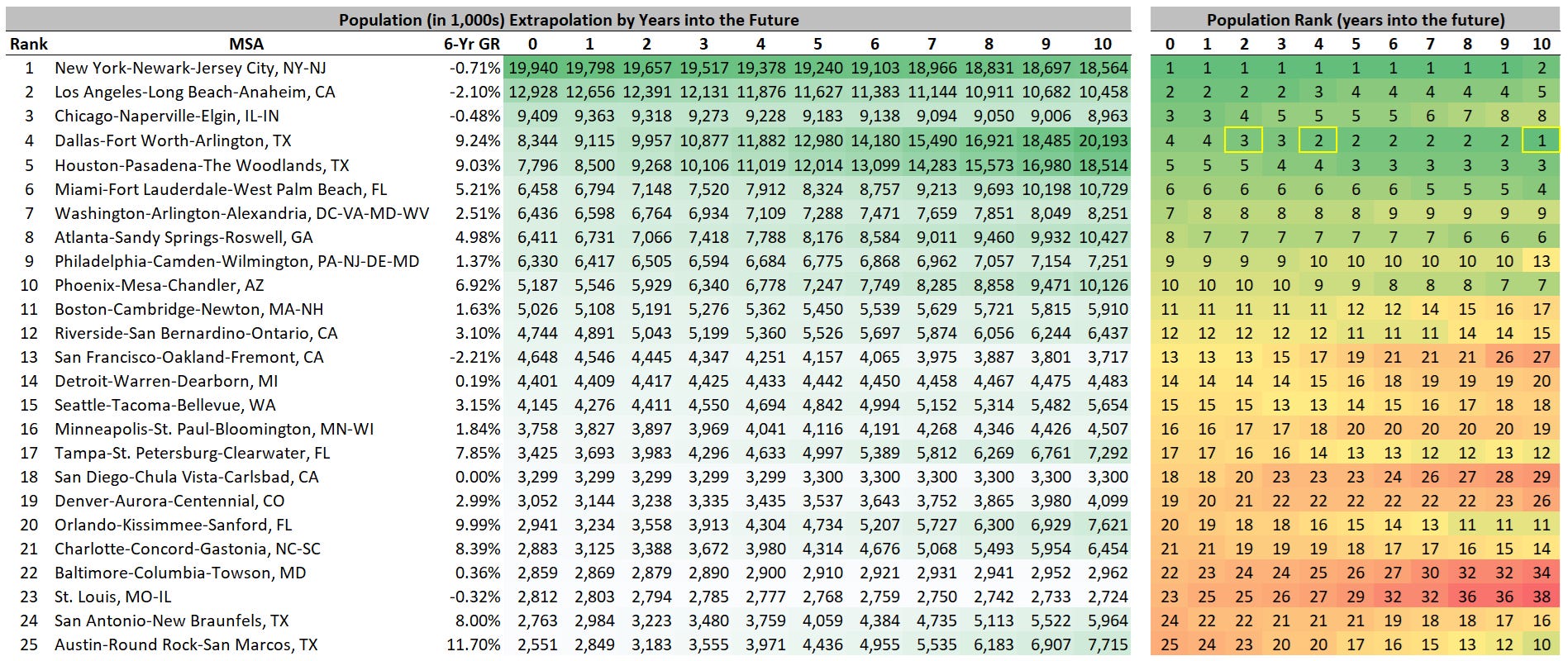
Using these growth estimates, Dallas overtakes Chicagoland in two years, overtakes Lala Land in four years, and overtakes the Big Apple in ten years.
In ten years this projection has three of the top five largest metropolitan areas being in either Texas (2) or Florida (1) and Austin would have climbed from 25th to 10th place. Zooming out we see the southern cities dominate at the expense of northern and west coast decline. It should be no surprise that Texas and Florida are on the move up while New York, Chicago, and California cities among others are in decline (relatively if not in absolute terms).
The biggest factors among many leading to population changes are taxes and cost of living with shelter being the big driver. A very important secondary effect is the business regulatory environment with its important implications for economic growth. These factors all feed upon themselves as virtuous or vicious cycles—choose your fighter wisely.
Sources:
Population: https://www.census.gov/data/datasets/time-series/demo/popest/2020s-metro-and-micro-statistical-areas-detail.html Income: https://www.bea.gov/itable/regional-gdp-and-personal-income Other: https://censusreporter.org/