

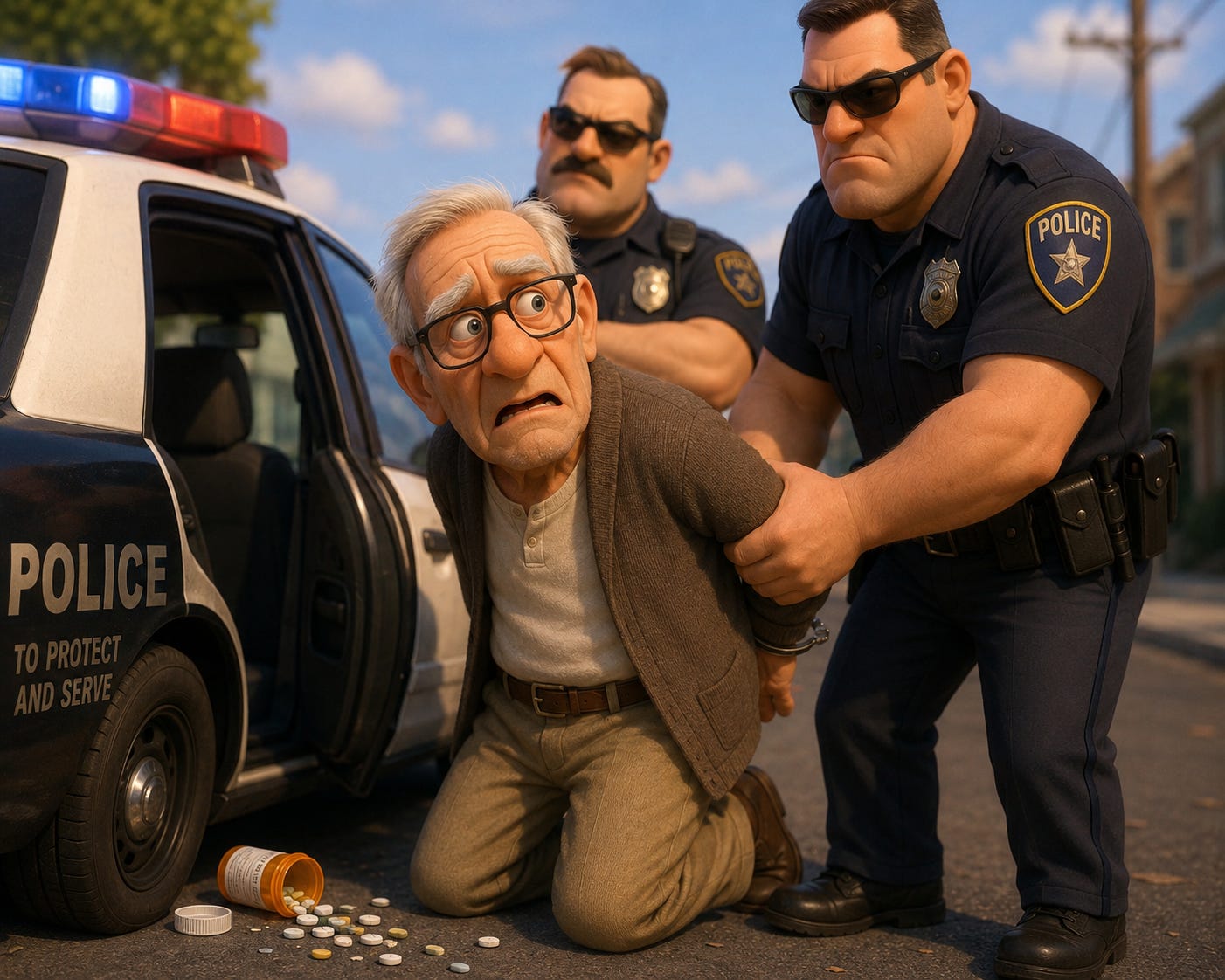
I can win the War on Drugs™.
We are losing the decades-long domestic Vietnam for the same reason hawks then and after said we lost in Southeast Asia—we simply haven’t tried to win.
To win, we need to finally get serious about it.
Here’s what it’s gonna take — A true no-tolerance policy.
You’re caught with an illegal narcotic, you go to jail with certainty and for a long time.
If you have prescription pills in your possession you must have a current valid prescription. And it must be in your possession with the pills at all times. If not, you go to jail.
If you have additional pills at home, you need to purchase a government-authorized safe for storage of them, register this safe with the federal, state, and local authorities, and keep valid, current prescription documents with them as well. Failure is at least steep fine for first offenders; jail time for others.
We need drone surveillance empowered with AI technology to watch, scan, sniff, and otherwise detect illegal narcotics or behavior that appears to be related to the trade, possession, or use of illegal narcotics.
We need to relax the burden of reasonable suspicion such that obtaining a search warrant is quite easy.
Increase dramatically the federal budget for enforcement of the drug laws. Target specifically any state that is seen to be lax on drug enforcement especially in the case of those that have legalized marijuana. Imagine the recent ICE interventions only permanent and for drugs.
Dealing drugs as defined by illegal possession above a (low) threshold or being caught in a drug transaction as the seller is a capital offense. The punishment has a mandatory minimum of 20 years in prison, and the death penalty is available in jurisdictions that allow it otherwise.
Using (under the influence or in the act of taking) illicit drugs in the presence of minors, in public view, or in a manner that could put others at risk (widely defined) is a serious offense that carries penalties both civil and criminal.
Mandatory drug testing must be implemented at checkpoints to include: any doctor visit especially in the emergency room, periodic random checks of anyone receiving government benefits (SNAP, TANF, Social Security, Medicare, etc.), workplace testing both at the hiring point and every couple of years when at the same employer, whenever one is under investigation including a minor traffic stop, and any time an officer of the law otherwise believes it is warranted (remember the loosening of reasonable suspicion above). This is just a partial list.
Rewards for tips that lead to a prosecution of anyone for illegal drug use will be large and proportionate to the resulting sentencing.
Etc. etc.
No, I do not think even this would win the war on drugs. And I don’t know what winning could possibly mean even if this did obtain the paper objective of stopping drug use.
Notice these drastic penalties above target the end market and particularly consumers. That is because you have to target demand to have any chance of this nonsense actually working. Hitting supply especially at the raw production side (e.g., bombing coca fields in South America, raiding cartels in Mexico, etc.) is a fool’s errand. By analogy: You cannot drive up the cost of fine-art paintings by making paint more expensive. It is a minor input cost. Theoretically you could increase the military size and activity enough to meaningfully limit supply, but that would require forever wars everywhere on Earth.
If you’re not willing to go to these extremes because you understand the sacrifices aren’t worth it, you’re on the road to understanding why the War on Drugs™ is a miserable failure in every dimension by its very design. It is an immoral concept, immorally executed no matter the extremity to which it is taken.
It fails in principle and it fails in practicality.
Prohibition doesn’t work. And even when it seemingly does, considering the spill-over costs, it is itself a large failure.