

This post is side two of a joint, two-sided argument supporting housing reform. The message here is you don’t want what you may think you have a right to. The message of the other side (that I offered in a previous post) is that IF reform has costs, those costs are manageable and temporary.
You don’t have a right to your house’s price.
You cannot limit the freedom and property rights of others just because their actions might negatively impact your property’s market value. This is using the state to prevent competition—something we normally see for the wrong it is. The objections to this flow out like from an angry, uncontrolled firehose:
What if someone opens a pig farm next door to my neighborhood house?
What if someone builds a giant skyscraper in a U shape blocking all my sunlight?
What if someone builds a three-story house blocking my view of the ocean that I’ve had for twenty years?
What if someone builds a house next to mine that is extremely “objectively” ugly?
What if someone puts a loud biker bar next to my family home that attracts seedy characters and vice?
None of those are what I am talking about. Those are either genuine rights disputes or are areas of ambiguity because of poorly or not-yet-defined property rights along with nuisance and other tort claims. And some are of a hyperbolic nature that defies logic.
What I am concerned with are support for limitations on housing supply from the standpoint of what that supply effect would have on existing property owners. This is a more general objection that supports all the tiny battles against deregulation.
To be fair, it is less a “there goes the neighborhood” as it is a ham-handed attempt to employ economics by NIMBYs as they try to hold the line. But it is instead an invention of a property right disguised as economic reasoning.
It is the housing reform opponent’s version of big hospital’s CON laws where existing hospitals get to decide if competing hospitals get to come into the market. While attempts at competition limitations almost always come from small (in number not power) vested interests (concentrated beneficiaries), this is a case of numerous vested interests using the same approach to hold back competition. They are grasping for the thin reed of harm avoidance as a property right to protect them from a sincere though probably false fear of wealth decline.
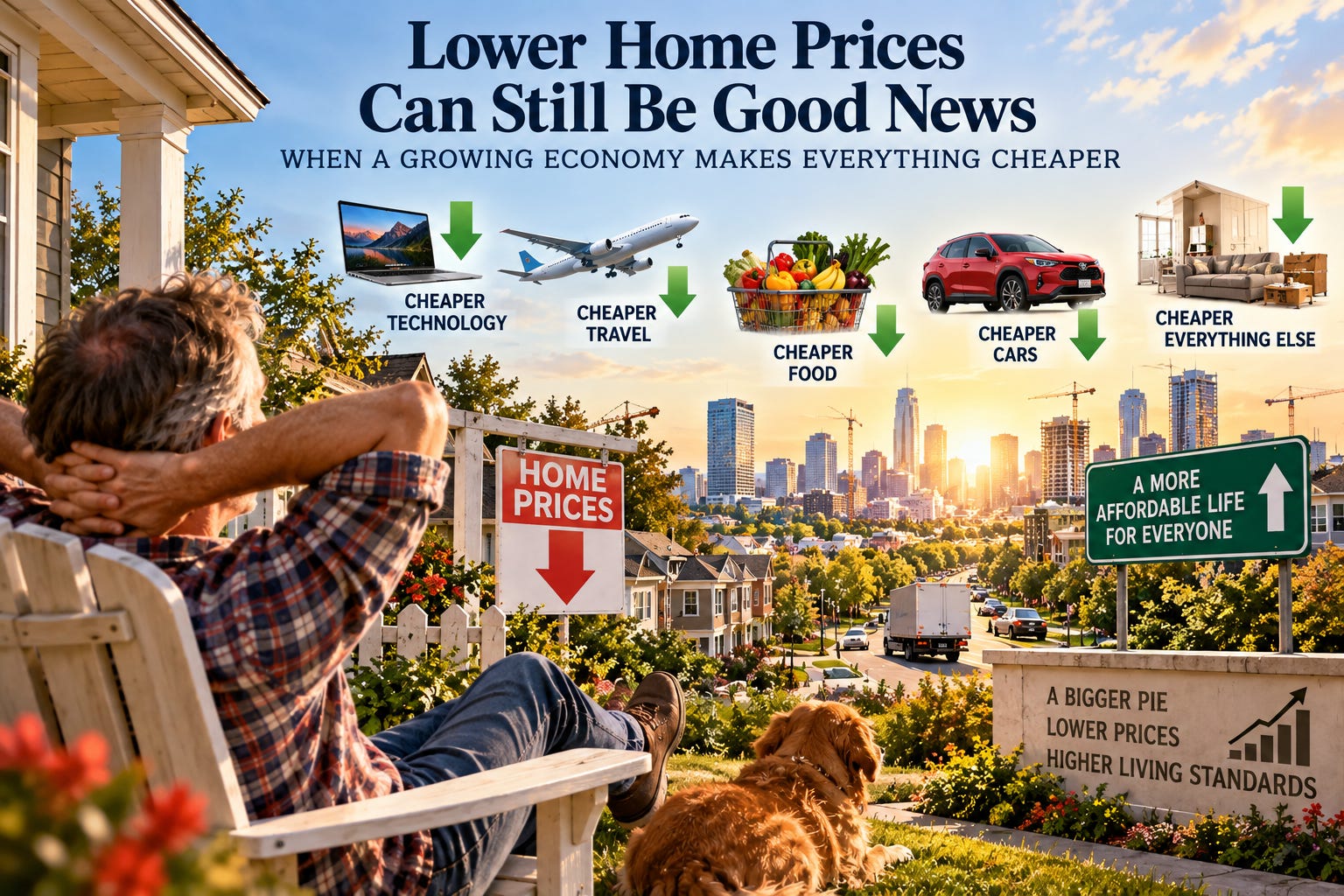
Fortunately there is good news. Your house’s price (and you generally) will likely benefit from what you seek to restrain—growth.
Don’t worry, though, because you don’t want that right.
On one level attacking the impulse to limit other’s true property rights is straightforward because of what such an invented right would imply. It would mean central planning by those most powerful and engaged and only among those currently in the market. It would lead to approval boards that cannot agree on the brand of coffee to have at the evening meetings much less what the aesthetic value priorities should actually be. It would grant veto rights to those with the strongest and likely most restrictive opinions. Most importantly, it would allow those with no skin in the game to dictate to those willing to put capital at risk. The end result is stagnation come depreciation.
In other words, there is no good way to enforce it with very bad knock-on effects.
Communities that don’t grow wither. Standing still while the world advances is obviously relative decline, but it is also absolute decline since depreciation compounds in such a world. In the simplest of examples, imagine the cost of maintenance just to keep your home the same as it is today well into the future. If your home is in a location of relative decline, the cost of doing this basic water-treading will be ever rising.
Yet this discussion is misguided still and gives away the game. How? By not realizing that absolute value decline—the price of your home falling—is simply not a problem if that decline is because of supply increase in the broader market.
Rising supply is the hallmark of social wealth advancement. Bryan Caplan offers a great illustrative example:
I have a massive collection of music CDs, about 4,000 in total. Over the years, I probably spent about $40,000 acquiring them. Now, thanks to streaming, they’re virtually worthless. While perusing the used CD section at Amoeba Music (both the LA and Berkeley locations), I discovered that most of my discs now retail for about $3. I doubt Amoeba would pay me $1 a disc, assuming they’d take them at all.
Applying familiar NIMBY logic, you might insist that streaming “hollowed me out.” Sure, kids can now enjoy unlimited music free of charge. But I’m $40,000 poorer. A victim of cruel progress. A clear-cut “loser.”
. . .
Thanks to streaming, I can now consume infinite new-to-me music gratis. Given my tastes, that means massive consumer surplus for multiple decades. In present value, that’s vastly more than $40,000. YouTube access to the complete Lebendige Vergangenheit catalog of vintage opera recordings alone is plausibly worth $5,000. Back in the day, I paid $13.99 for each of these premium imports. Now they’re all $0.
To repeat, the lesson is not that everyone in my position gains from streaming. If I were totally set in my ways, I really would be $40,000 poorer with no offsetting gain. The lesson, rather, is that NIMBY negativity is not the automatic response for everyone who experiences a capital loss. Most enjoy some upside with their downside. Some, like me, enjoy a net gain despite a large gross loss.
But the more general lesson is that this is not just a curiosity for music lovers. It fully applies to the archetypal NIMBY who opposes housing deregulation because he already has a valuable home!
Suppose you own a $1M home, then deregulation halves its value. Yes, someone who has zero desire to live in any other home suffers a $500k loss. But suppose they want to upgrade to a better home. Then they have an offsetting gain: The dream home that previously cost $2M now only costs $1M, so their consumer surplus potentially rises by a full $1M. And the same goes to a lesser extent if they were planning on downgrading: The home that cost $500k is now just $250k.
The offset is even larger if the homeowner was thinking of buying a second home. Indeed, since rental and sale markets are closely connected, the owner gets an offset every time he checks into a hotel or rents a vacation property.
For alleged “losers” who love their children, the potential upside is greater still. Let’s go back to my CD collection. Even if streaming didn’t benefit me personally, I have four children. I love them, so their surplus is also my surplus. The $40,000 capital value I lost was going to them anyway. So while each will now inherit $10k less, in exchange they get infinite free music for a lifetime. And so will their kids. The blessings of streaming shall be their patrimony.
The same holds for any homeowner who loves his children. Even if you’re in your “forever home,” even if you have no desire to travel, crashing housing prices have a massive upside: cheaper housing for your kids. Maybe even cheap enough to buy the house down the street. Yes, their inheritance will be less, but they’ll get to enjoy cheaper housing for a lifetime.
Let me address the apparent small chink in his argument’s armor. For those with no intention of selling their now depreciated home (the $1 million becomes $500k example), they suffer no real loss. They still have the same home. And now they can repair and maintain it more cheaply. The only “loss” they suffer is hedonic—relative decline on their personal balance sheet.
I’m sorry, but that is not a loss we can or should care about. We don’t unduly fret that holders of stock in disrupted companies like Eastman Kodak, General Motors (before the bankruptcy), Sears Roebuck, Blockbuster Video, Pan Am, etc. suffered complete or near complete loss when economic advancement and technological innovation disrupted them into oblivion. We shrug and move on knowing this is a cost of doing business where the business is social economic advancement.
The same is the case when economic advancement means a job category is changed resulting in the elimination of those jobs or substantial changes in those jobs. You do not have a right to your job nor your work vocation. At the very most we might compensate those affected, which we do with unemployment and other welfare benefits. But keep in mind two things: One, these types of changes are never as catastrophic and sudden as feared (current AI job doom included), and two, the cost of recompense is not just the check written. There is also a damaging incentive effect.
You know you don’t actually have the right to tell others what they can peacefully do with their own property. If for no other reason, you see it when the shoe is on the other foot—when they are telling you what you can and cannot do. Likewise, you should see that this distortion of property rights leads to madness. Most comforting, though, is the realization that the thing you fear, growth through development, is the thing you actually wanted all along, sustained and improved wealth.
Substack mentioned: