

It seems like only a decade ago this second Trump presidential term began. Yet it has been only a bit over one year.
Let’s take a look at how its going all based on terms Trump has himself proclaimed as good benchmarks.
The obvious objection is that a U.S. President only has a limited impact on the broader economy especially in the short run—though, probably more downside than upside. But Trump and his supporters don’t allow for this nuance. They claim every success they can identify including made up statistics. They also deny everything that goes against their narrative.
One could also object that the president is not all powerful. I read somewhere about this theoretical thing called “Congress”. Yet Trump and his endless executive orders seem to defy its existence.
So this is an honest attempt to look at wins and losses on Trump’s own terms.
I’m not sure this is winning, but I am getting tired of quite a bit of it.
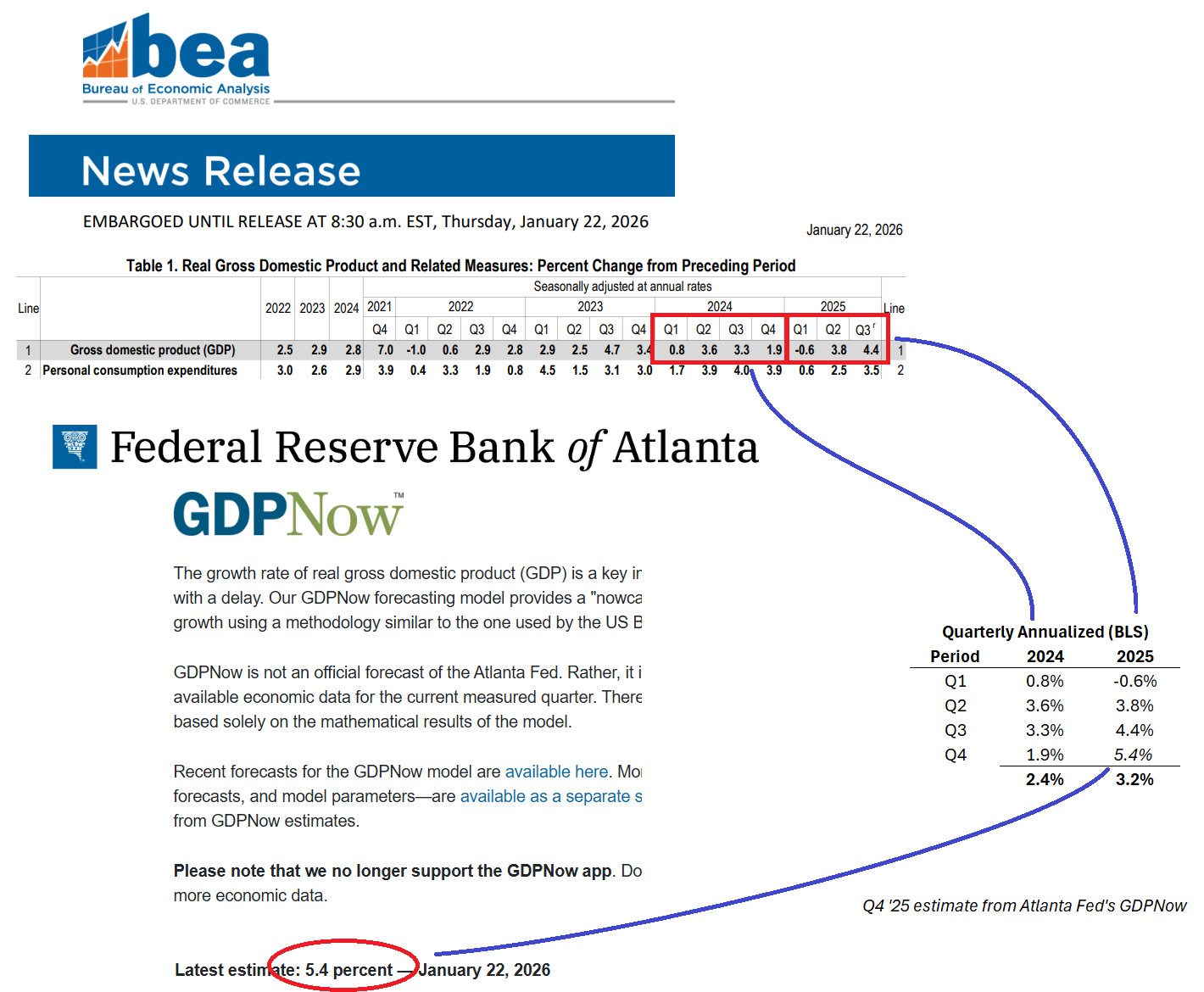
GDP growth - win. We start with a winner for Trump. Real GDP is estimated to have grown about 3.2% in 2025 meaningfully above the 2.4% performance in 2024.
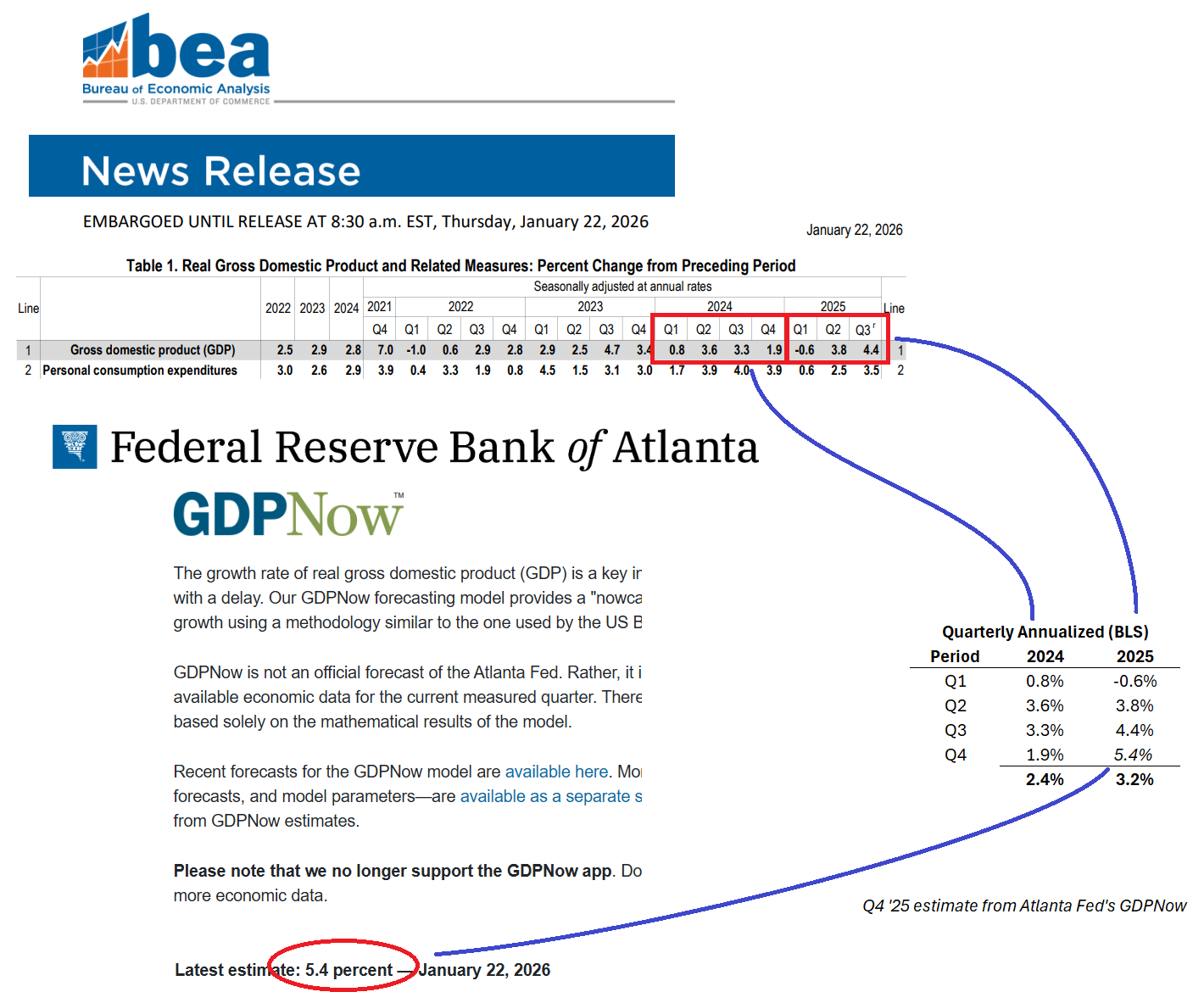
Sources: bea.gov; atlantafed.org; author’s calculation Eventually this graph from Fred will update with the official number.
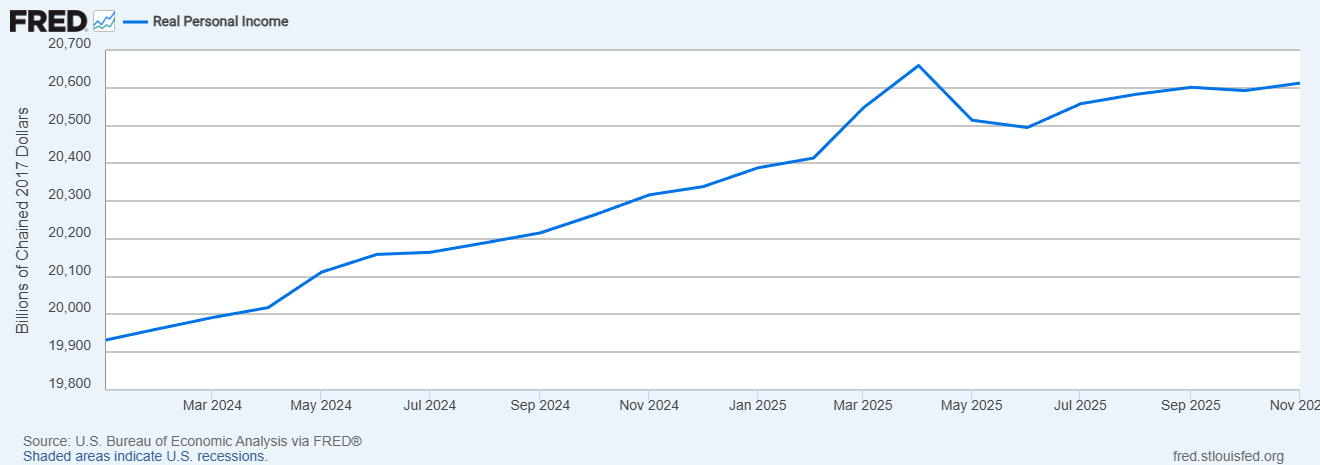
Real personal income - win*. While this figure is up since the start of the year, it has not yet recovered from “Liberation Day”. I’ll be generous and give the W.
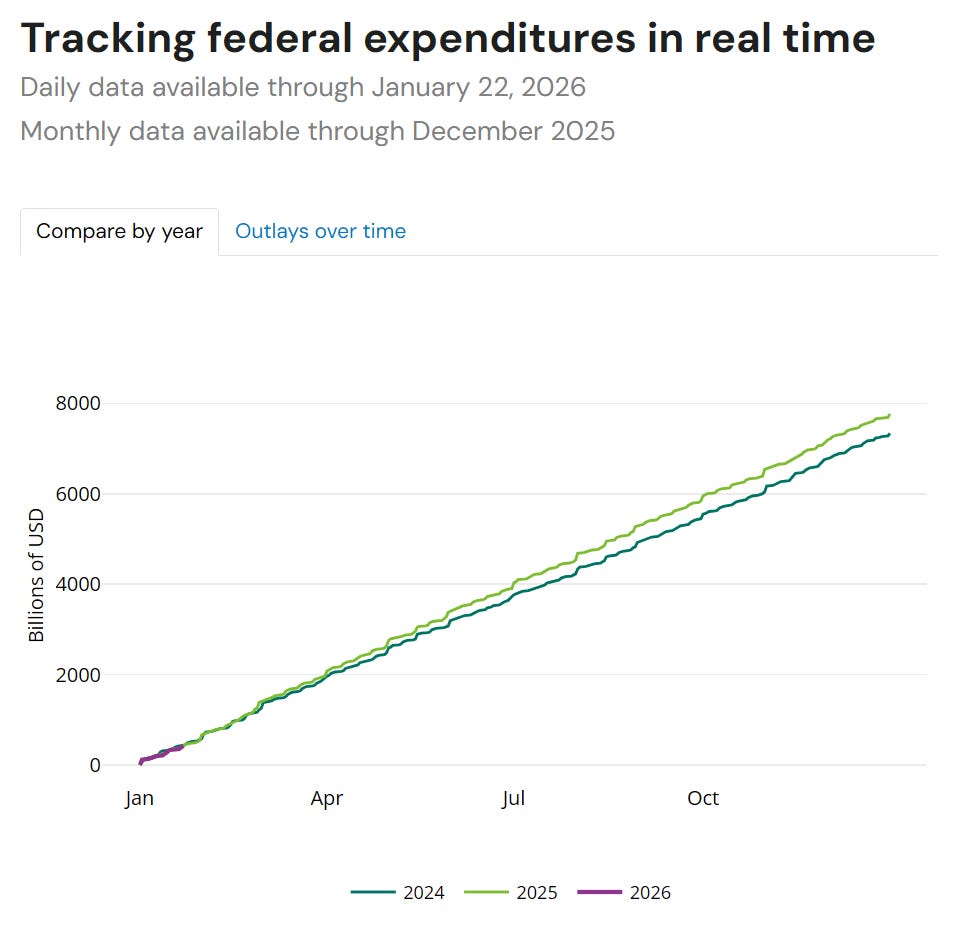
Federal government spending - loss. Despite what they told you about DOGE, spending just keeps on truckin’. The total for calendar year 2025 was $7.765 trillion. That is a 5.8% increase in spending over 2024’s $7.34 trillion.
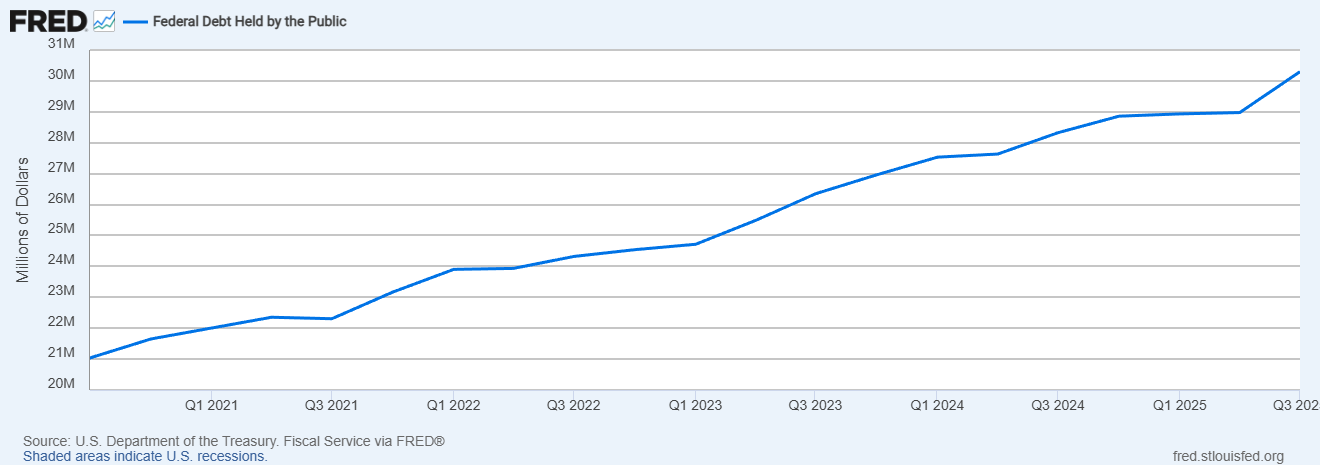
Federal debt - loss. Having promised to erase the national debt, he sure isn’t progressing well on that goal.
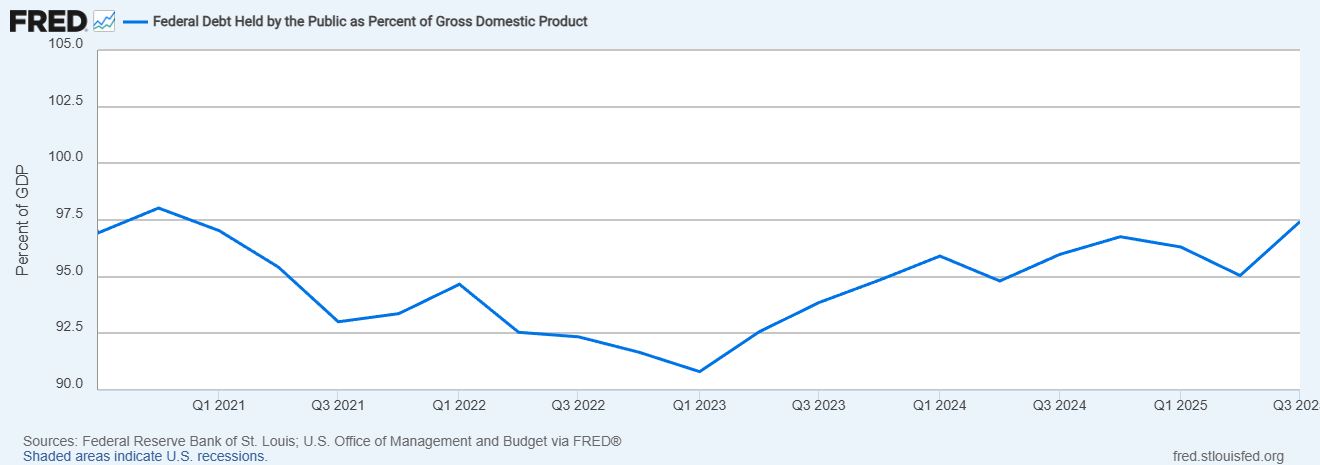
Debt/GDP - loss. Looking at debt relative to the economy provides no help.
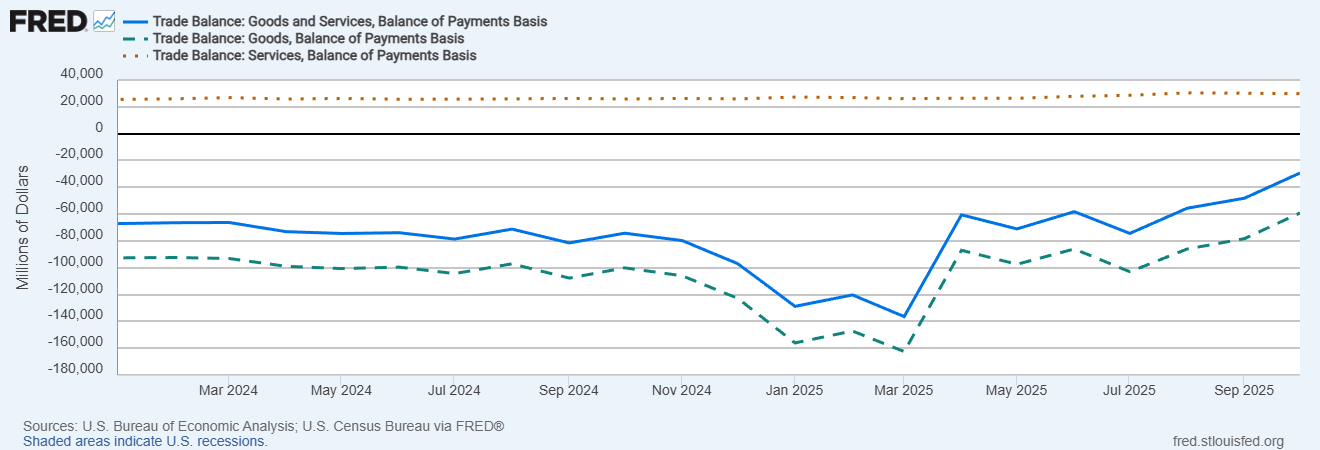
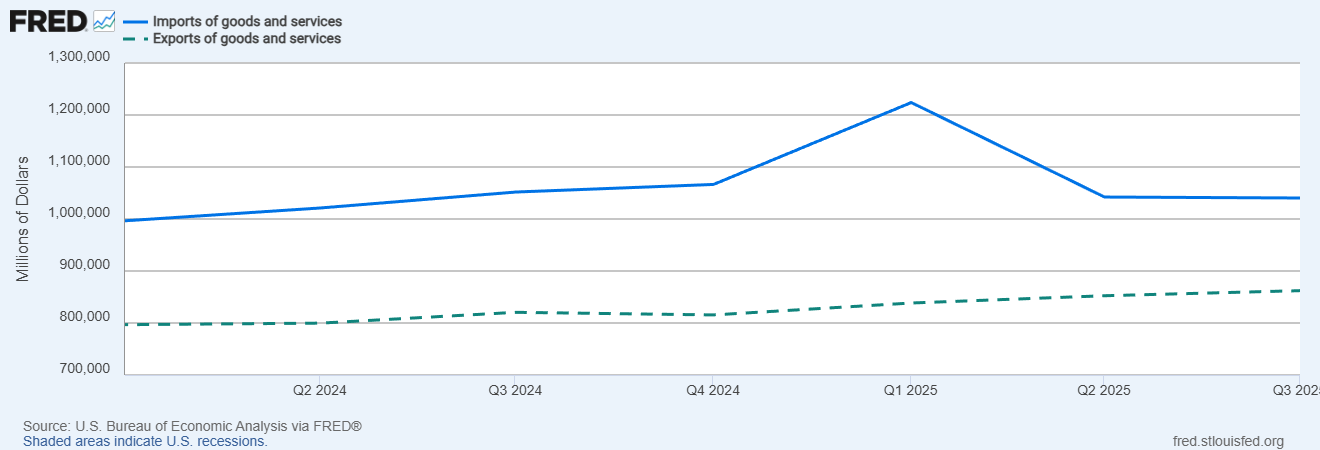
Trade balance - win? You and I know this doesn’t mean anything in and of itself, but the administration certainly thinks it does. More importantly this metric “improved” by imports falling (second chart). In other words the benefit of trade (imports) went down while the cost of trade (exports) stayed about the same. It’s a win in his mind and his mind alone.
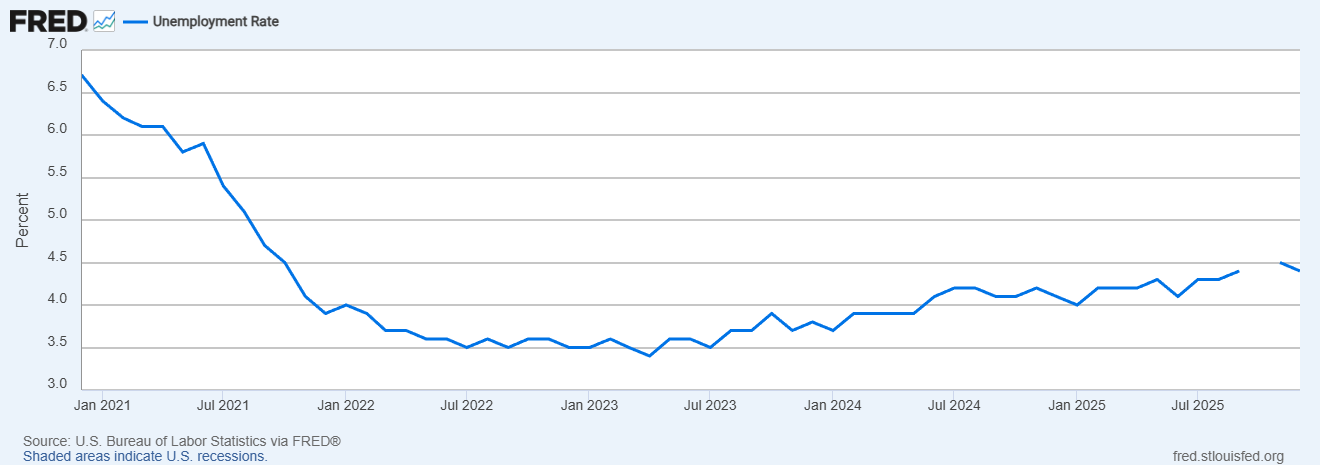
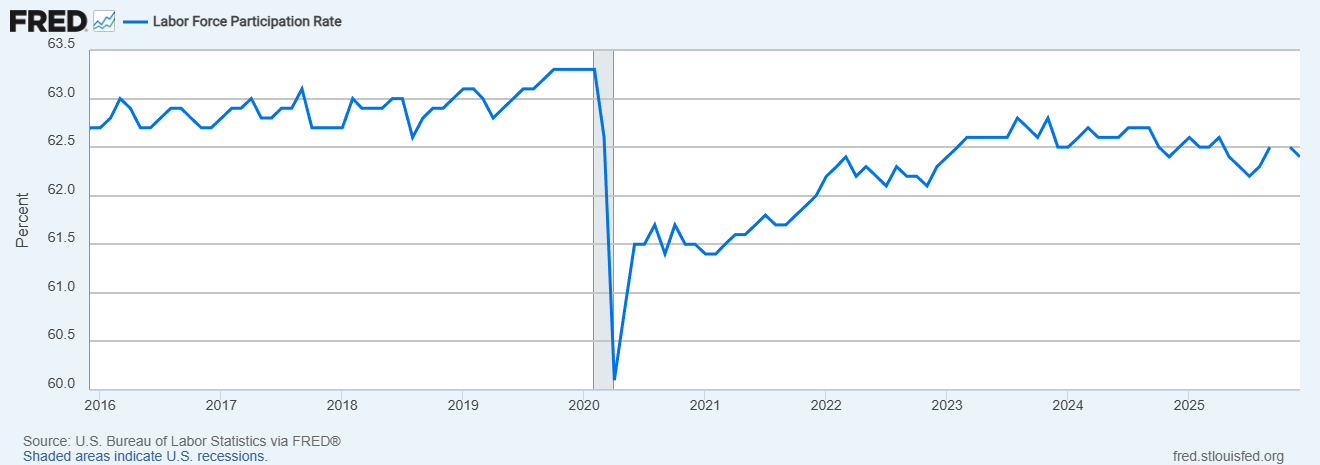
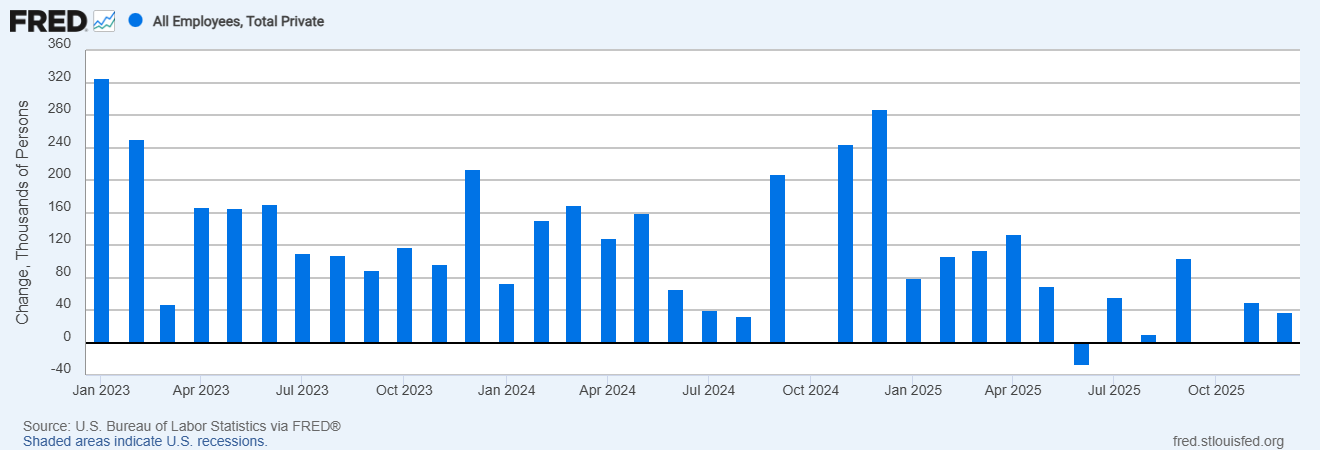
Employment overall - loss. The unemployment rate has slightly increased and the labor force participation rate has slightly fallen. Job growth has consistently slowed.
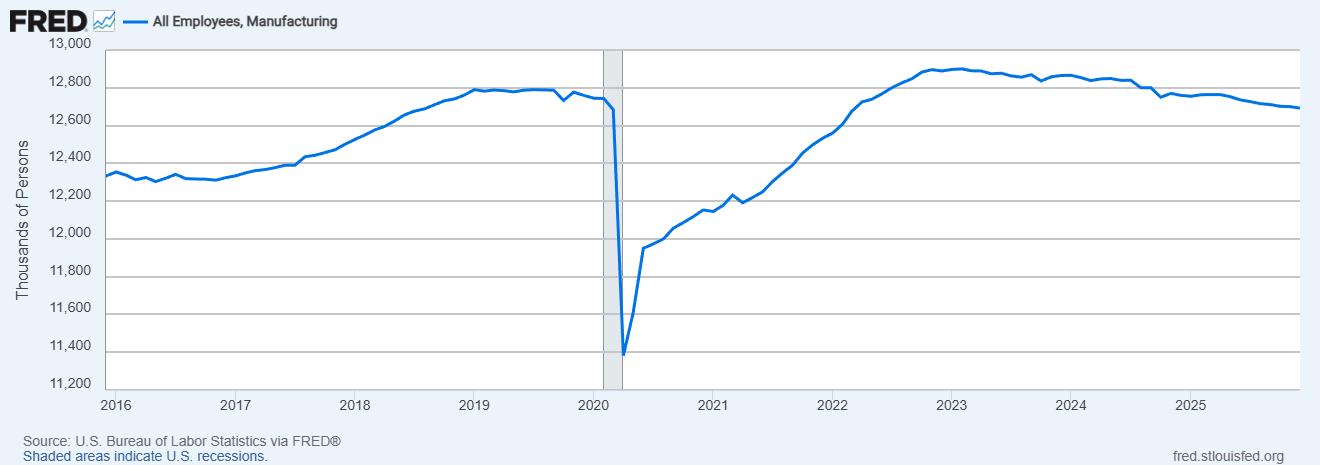
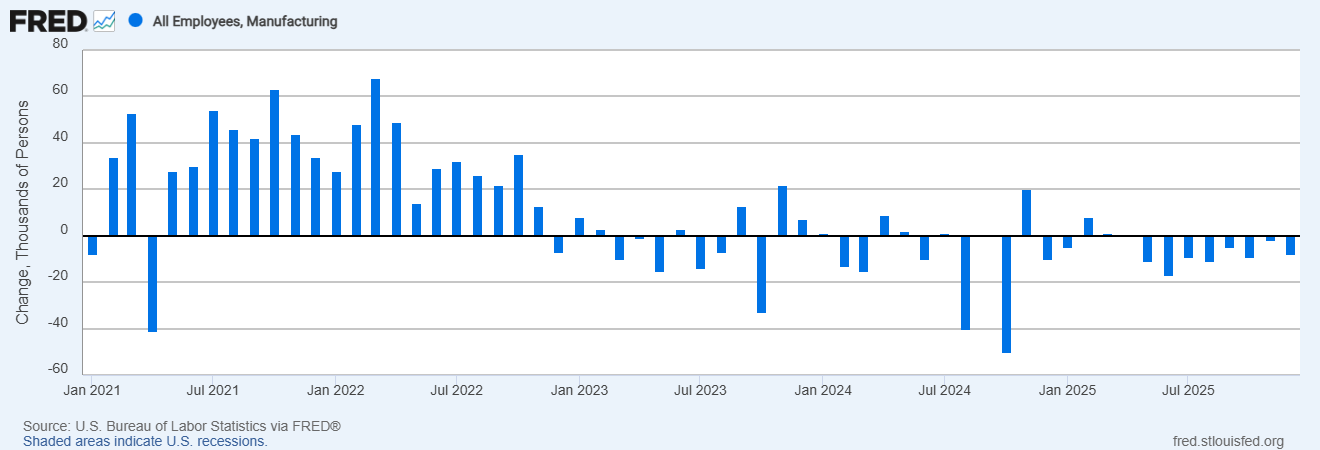
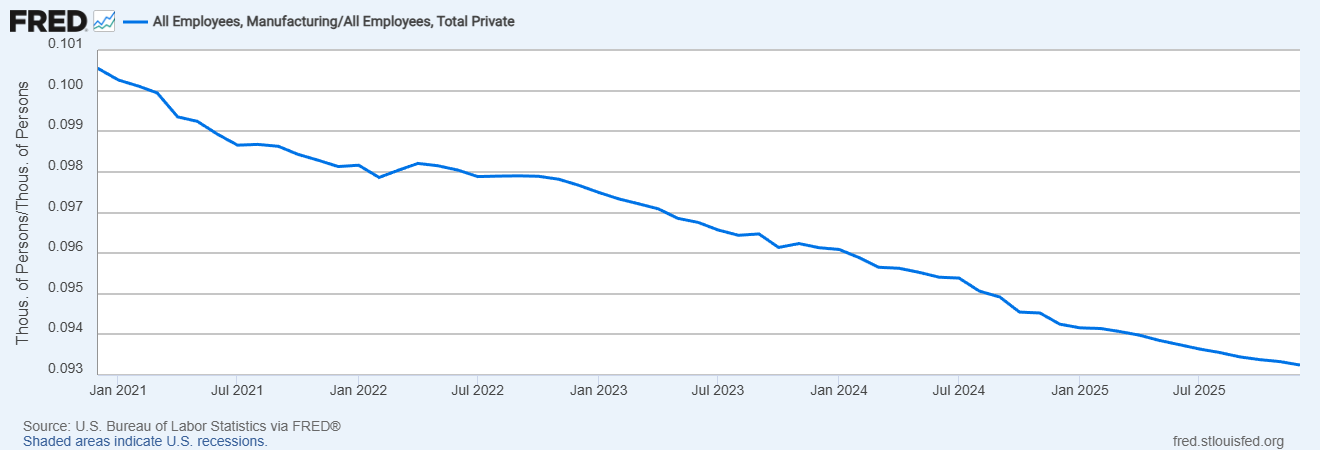
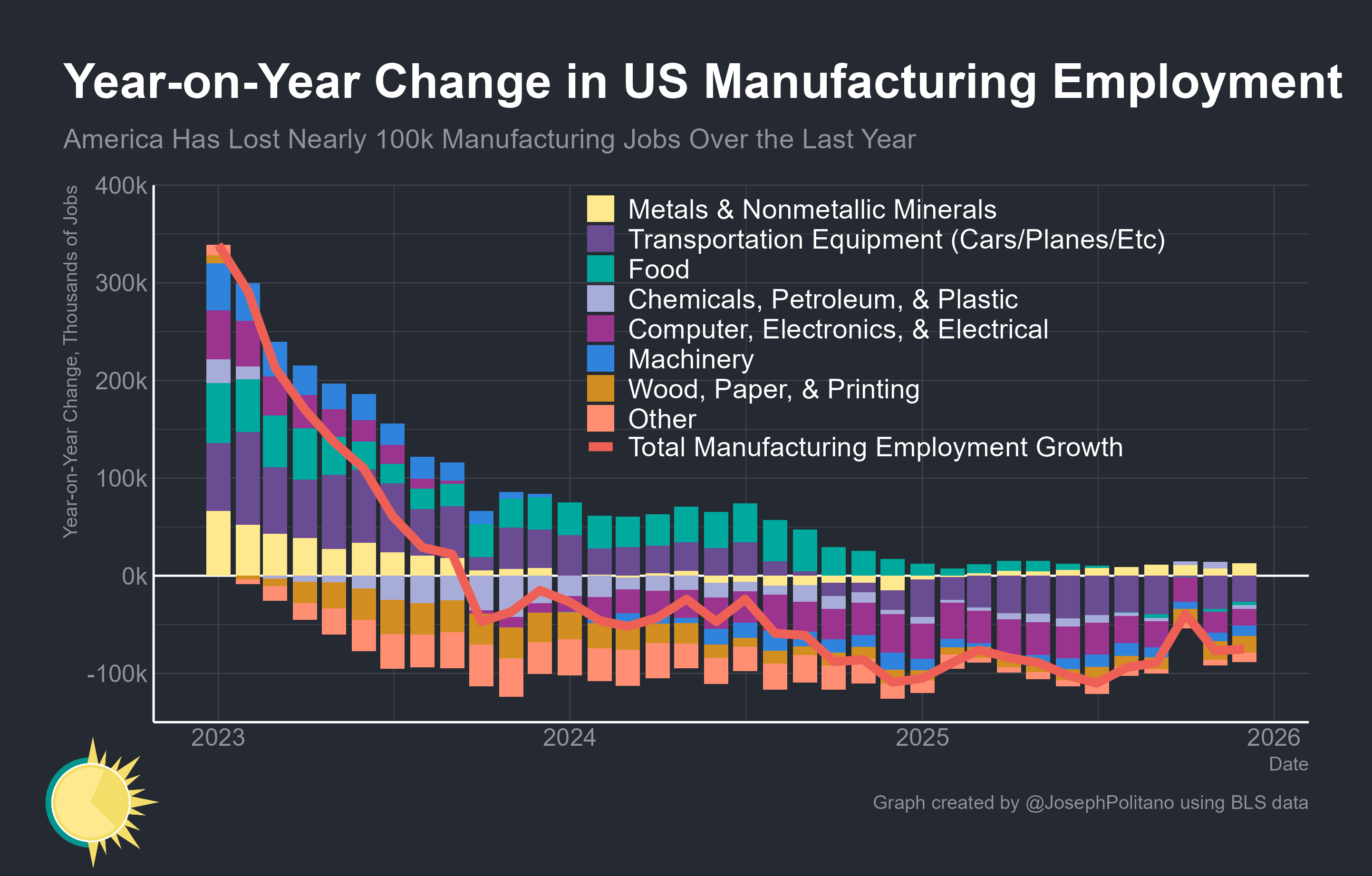
Number and percentage of manufacturing jobs in the U.S. - loss. Trump’s term has been an acceleration of the decline in manufacturing jobs in total and a continuation of decline as a percentage of total jobs.
Border/Immigration - win and loss. This one is tricky because achieving success on Trump’s terms is basically impossible. He and his administration have repeatedly claimed there are over 30 million illegal immigrants in the country, who they are going to fully deport. Well, there aren’t anywhere near that many. So they cannot possibly do it. (Not to mention how inconvenient it would be for them if there were so many.)
Nonetheless, DHS claims to have removed over 2.5 million illegal aliens.1 So let’s dig into this a bit to see if we can salvage the complete win [spoiler: we cannot].
Let’s not lose focus as we do this. There are at least two things at play that get muddled together. (1) Border security and calm. (2) Overall immigration, which Trump pledges to reduce including legal immigration despite moments he sees the benefits (and graft potential) of high-skilled immigrants. Regardless, the major concern of Trump is on illegal immigration.
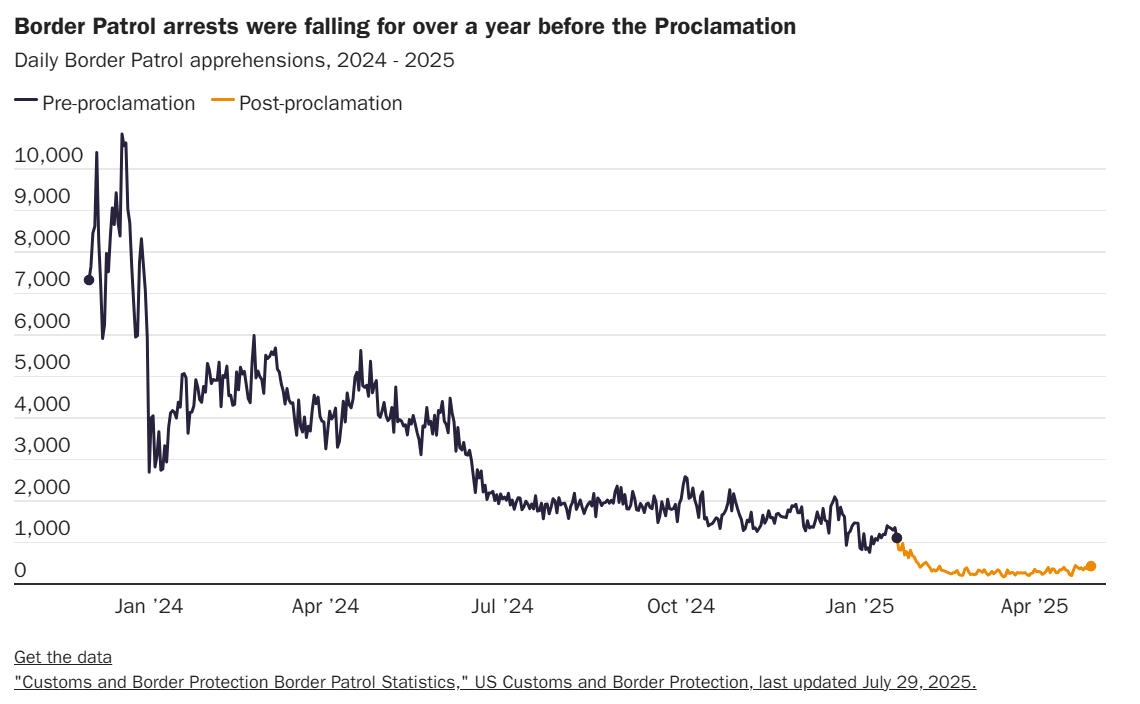
One thing to consider with regard to the first aspect is if Trump’s actions brought about calm to the chaotic southern border. There was an effect, but border arrests were falling well before he took office.
Still, the border is a lot calmer; so I think this counts as a win on his terms.
As far as the second issue of immigration itself goes, the deportation machine has moved inland. This was necessary to meet the state goals of getting all the illegal immigrants out of America, but I think it is mission creep that will come back to bite them (see the approval section at the bottom).
To get the victory here, Trump needs to almost double the claimed rate of deportations since just using a more realistic number of 15 million illegal immigrants at the start of his term requires 4.17 million per year over the next three years. He might get there (God forbid), but he is not on track.
Federal criminal investigations, arrests, and clearance (solved) rates - loss. We live in a world of tradeoffs. With the substantial increase in the focus of federal law enforcement into immigration, we find that stopping all other crime fighting is what we give up. Over 25,000 federal officers have been diverted from their day jobs at the FBI, DEA, etc. to help in the deportation efforts. Additionally many state and local officers have been diverted as well. Since illegal immigrants are less likely to be criminals than natives, it is no surprise that this surge has led to an overwhelming number (73%) of ICE detentions being people with no prior convictions. The upshot is that more crime goes unreported and unsolved undermining public safety.
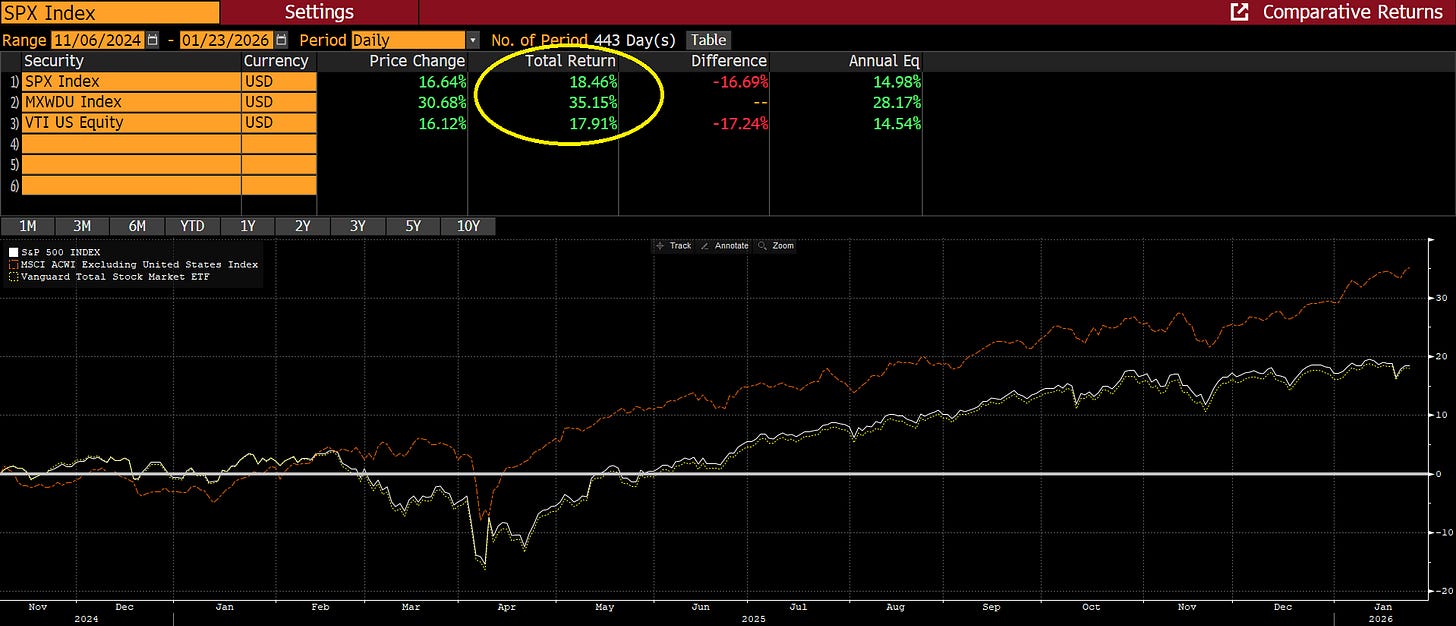
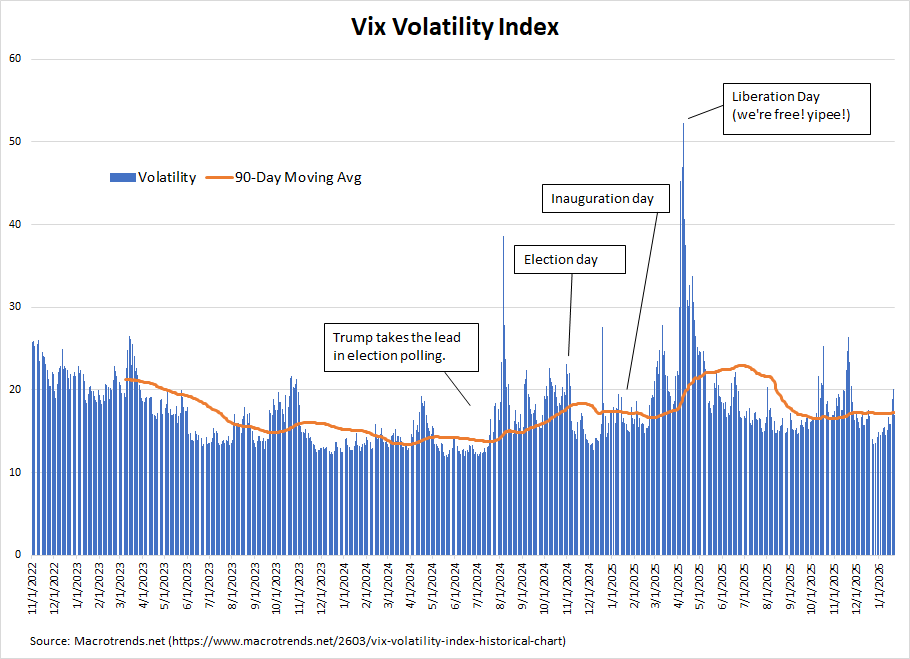
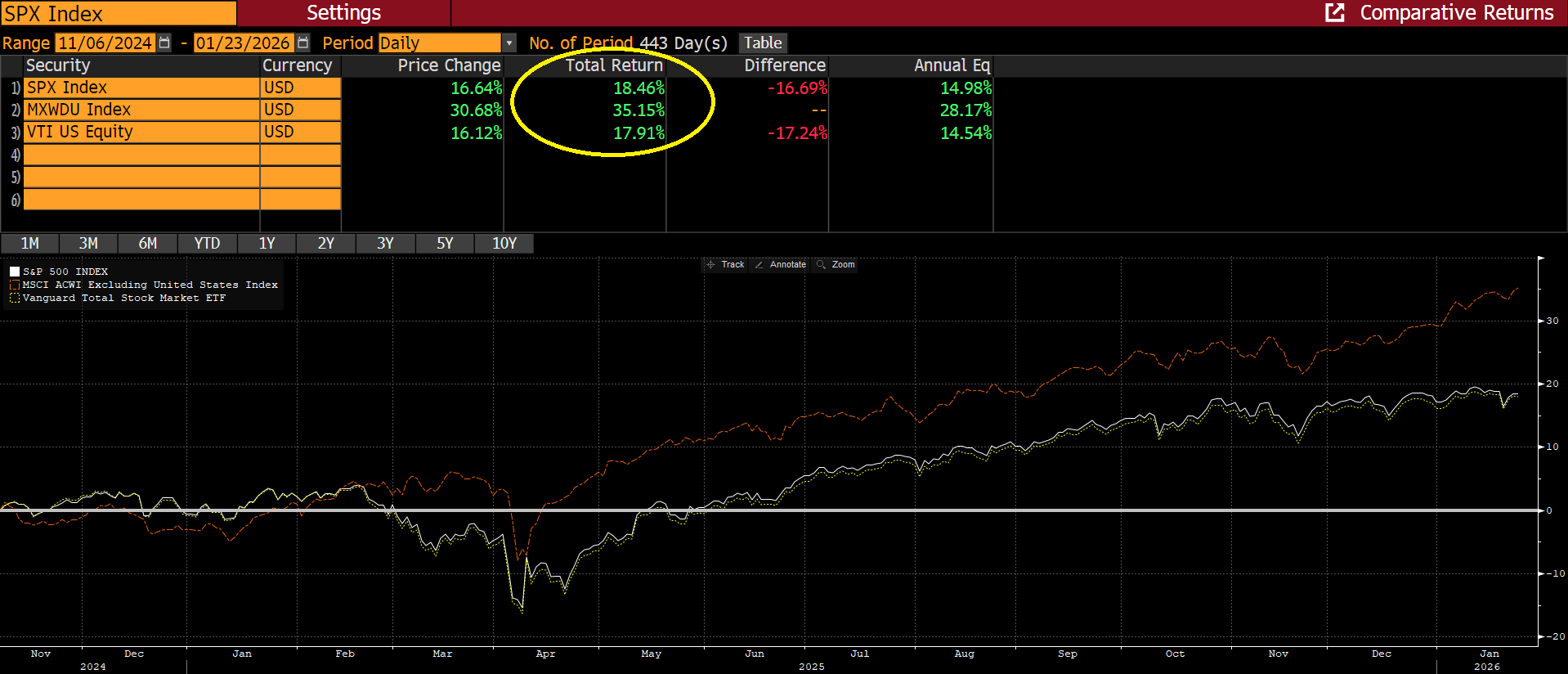
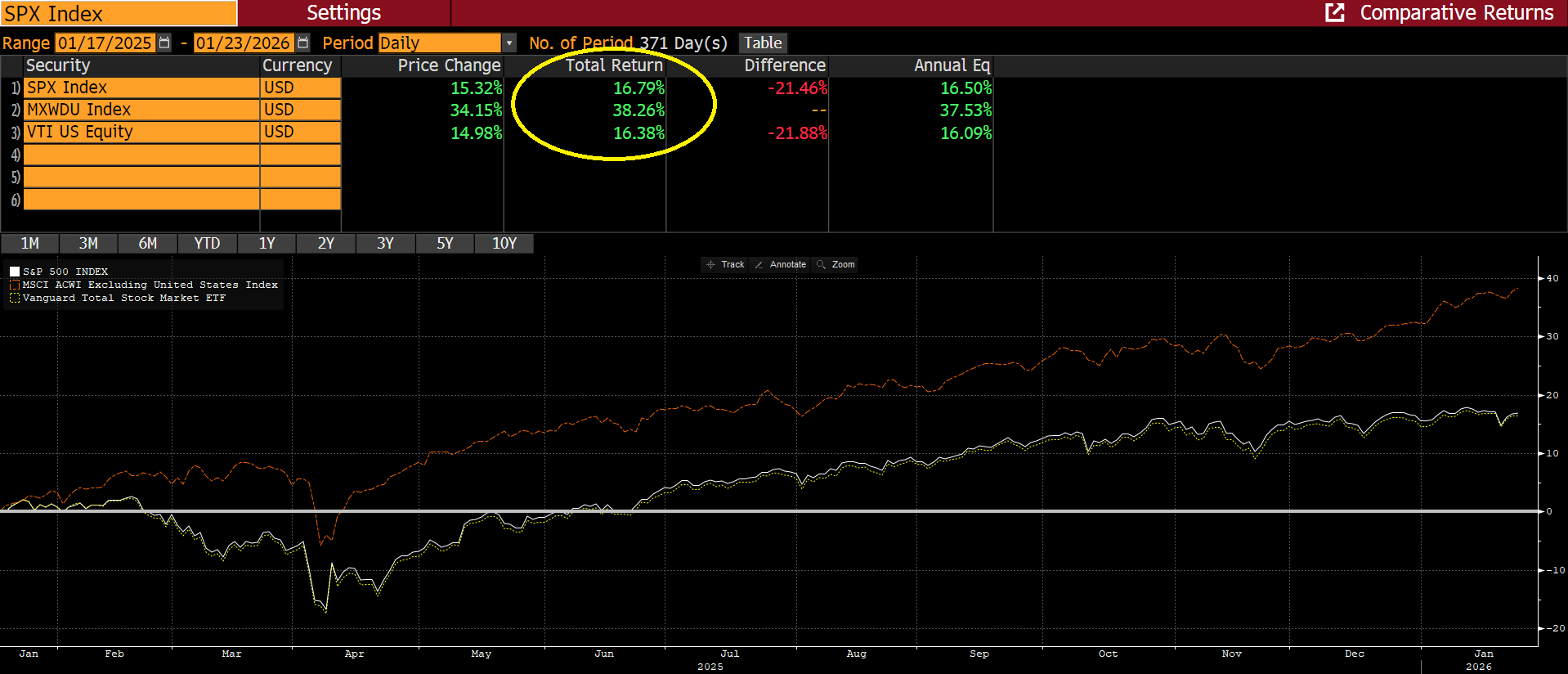
Stock market performance - loss. I’m going to be a sticker on this one. He cannot get credit for the market simply going up. It usually goes up. We have to evaluate it against proper benchmarks. One of those would be international stocks. When we do so, we see that the U.S. market (either the S&P 500 or the total U.S. stock market) has not advanced nearly as much as international stocks. This is true whether we look at it since inauguration day or election day. In both cases the U.S. has underperformed international markets by ~16 to ~22 percentage points. (Bonus for those who can identify “Liberation Day” in the charts below.)
Since election day:
Source: Bloomberg Since inauguration day:
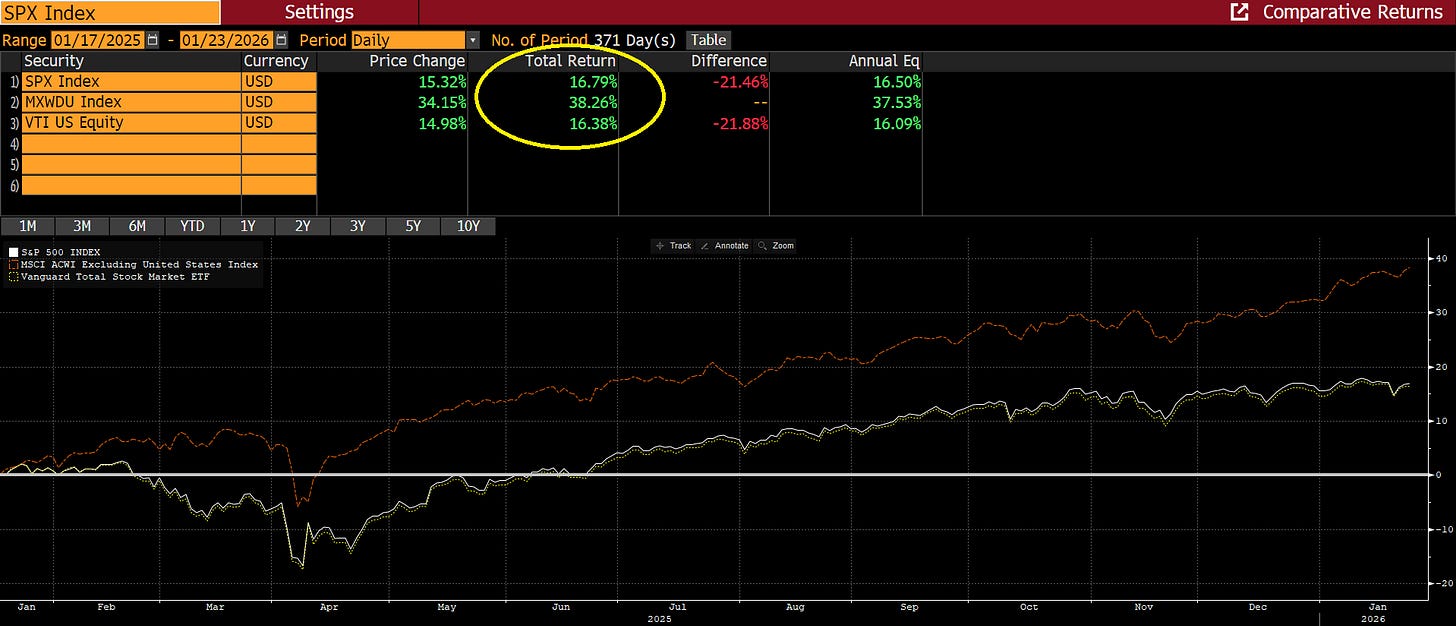
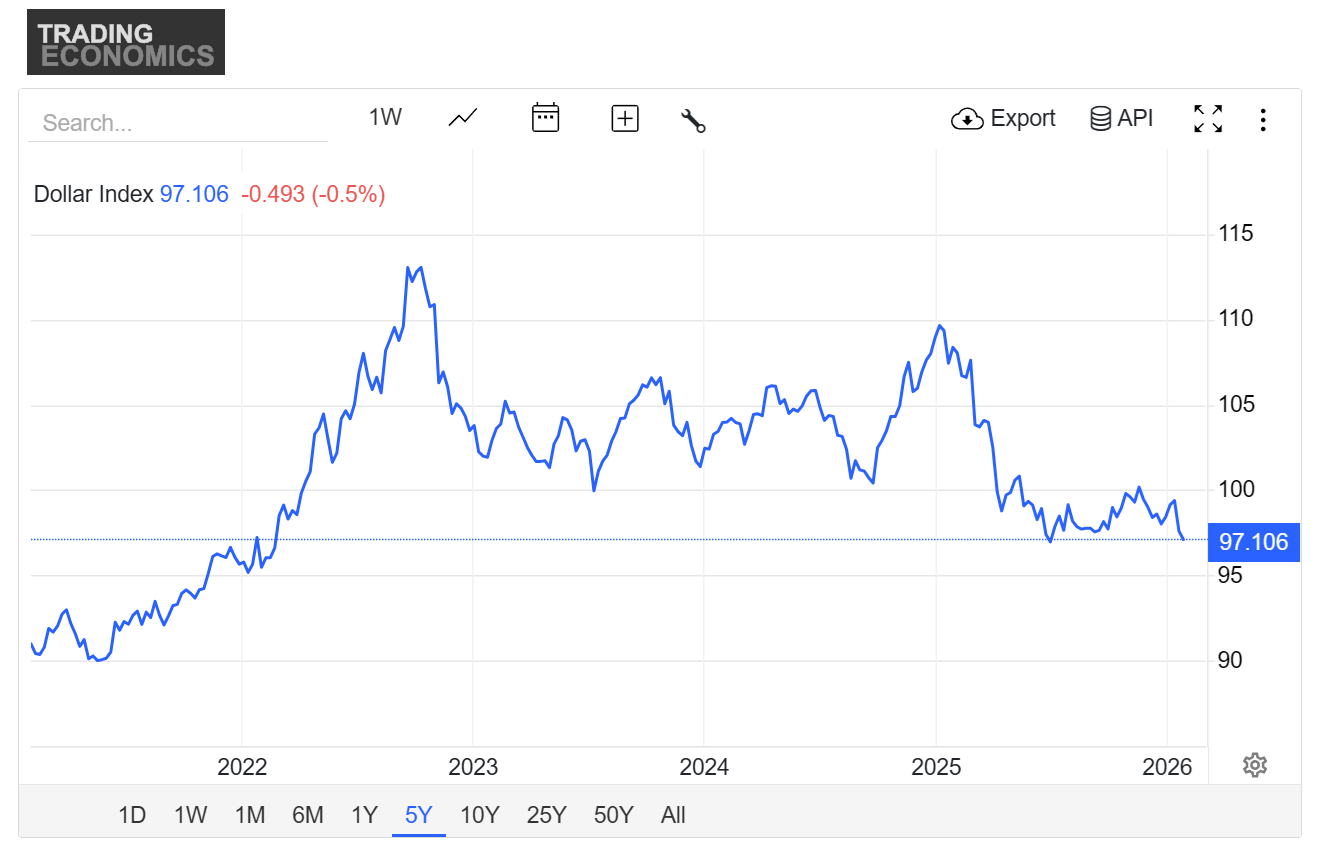
Source: Bloomberg Ironically he probably does deserve some credit for the international returns since they are driven in large part by the decline in the value of the dollar.
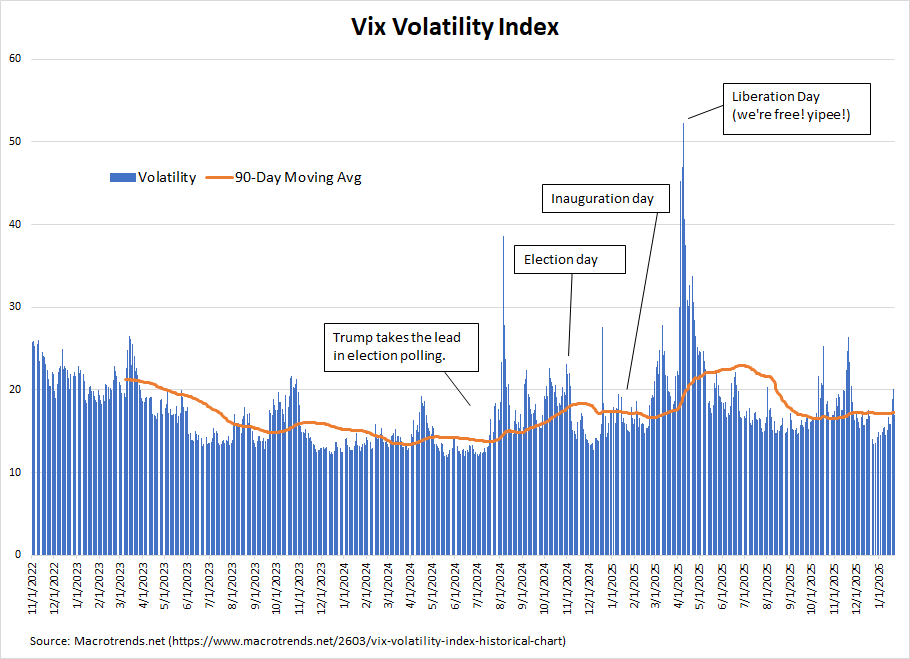
Volatility hasn’t been favorable either rising considerably in 2025 over 2024. (annotations below are my own)
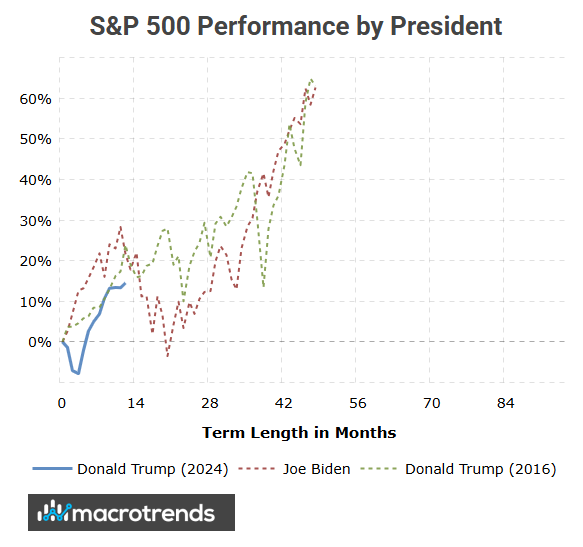
Another benchmark would be to compare him against the past two presidential terms (Biden and Trump I). He is underperforming both. And he certainly doesn’t want me to include Obama—it would just look worse.
As I said at the top, this is all a bunch of post hoc, ergo propter hoc fallacy—but he insists on doing this taking credit for what he claims is great; so here we are.
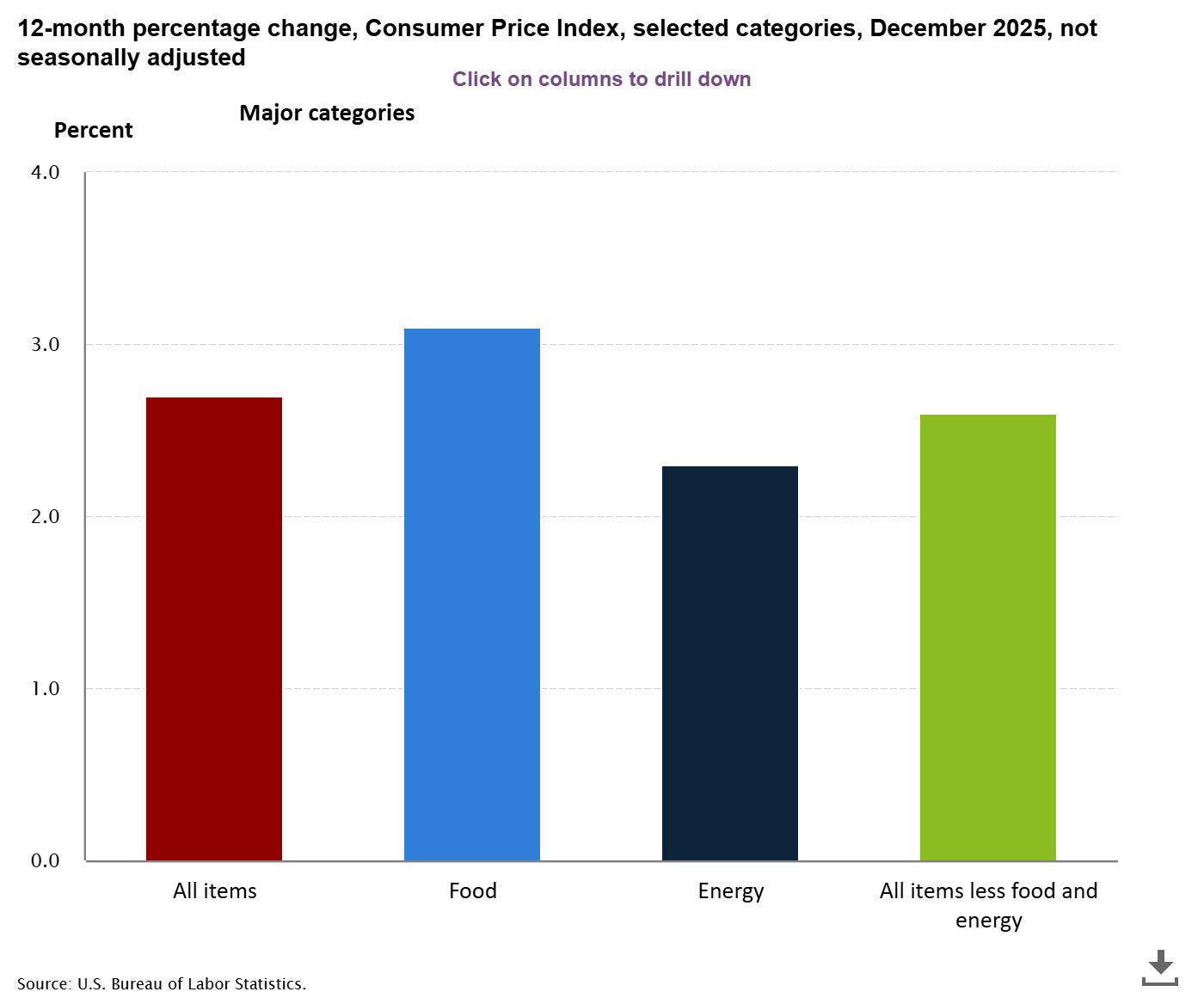
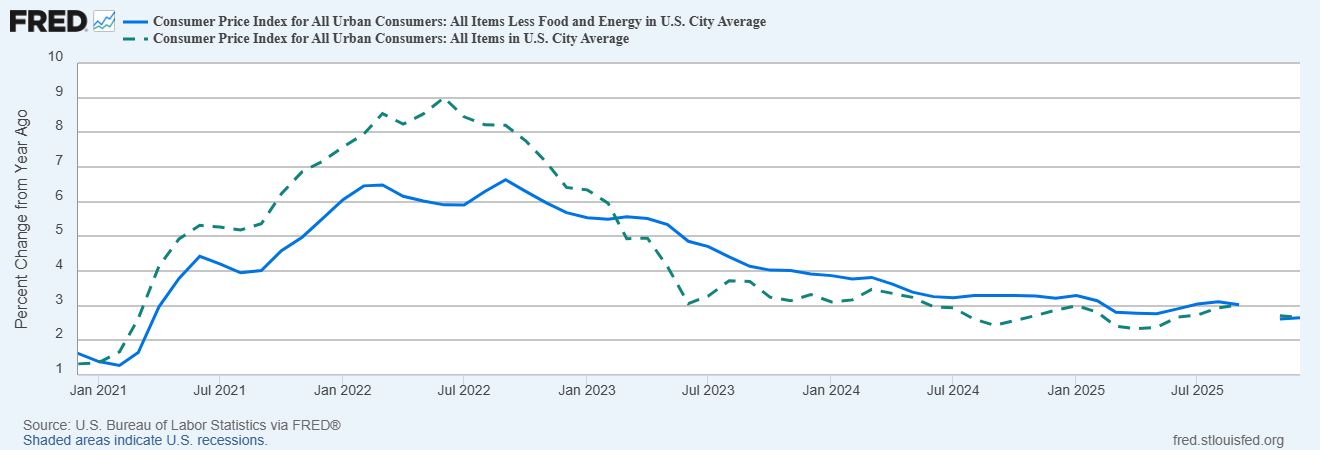
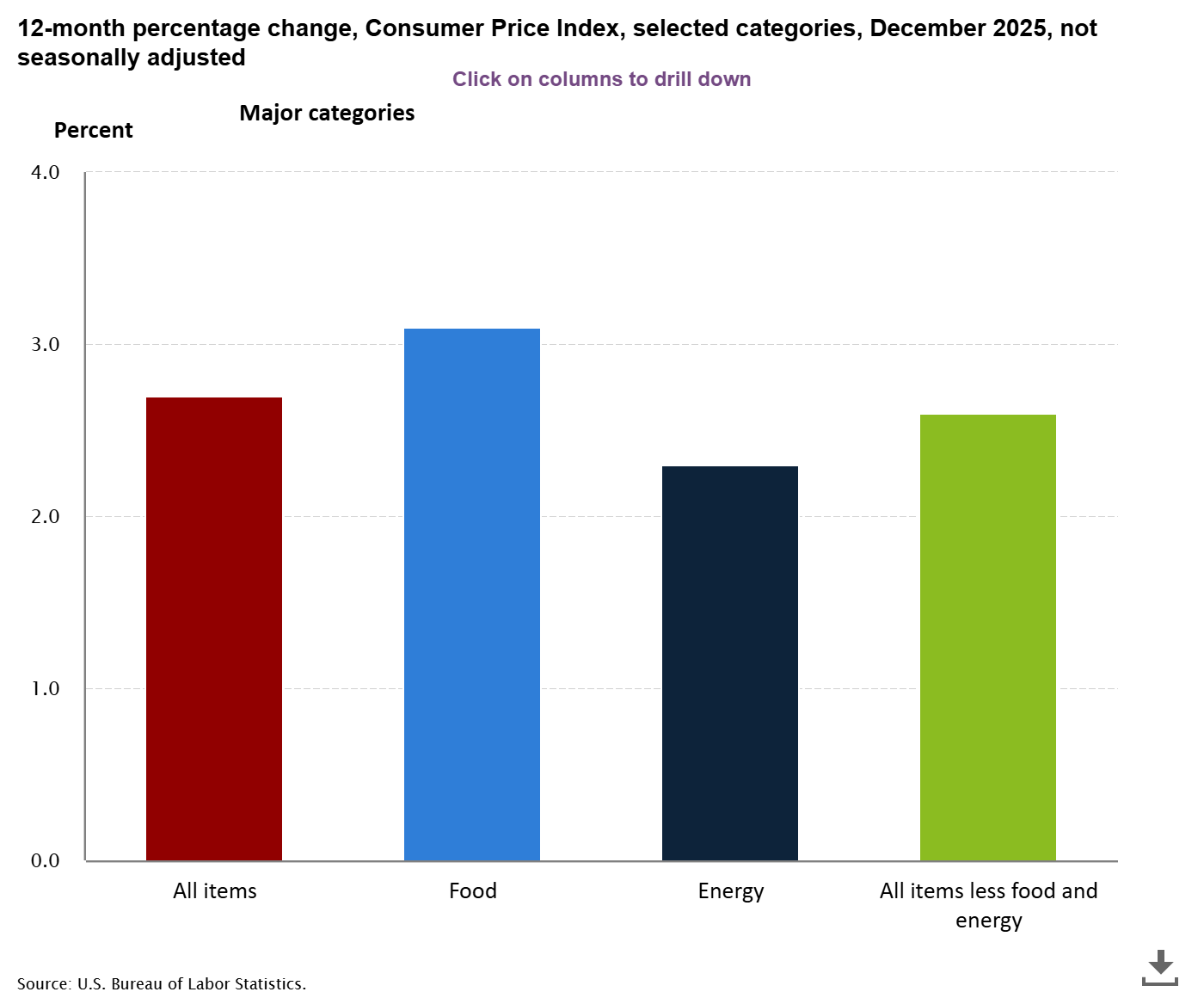
Inflation and cost of living - loss. The overall rate has not moved much in the past year—2.7% in December compared to 2.9% December ‘24. The cost of food and energy have risen 3.1% and 2.3% respectively over the past year. This one is a loss since he claimed he would “end inflation” and drastically cut energy prices.
European defense spending (% of GDP) - win. He deserves credit here with a lot of it coming in his first term when the trend started. Obviously Russia’s invasion of Ukraine played an large, independent role as well. Still, the momentum has been maintained under Trump II as the expectation is average military spending in the EU will soon exceed 2% of GDP.
War - loss. He claims to be the peace president; however, he has failed to produce peace in the Russian-Ukraine War, he has engaged in acts of war on top of high seas violence in Venezuela, he has launched more attacks in Yemen than Biden did, he has bombed and seems to somewhat savor the idea of an invasion of Nigeria, he has escalated military actions in Somalia, and let’s not forget the ambiguous threats he’s made regarding Panama and Greenland/Denmark and even Canada. His airstrike on a Iran was limited and potentially did bring that long-running hotspot to a cooler simmer, but it was an act of war. In fact, his track record in the Middle East is relatively fairly setting aside the fact that he allows for a pretty cozy relationship with brutal regimes.
The overall grade is a loss because he has definitely not brought about peace in our time. If so, he wouldn’t be losing the anti-war right like he is.
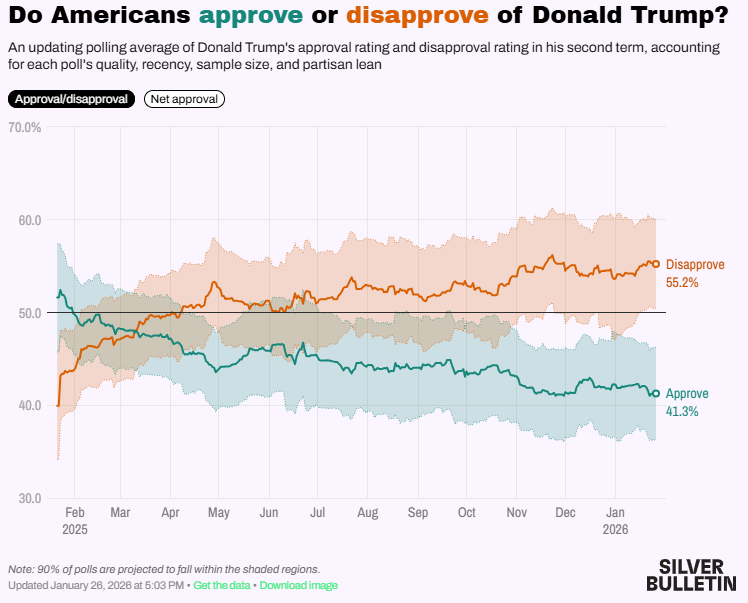
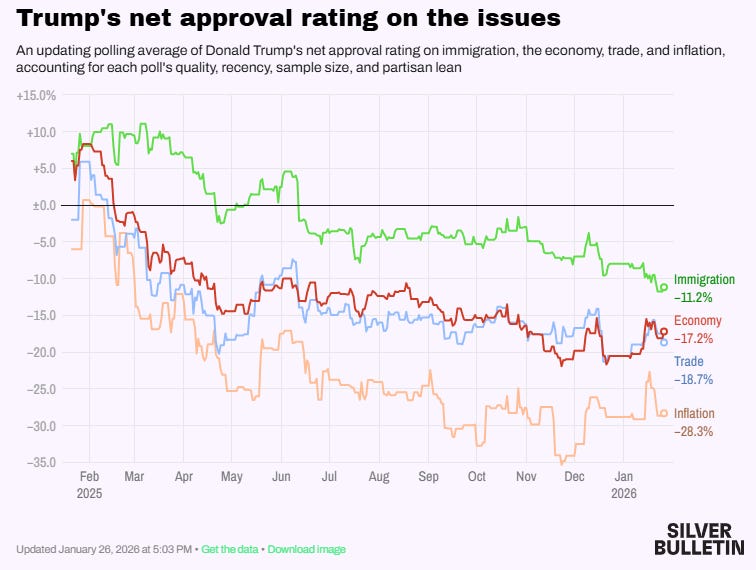
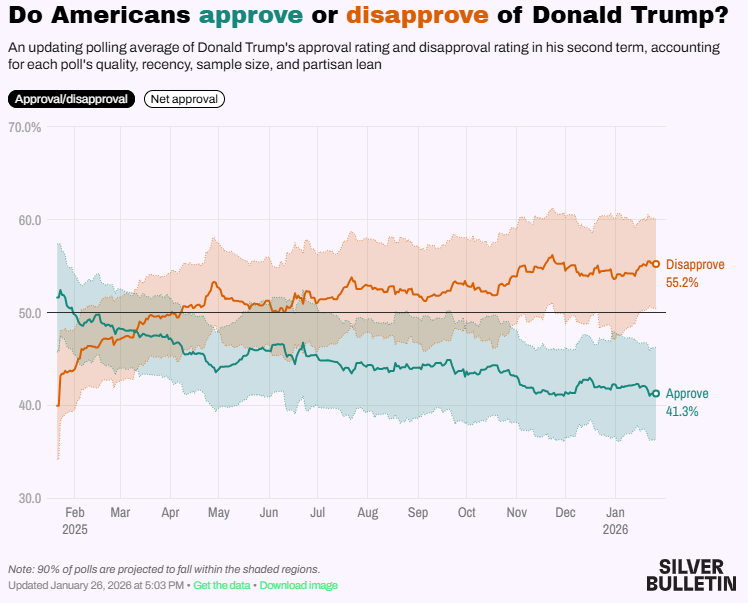
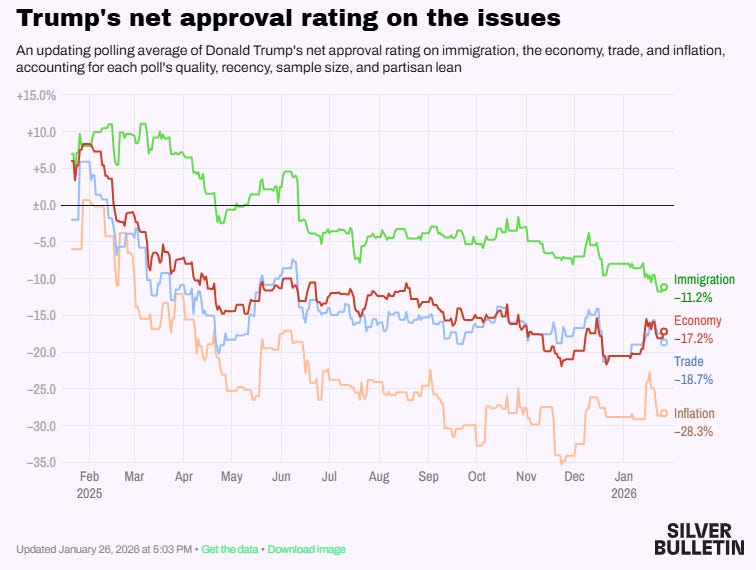
Approval - loss. He desperately seeks approval and claims to have it. He does not.
Overall
I show 5 wins and 11 losses. This is certainly not a complete list, and I welcome suggestions to add or criticism of my analysis.
PS: In the spirit of this analysis, see the Trump Tracker as linked in this tweet:


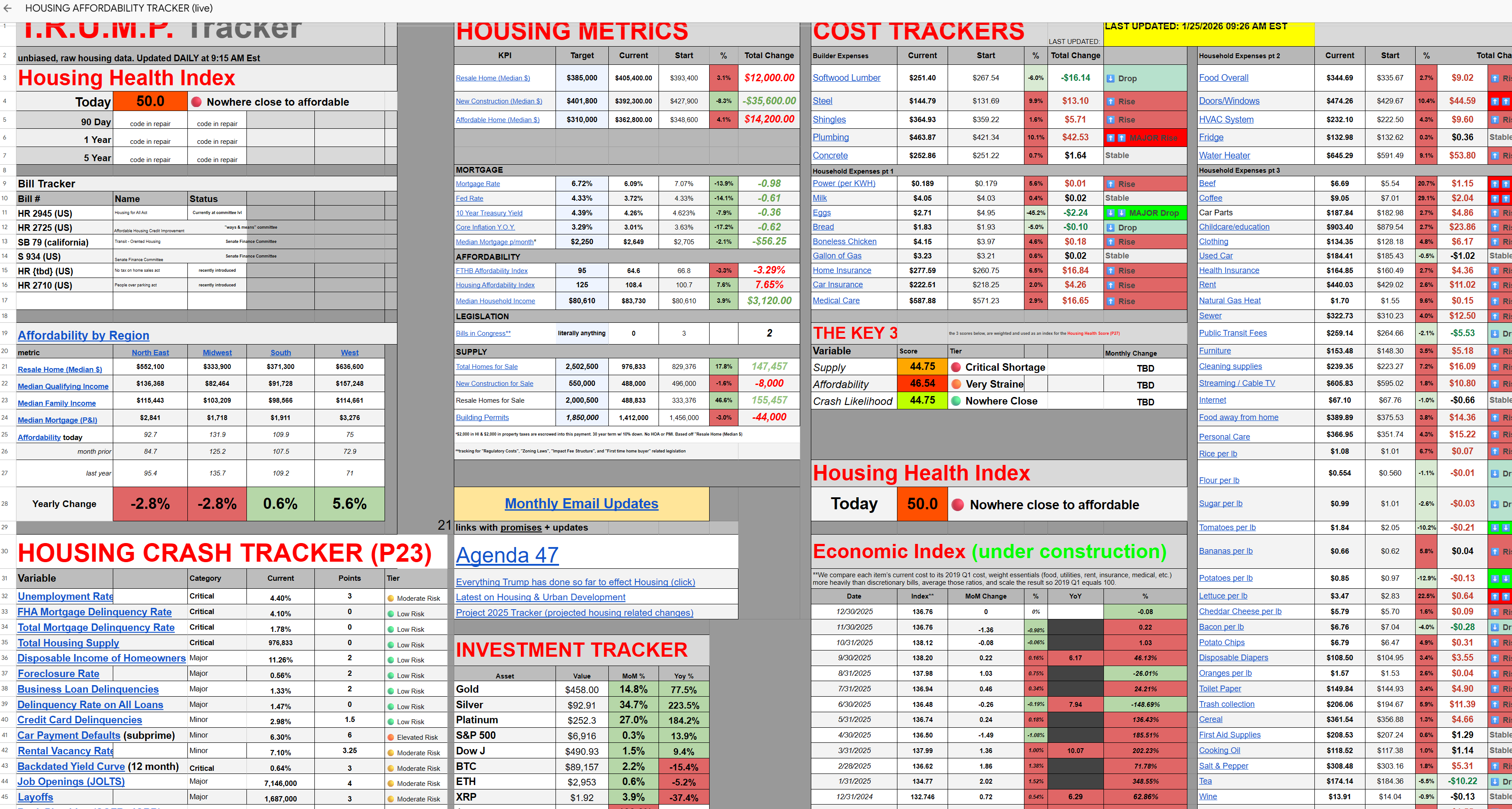
Notably, that relies on 1.9 million self deporting. So it seems making life scary or miserable for immigrants is a major component in this effort. That should raise concerns since job opportunities is one of the key features in determining immigration flows. I guess if we had less work in America . . . But there is also the concern that diminishing returns to scale will require enforcement actions and misery conditions increase dramatically to get out the next 10 million (or 28 million if Trump is right about the count).