

I admit my title is highly accusatory. I don’t fully mean this post to be so as I hope you’ll soon see. The title is not that way just for the clicks, though. It is a little bit, but I am making some charges here. I hope to be constructive, and I’m leaning on the technique I often employ (that I think works) to get the attention of my audience with a little bit of provocation.
My target audience starts with those managing the University of Oklahoma’s athletic department and football team facilities.1 It then includes the OU donor and fan base as well as Oklahoma taxpayers. Yet this is likely applicable to the larger college-football world especially for major programs.
The purpose of this post is to discuss and push back on many of the recent developments concerning the OU football stadium. This includes those planned as well as those already begun or completed. I think the direction of these changes are, though well intended, misguided and shortsighted.
As I wrote recently:
To use a personal example, I have indoctrinated my children in the cult of OU football not by corralling them in front of the TV making them sit and watch a four-hour game but rather by bringing them with me to the actual game. The difference in the connection is stark.
Add to this that a big part of the case for a college football team is that it is marketing to future students (the customers/output of universities). For public institutions like OU it is also desirable to be in good stead with the voters, who ultimately hold sway with how much support the university gets from the state’s resources, and locals in the city it resides. Not all of my neighbors here in Norman love the university they live right by. Don’t give them another reason to push back against it—that reason being the accusation that it is only for the rich and elite.
Before you think I’m just an anxious (or obnoxious) fan who is scared of change for the entertainment product I love more than any other, realize I come at this with a deeper perspective than that. Sure, this is my baby. But in this post I will be addressing it in a professional capacity. I am a financial analyst holding the CFA Charterholder designation and work professionally as a manager of a multibillion dollar portfolio. I am trained and seasoned in analyzing businesses, investments, and economic decisions. I am a published sports economist. This is literally the type of stuff that I do. [full disclaimer: I mean that from the standpoint of my qualifications. This is a personal project completely unaffiliated with my employment (day job) and my employer.]
I certainly recognize that I am an outsider. While I bring humility to the situation knowing that I don’t have all the information, probably have a biased perspective, and likely have a different value objective than the administration I am about to critique, I have a very strong foundation upon which to make my case. Dismissing my analysis out of hand or failing to critically address it would represent a large failing on the part of the opposition.
Where we are
It is obvious to all college-football fans that the sport is undergoing radical change. The long-overdue changes to the relationship teams have with their players is bringing new challenges (both financial and operational) as well as new opportunities. Fielding a competitive football team and building a program that can compete long term now comes at a much higher expense. Player pay whether it be from NIL or simply direct compensation has become a new, significant line item on budgets.
Yet, any business (and college football is a business) facing higher costs cannot simply pass these along to the customer. Some businesses face customers very insensitive to price (inelastic demand in economics parlance). Yet even these businesses can exploit this position only in the short run. As time goes on, consumers become more price responsive (demand curves flatten) because alternatives (substitutes) emerge.
The other constraint limiting how successfully firms can pass along cost increases to customers is customer ability to pay. Budget constraints bind in the real-world forcing consumers to alter their buying decision, and with big enough price increases consumers find themselves completely exiting the market.2 This version of what economists call corner solutions comes about when a person cannot buy any of the product being offered. The analogy here might be that I can afford to rent a Ferrari to drive to an Airbnb mansion in Los Angeles I have rented for the week, but I cannot afford to buy these two things outright. The purchases are fully outside of my budget constraint.
Therefore, the new economic reality requires a reevaluation of athletic department finances on the expense side as well as the revenue side. Yes, they need more revenues. But that won’t be enough. In the simplest of terms: Just because your costs went up, doesn’t mean your price can as well—at least not enough to fully pay the new expenses. Expenses must also come down. Keeping in mind that football coaching pay is disproportionately large as a share of revenues when compared to the NFL, reducing coaching salaries is an obvious first candidate to find savings. Other administrative expenses likely follow.
Still, the OU athletic department, et al. seems insistent that other expenses will continue and that new, additional revenue must/can be found.
What is the plan?
The university announced the plans for stadium renovations in November 2025 in what can only be described as a tone-deaf marketing plan. The immediate reaction on X.com was one-sided, brutal opposition. The biggest complaint among several was having this abrupt, incomplete message being the first fans had learned of massive seat dislocations and overall seat reductions. It was a masterclass in not getting ahead of the message.
The only details offered were sparse. They indicated there would be “47 suites, 64 loge boxes, about 4,000 new club seats and six club/lounge spaces commences” and a reduction of capacity losing approximately 7,000 seats on net. The only overall objectives revealed were (reading between the lines) raising revenue.
Besides these sketchy announcements, some architectural renderings were offered along with the original website for information on the stadium plans, www.gfoms.com. That site now redirects to this site on SoonerSports, which still gives little details other than renderings where fans can easily see where their seats are substantially different. For loyal fans it stoked fear and anxiety about potentially getting displaced by new luxury seating or at least facing substantial increases in the price of attendance.
I was not alone in finding the communication wrought with arrogance and conceit. They gave no indication they understood how badly this would be received much less that the existing fanbase including existing season ticket holders (many of whom are very long term) would have any voice in the matter. They didn’t even pay lip service before or after the announcement to the very obvious, foreseeable backlash. It would have been quite easy to stipulate how it is all a work in progress where the administration would be very responsive to all the needs and desires of all fans with clear understanding of how sensitive the many constituencies are to possible changes. People (customers) understand the new realities of college football, but they also understand their own personal budget realities.
It is not like this hasn’t just recently been a lesson learned. When OU moved to the SEC, they were forced by agreements with the conference to change configurations within the stadium. These required changes forced many fans to move from the seats they had held for years—some for decades. This too was addressed poorly in communication showing little sympathy and poorly in execution resulting in a bad process. It was unclear what people’s options would be and what would determine these options. Anxiety was maximized as people were left in the dark as to why, when, and how their seats would be relocated.
For what it’s worth I know hundreds of fans from a wide variety of backgrounds. I don’t know any who are wholeheartedly enthusiastic about the changes or highly confident in the university’s ability to improve their situation. They all are approaching this with some combination of trepidation and frustration. It would be accurate to describe the perspective of many as disgust.
Communication errors are not my central focus. They just reinforce my doubts that the leadership has a good grasp on how to satisfy their customers.
Understandably, but never communicated, this is a work in progress. In July of this year the new athletic director, Roger Denny, acknowledged the backlash as well as the initial poor communication saying in part, “. . . particularly when it comes to some who potentially will be forced to move seats or pay significantly more to remain in premium locations. . . . We’re certainly reevaluating some things.”
Consider these key points from The Oklahoman on Denny’s plans.
Oklahoma’s athletic director confirmed the $450 million stadium renovation project is still on track to begin after the 2027 season.
A stadium-wide reseating process will still occur, and the athletic department plans to speak with every season ticket holder.
Declining ticket revenue relative to football expenses necessitates the project to keep the program economically viable.
So, perhaps the communication gap is getting filled and fences mended. But like I said, that is not the heart of what I think is broken.
How it is broken
OU is not at all alone in this endeavor. Here is a list from ChatGPT summarizing stadium renovation projects recently announced or completed. I include the announcement summary table pictured below.
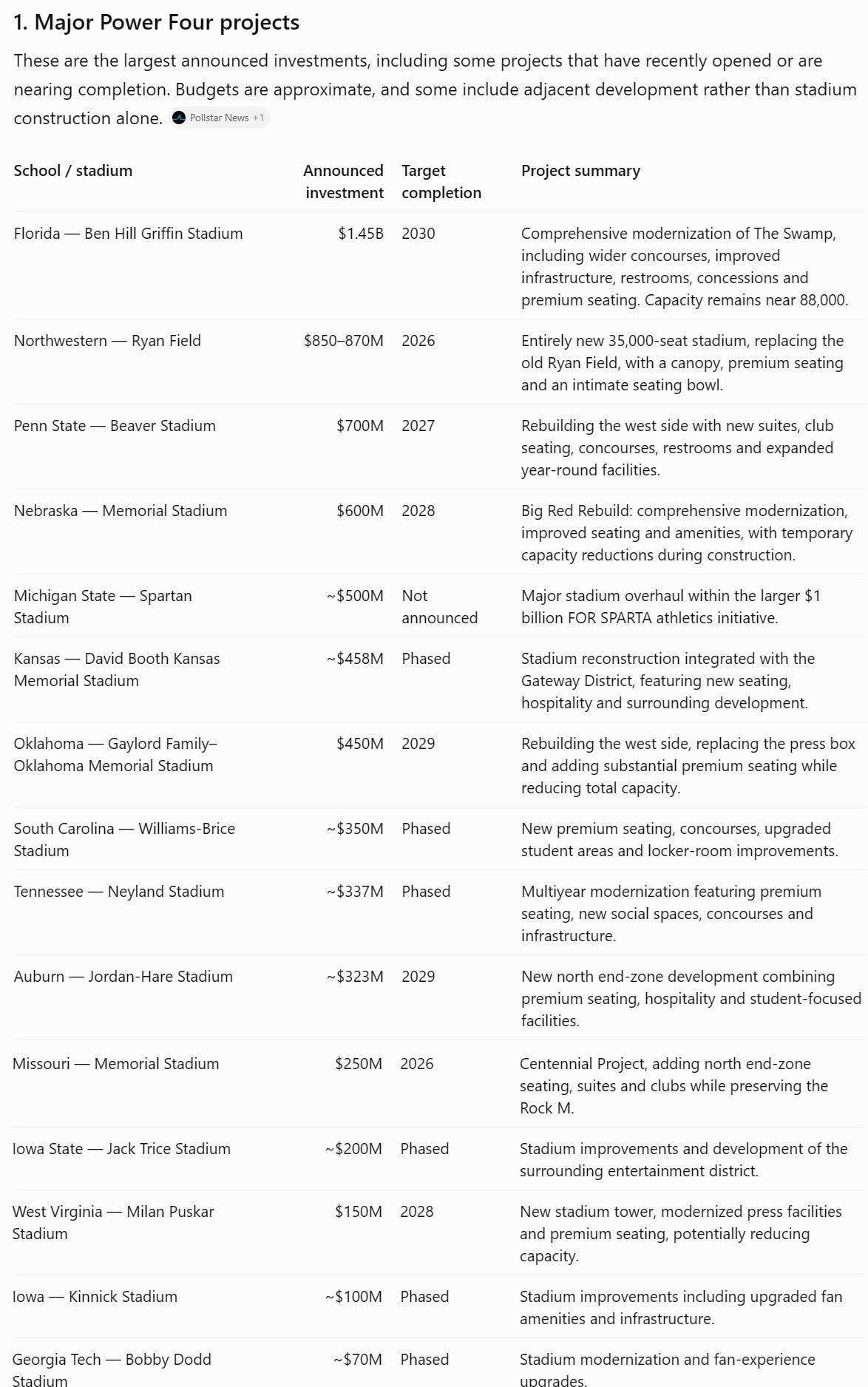
The central theme, as Pollstar News says, is a shift from capacity to revenue. As those who read my original piece know, I don’t accept that as a tradeoff. Rather I think it is more a matter of “Why not both?”.
As a long-suffering member of the neglected upper west stands at Gaylord Family Memorial Stadium, I very much agree renovations are in dire need. I also very much support efforts to improve quality including making accommodations to welcome those who have a willingness to pay for luxury. And I am very willing to accept that my seat might be more or much more highly valued by others than myself. And I am willing to pay (somewhat) more to receive a better product (experience when attending).
Displacement per se is not my complaint. In fact I am not complaining. I am pleading they do not fall for the fallacy that the price can/must/should just go up because expenses went up. I am also contending that reduced capacity sacrificed for the highest of high payers (who may be mythical—see below) is a bad bargain.
Killing the golden goose by chasing golden geese
For the state and its population, Oklahoma’s income and wealth has seen substantial increases in the past couple of decades. As I’ll discuss in the next section, we are much wealthier than we were the last two times we won national titles in football (2000 and 1985).
However, the correct analysis has to put the current state of income/wealth into perspective to see how much one can expect to further grow OU athletic revenues. While I wouldn’t describe the situation as “tapped out”, I would also not depict it as having “plentiful low-hanging fruit”.
Relevant comparisons can be made between Oklahoma and Texas as states and the Oklahoma City MSA and the Austin MSA as both programs look to each other as benchmarks. Doing so might give some indication as to what opportunities are available for growing athletic revenues at Oklahoma.
Let’s start by looking at where Oklahoma and Texas athletic department revenues currently stand using the very helpful work of Greg Chick at NILnomics.com specifically his analytical dashboard.
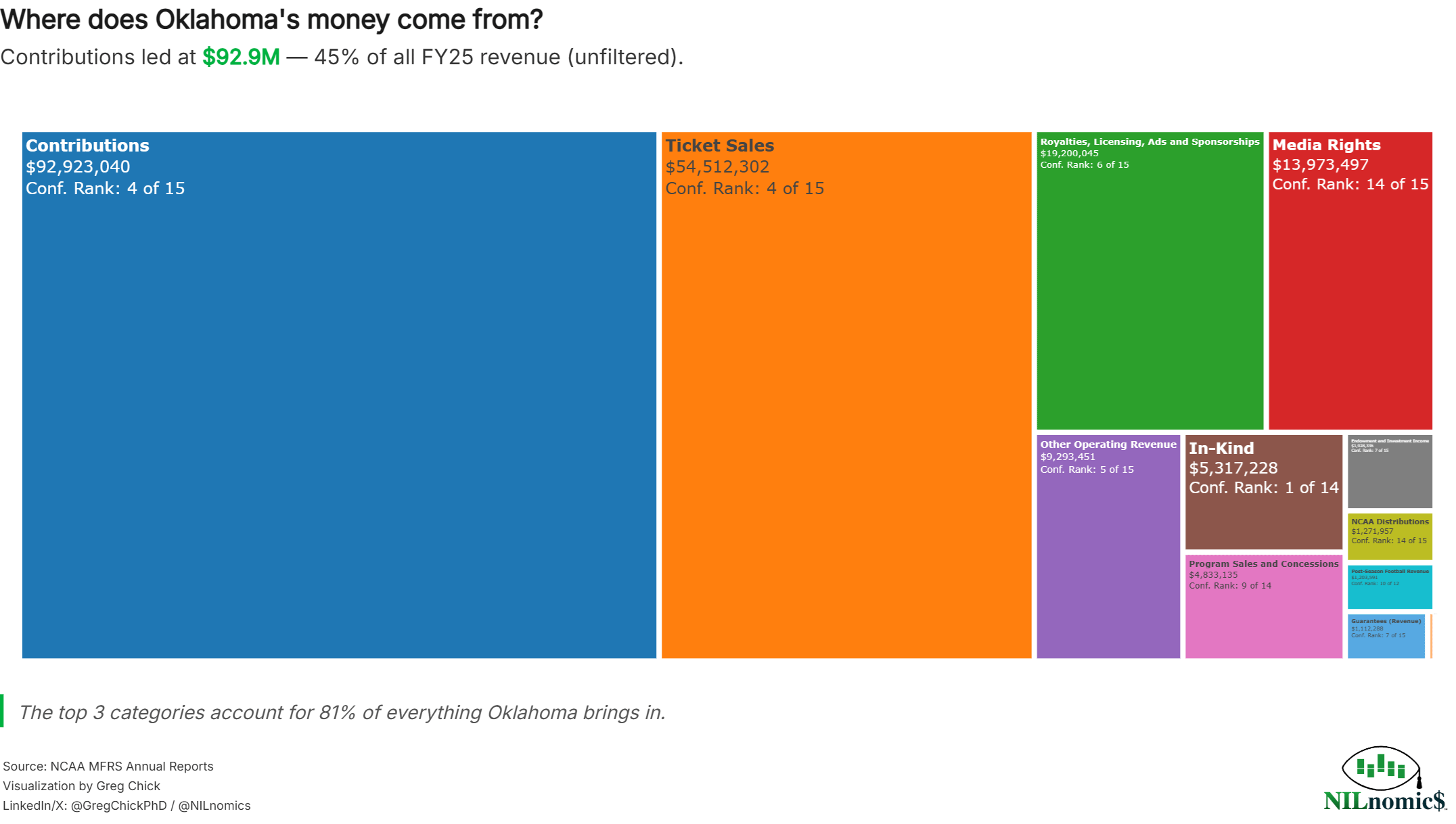
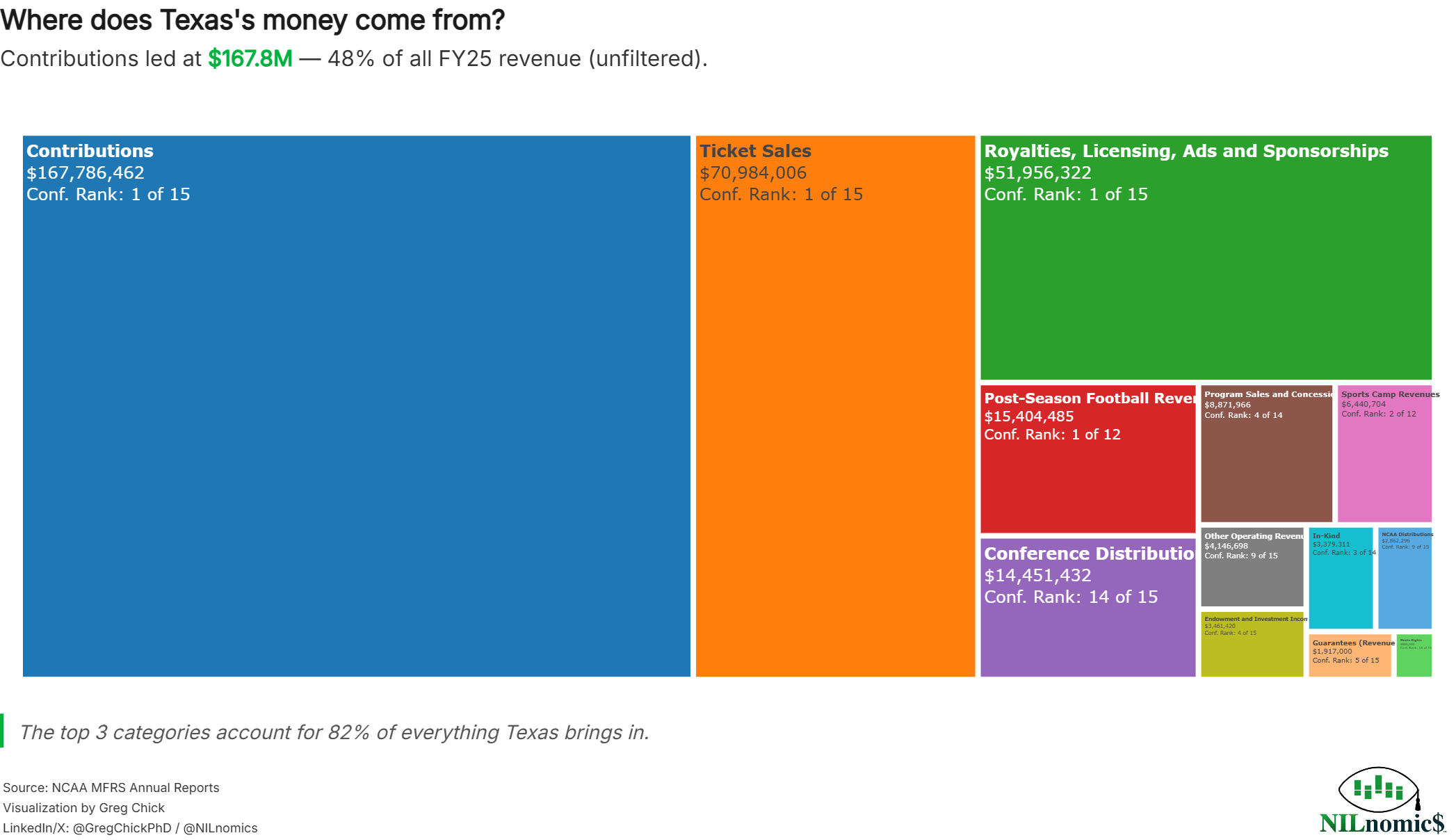
Texas is obviously bigger than Oklahoma (state-wise and university-wise). How much bigger is a key part of this, but how much relatively bigger (wealthier) is also important.
In FY25, Oklahoma had $205.7 million in revenue while Texas had $352.5 million. Notice something right of the bat in the revenue breakdown above. Both OU and Texas derive about the same amount of their revenues from donor contributions—about 45 and 48% each, respectively. For the raw figures, OU at $92.9 million versus Texas at $167.8 million shows a 1.8x ratio TX:OK. Keep that in mind for an analysis of wealth and income shortly.
Ticket sales represent about 27% of Oklahoma’s revenue while only comprising about 20% for Texas. It would seem either Texas is relatively underpricing its tickets or Oklahoma is already outperforming in this area. Certainly there is more to it as the revenue-maximizing strategy at each organization is likely at least somewhat different, but this is suggestive that increased ticket sales are not a huge opportunity for OU.
In fact both on contributions and ticket sales OU is already an outperformer compared to the larger SEC universe (I compared all sports first and then football specifically below).
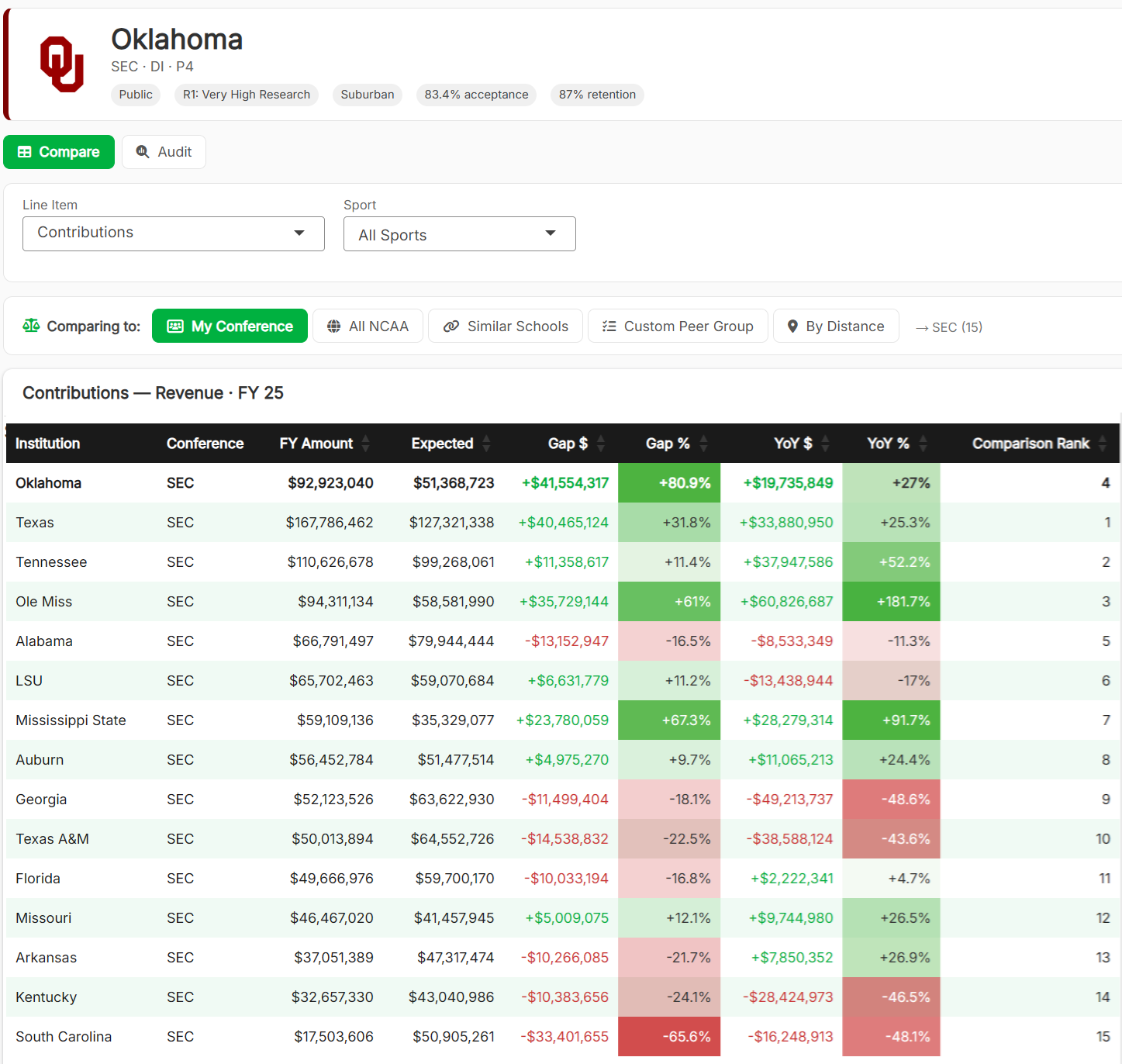
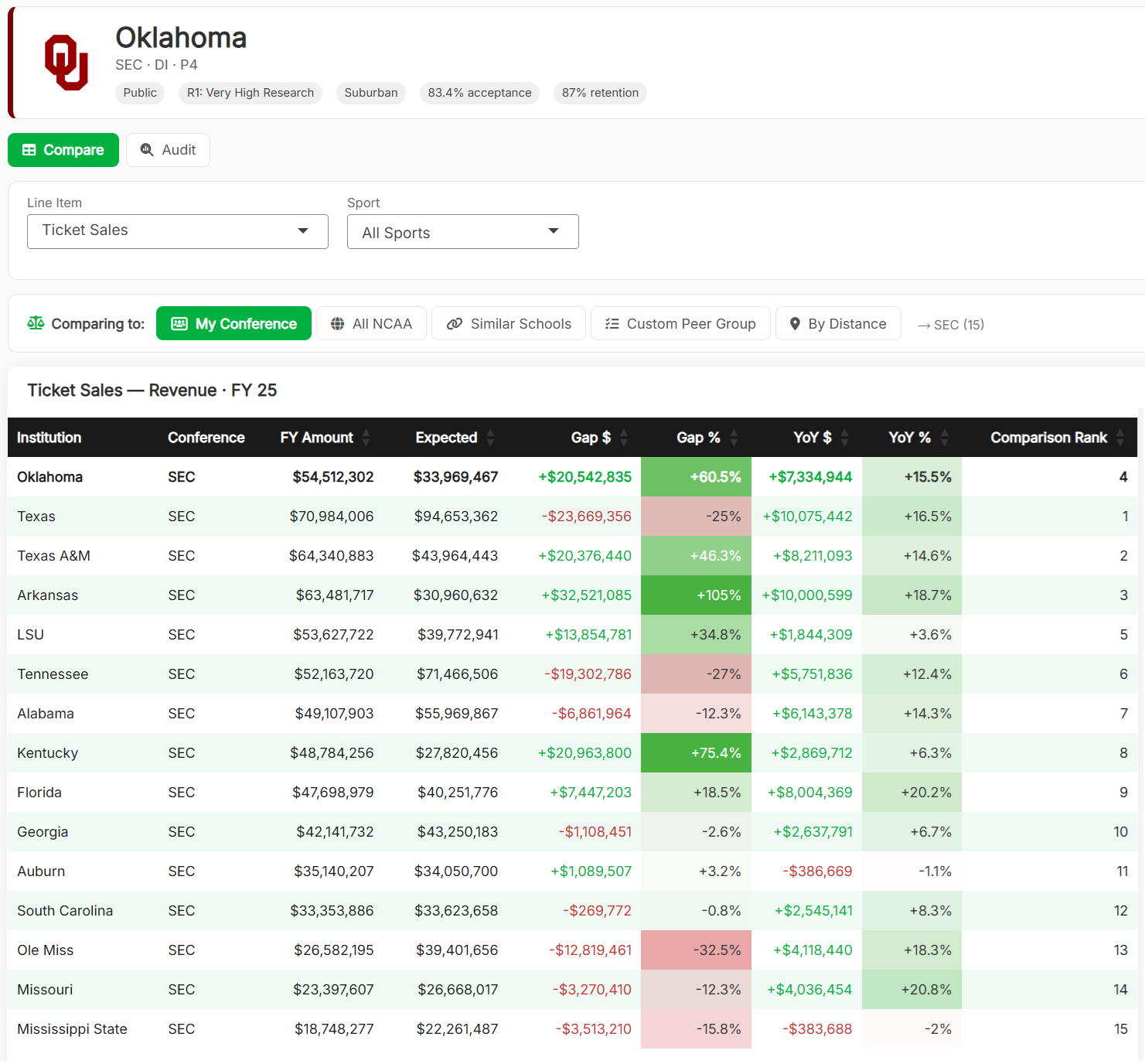
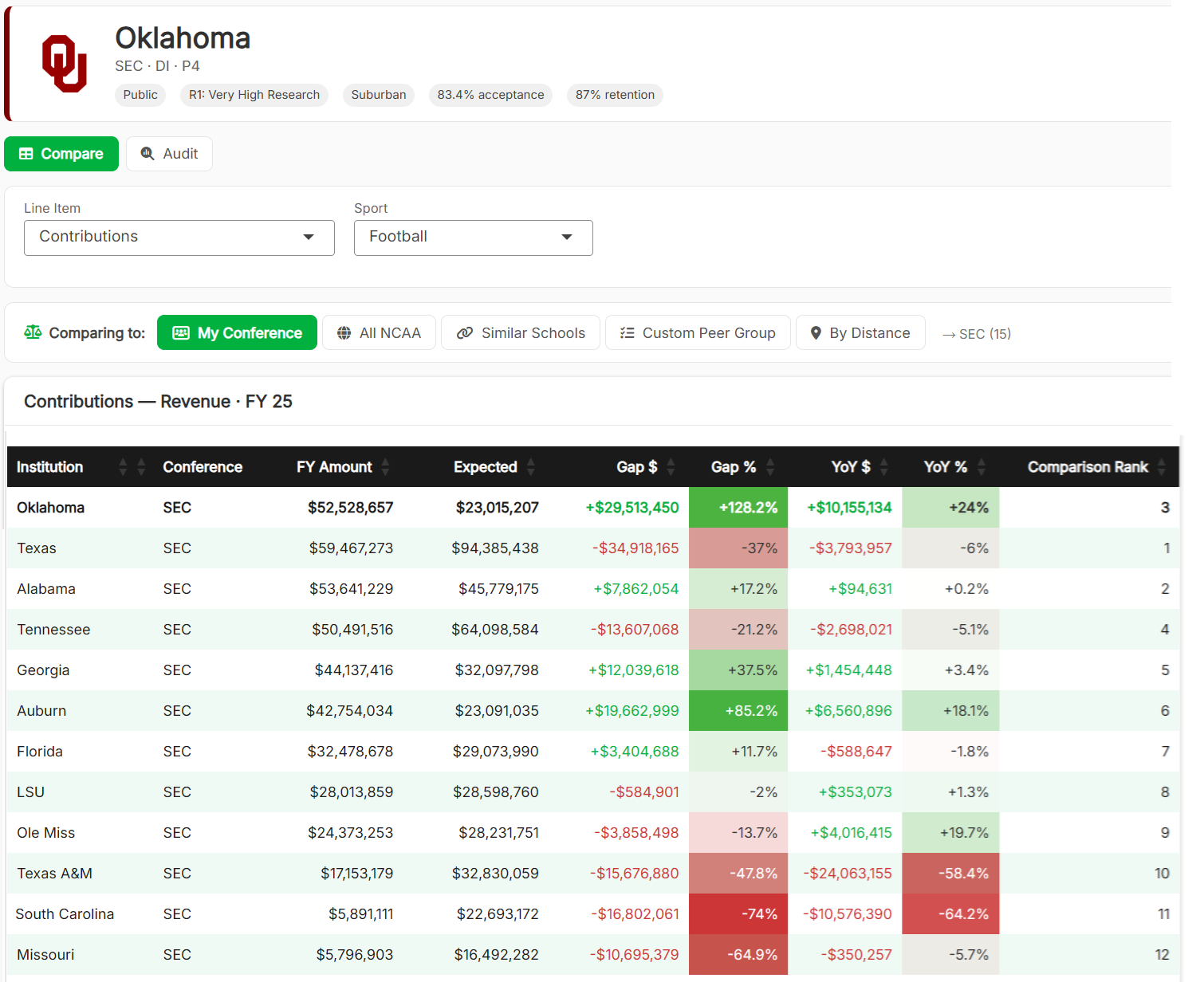
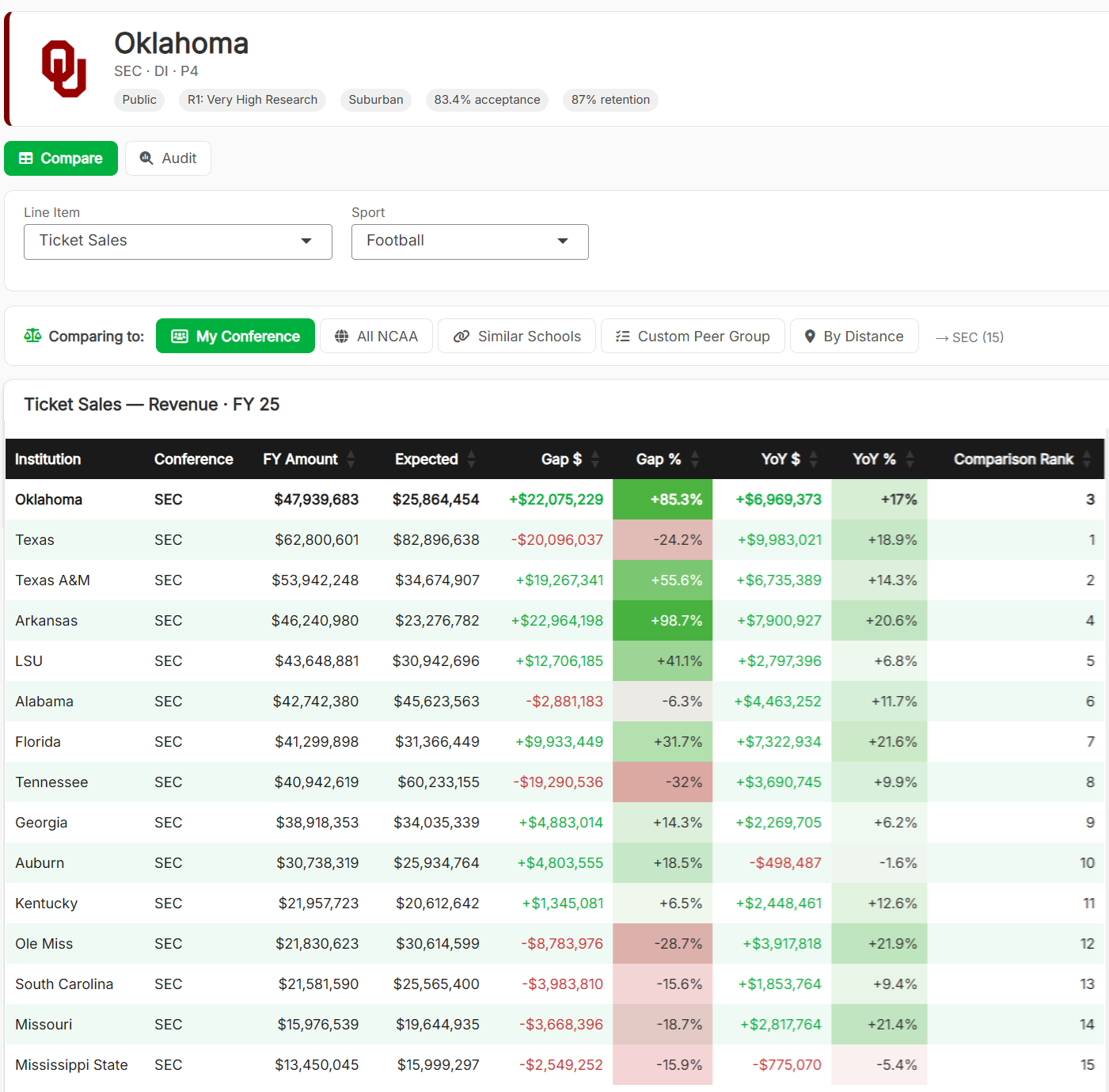
Oklahoma is a significant outperformer in comparison to the expected revenues the model would predict. Obviously, this is sensitive to just how good that model is. Regardless, again we find results that are at the very least highly suggestive that OU is already tapping into its resource base well. How much more can reasonably be expected?
Now let’s look at wealth differences. The size difference between Texas and Oklahoma hides an underlying wealth difference. There are two ways to tease out the wealth gap. One is to see how many households Texas versus Oklahoma has in the upper wealth categories as a percentage of the total. Another is to look at the ratios between the two at various levels. However, the overall size difference still matters as this shows some indication of the base itself, which is highly meaningful. As an analogy, Denmark is about 85% as wealthy as the United States (GDP per capita) but is substantially smaller. Switzerland is about 129% as wealthy as the U.S and also substantially smaller. Because both economies are vastly smaller than the U.S., neither one can accomplish what the U.S. economy can provide. Wealth alone is not enough. Size matters.
Here is a table from the U.S. Census Bureau on wealth data by state:
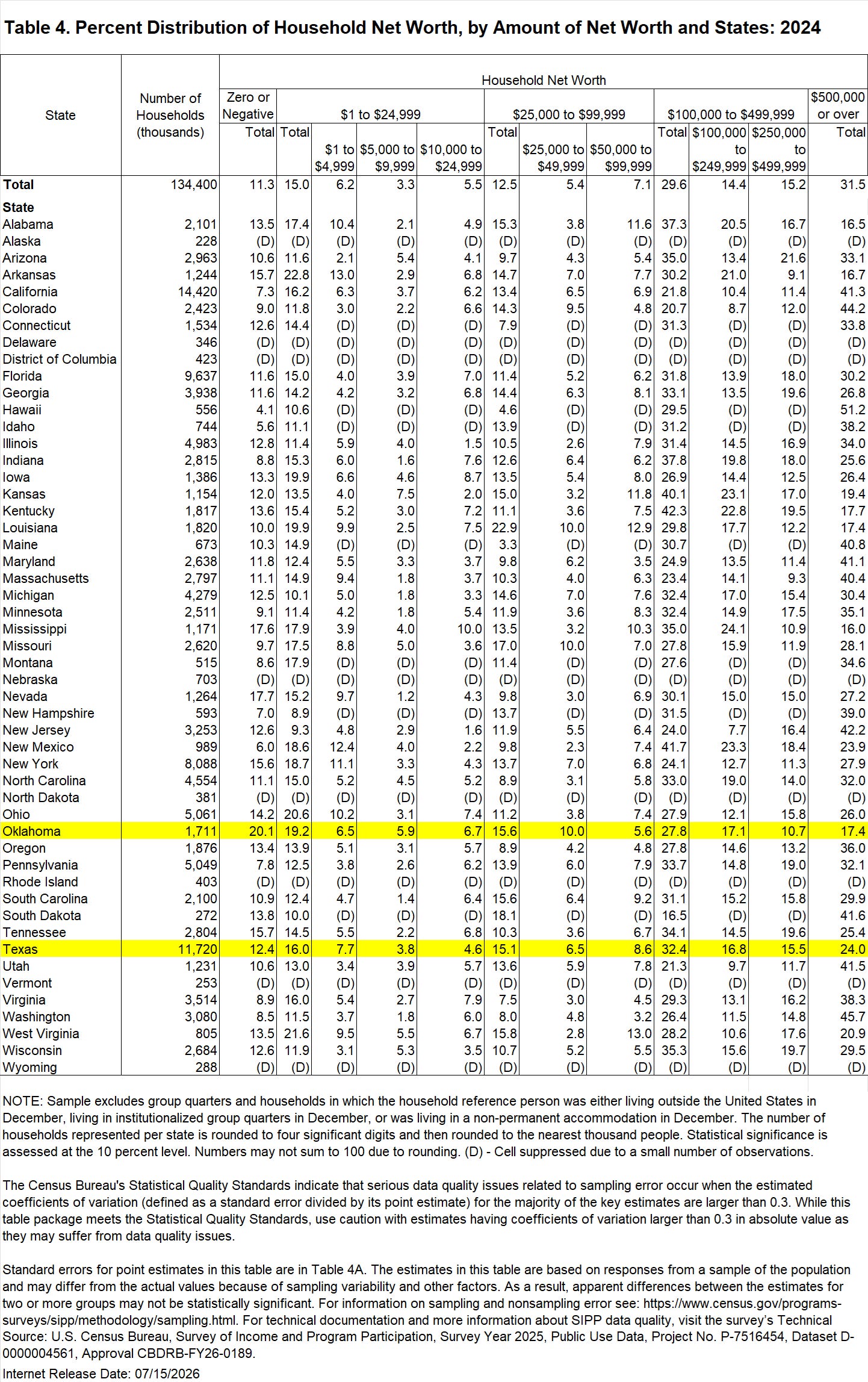
To tease out the wealth differences, I want to look at the number of households in the various wealth categories and the ratio of Texas to Oklahoma.
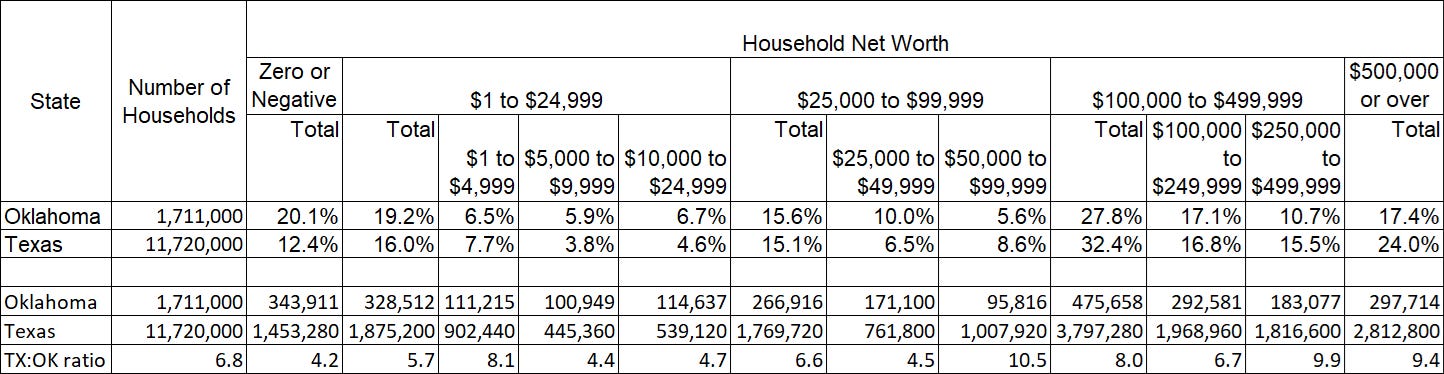
Texas is more than just the University of Texas’ base in the Austin area. Houston and Dallas-Fort Worth are major contributors here, and Oklahoma has many alumni in DFW. Therefore, some of the wealth located in Texas is a reasonable target market for OU. With that caveat in mind, notice both the percentage of household differences in the upper categories and the ratio differences. OU needs capture a lot of the Texas-based wealth in order to close these gaps.
Now let’s looks at income differences. For this we can drill down to the metropolitan statistical areas (MSA) comparing Oklahoma City and Austin using the Census Bureau’s American Community Survey (ACS) for 2024. Notice here as well both the total figure differences especially at the higher end as well as the percentage differences. The story for the OKC MSA as compared to Austin is fewer (raw number) and less (percentage of the total).
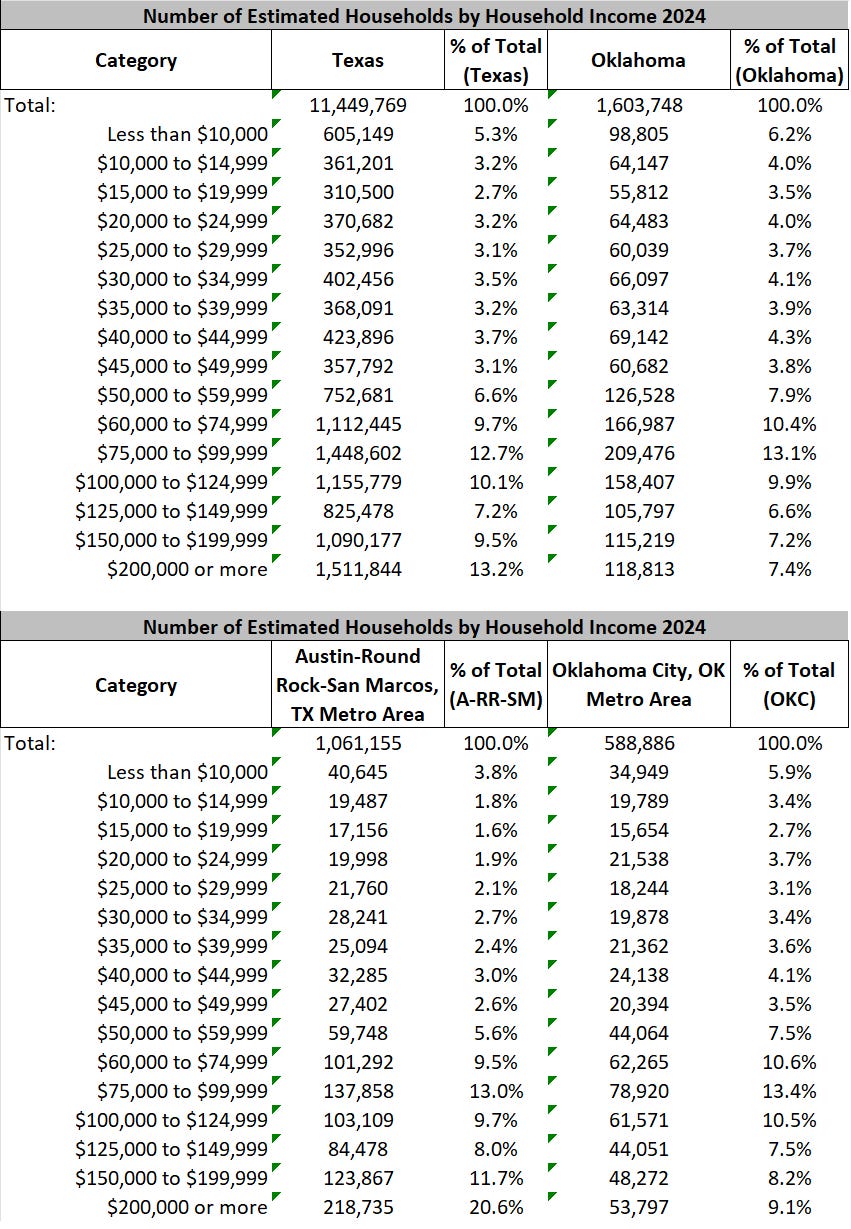
Austin has about 165,000 more households in the top category of $200,000 or more—about a 4:1 advantage—and the percentage in this category is more than twice as large—20.6% versus 9.1%. The Oklahoma and OKC market bases are smaller and less affluent than the Texas and Austin bases.
Remembering the raw figures and the 1.8x ratio of donor contributions to total revenue for Texas versus Oklahoma, these wealth and income gaps for Oklahoma/OKC versus Texas/Austin indicate OU athletic department revenue is already very efficient getting more out of less. Perhaps there isn’t a lot of room for growth.
I fully admit that all of this is more suggestive than conclusive. My strongest point is that the idea there is a meaningful capacity to grow revenue by increasing price (ticket and donor contribution) is very limited. Speaking of capacity . . .
Must we shrink to grow?
Referencing again to my prior post,
Since 1985 OU’s stadium has increased and then slightly decreased in size going from 75,004 to 80,126 today—a 6.8% overall increase. Over that same span the population of the OKC MSA has increased from about 900,000 to about 1,500,000—about a 67% increase. For the state the increase is about 34%.
Over that same span real (inflation-adjusted) median household income in Oklahoma has increased over
18%[revised to 33% from the source]. . . .With OU as the example as I continue to focus on blue bloods, an expansion to 100,000 seats would be quite possible from a realistic cost and engineering standpoint—just fill in the north end zone with an upper deck and perhaps expand the soon-to-be-renovated west upper deck. That would be approximately a 25% increase in the stadium’s capacity. Given the parameters of the 67% increase in the population in the OKC MSA along with the 18% increase in real income, this seems realistic as well from a demand standpoint.
An increase in capacity to 100,000 would represent just a 24% increase in current capacity. I say “just” in part because the OKC metro population has increased about 35% since the stadium reached >80,000 capacity in 2003. I say it also in part because real median income for the state of Oklahoma has risen about 33% over this time span. Note that the percentage increases being rumored for the price of attendance at OU is an order of magnitude higher than 33%. And this increase has been at the median level, which requires us to go back to what that median is (the income analysis above) as well as the entire distribution of income—still a small base.
Yet this still doesn’t capture the entire context. With that substantial rise in income there has been a reciprocal increase in alternatives including one’s own living room as a great venue to watch a game. Obtaining audience in the form of attending fans certainly requires matching up well against substitutes. That is a call for a quality increase. But it does not mean ticket prices can necessarily increase commensurately, and it very much does not mean every fan is suddenly a premium seat demander (be it club, loge box, or luxury suite).
This renovation is putting all the chips in on high quality/high price. That might not be a winning formula.
Consider as well in the realm of alternatives that fans can still attend games without being season ticket holders or even buying single-game tickets from the university. Aside from a fledgling eBay, at the start of this millennium (the time of OU’s last national championship in football) the secondary market was a collection of fans and sketchy market makers outside the stadium on gameday. Today we have a thriving online marketplace where fans can make and change plans weeks before a game kicks off.
While OU leadership might say this solves the problem since they would presumably sell the tickets at premium prices and then those tickets would often go to fans with lower willingness to pay (lesser means) through secondary markets, I would counter this assumes too much. I think they will struggle to sell them in the first place. For those they do, there will be limited transfers in secondary markets. People do not always find it worth their time to try to sell tickets they hold—especially true of people with the means to buy premium tickets in the first place. The more you are depending on this redistribution, the more you are encouraging the initial buyers to reconsider their generosity of being the high payer, and the more you are dependent upon a secondary market to actually fill your stadium. Which leads to my next concern.
But those aren’t the only reasons to worry about this renovation
Suppose it works. Suppose the university is able to command large price increases from fans without much loss of customer base especially among season ticket holders. Suppose also that luxury and loge box sales are completely full. There are still pitfalls to consider.
The composition of fans changes even with these assumptions of success. Notably loyal fans will be pushed toward the endzone to make way for higher payers. This displacement is not just where suites and loge boxes will now sit. The higher quality at a higher price would bring new, different fans into the fold. This displacement means a fans currently in the endzone will be pushed out of the stadium entirely. Again, for this to work it has to be the case that prices go up everywhere. That has to leave some meaningful group out. Since the stadium is getting smaller, this is exacerbated.
Okay, maybe that is a trade the university is willing to accept—more money and (some) different fans. Who are these fans?
I think the description label I would give them is some combination of occasionals and corporates. This is a group that likes OU football but doesn’t love it—at least not enough to have already been a season ticket holder and definitely not enough to endure bad seasons or bad weather. I haven’t missed a home game in the last 247 and counting. In contrast this is a group that would struggle to put 3 together consecutively.
Again, this might be fine from the university’s perspective. I think that would be a mistake. I think there are three major downsides to a corporate-dominant atmosphere:
Lukewarm fans - people more likely to be indoor and quiet
Empty seats - lack of secondary-market offerings
Missing demos - lack of fans of a certain age
There are noticeable absences when sitting in the stands at OU during even a big game on big plays when the weather isn’t perfect including just if the sun is hot and in one’s eyes. That is the club seats. The club is full, mind you. It is just that—full inside. The team needs a home-field advantage and that comes from cheering fans (not a crazy loud music/PA systems . . . a rant for another post but in concert with this section since this type of NBA-corporate environment problem seems to be what the current in-game experience is becoming otherwise).
Another source of absences are game long when you have people who don’t bother coming. That’s okay in my book. It’s their prerogative, but I don’t think that is what the university has in mind, and it is not my idea of a great home crowd. The reason this one is separate from the first item is it is a different, upshot problem. These fans not only don’t come. They don’t bother putting their seats on secondary markets. Remember, we deliberately decided to sell tickets to wealthier people. Well, wealthier people’s time isn’t worth keeping up with an online sale and transfer. So this is a continuation of my point in the previous section as well.
Lastly, I think there is a big risk of stifling fan development as it prices out families with young children—the key demo for future fans and students aged 7-16. Up at the top of this long post I mentioned how the football team is a great marketing tool to future students as well as other constituencies. This concern is perhaps the most far out threat making it hard to see. But if this were a formal SWOT analysis, it might be the most substantial.
Shrinking rather than growing the stadium means the high-price strategy has to make up for a lot of crowding out.
Conclusion
Oklahoma is wealthier today than it was in 1985 or 2000, but it is still Oklahoma. By that I mean our corporate base is small. Our upper income base is also relatively small. Austin, home of the rival Texas Longhorns, is much wealthier with a much larger corporate base and much larger upper-income population. While I would imagine my same analysis and conclusion reached above would apply to Darrell K Royal stadium just on a different scale, the maximize-revenue-by-maximizing-quality strategy would have a much better chance of success on paper in that economy. I think we simply do not have the economic base to support this model even if my other concerns are ignored.
The stadium should be substantially improved. The price likely should go up in many respects. High income and wealth customers absolutely need to be targeted for maximum profit. But maximizing revenue and profit (defined as what is best for the university overall) is more nuanced than simply designing the most luxurious accommodations imaginable and assuming they will be filled. As I’ve shown, even filling them could be a long-term losing strategy.
For the median Oklahoman, they have enjoyed real income growth. At the same time entertainment options for those in the lower part of the upper income down through the median income are substantially better than in 1985 for sure and somewhat since 2000. To be economically technical about it, I just cannot assume this part of the demand base is not sensitive to price—inelastic demanders. Therefore, this large cohort will not bear substantial price increases.
I hear broadly, though still anecdotally, that the push back against the increase in prices has been substantial. That is likely why Denny alludes to on-going revisions to the plan. My bet would be they scale it down from a luxury standpoint but fail to fully appreciate how restrained they are in pricing power. And my hopes for a larger stadium are less than faint in even my own dreams.
It shouldn’t be necessary but probably is to point out that I wrote most of this post back in March when I first posted about college football stadiums needing to change—the link at the top of this post in which I mentioned this then-future post. OU’s disappointing start to the 2026 season has not played a part in my views here other than to be a bit of an example of the market risk the university runs in the event it makes plans based on only the best-case scenarios.
These extra details are partially necessary since in the typical price change/budget constraint indifference analysis a buyer just moves to a parallel utility curve on the new constraint, which is just the origin story for the emergent demand elasticity I mentioned in the prior paragraph. I want to get to the fact that in the extreme that is applicable to the later discussion in the post some consumers are being completely priced out.